Daphne and Fairhope Take Divergent Paths in 2006 Budget Debates
Daphne and Fairhope city councils spent late November wrestling with very different fiscal pictures as they worked toward adopting their 2006 budgets, with Daphne stalling on a vote despite a healthy tax surplus and Fairhope weighing new fees to close a revenue gap.
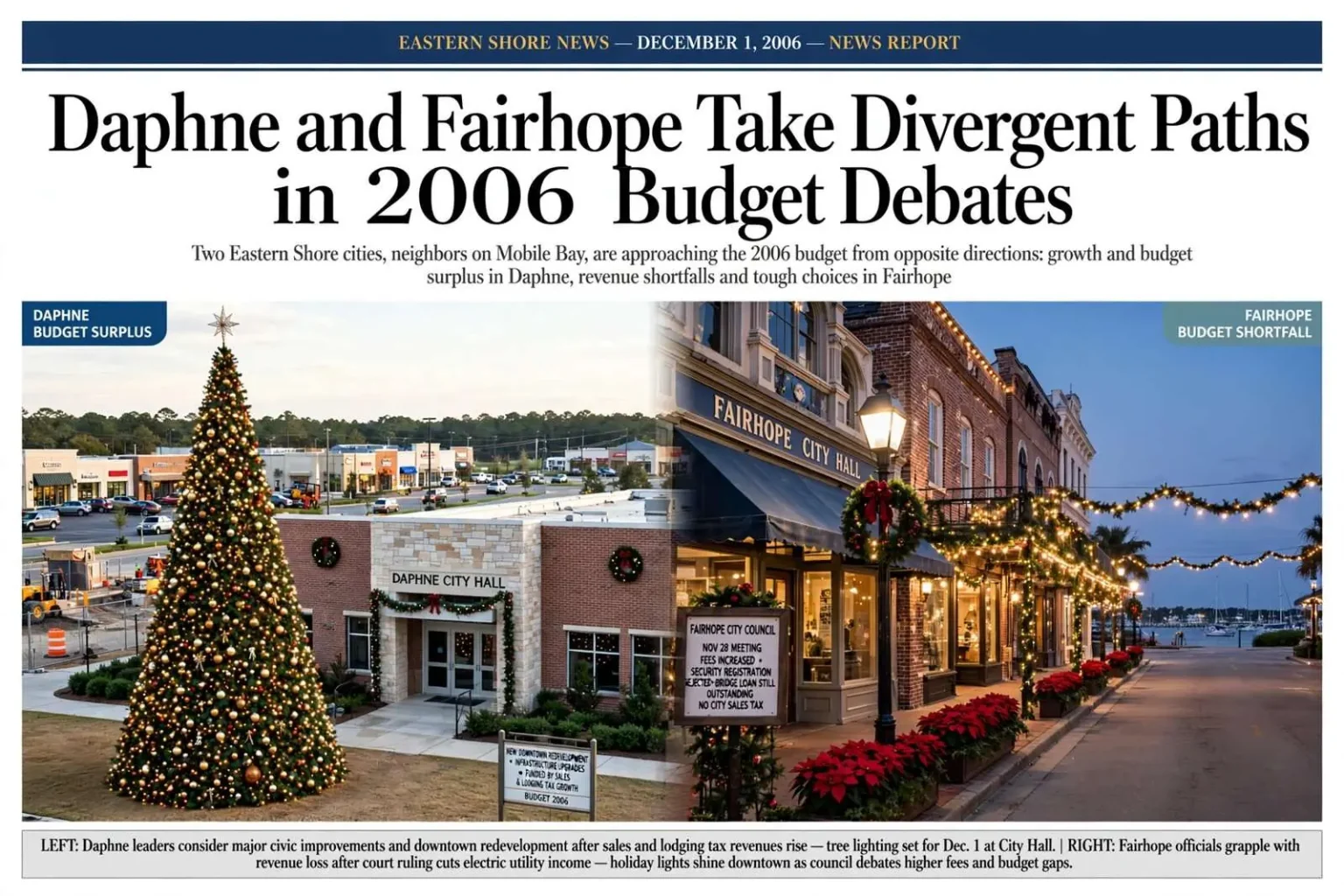
Two Eastern Shore cities that share a border are approaching next year’s municipal budget from opposite financial positions, according to discussions at recent Daphne and Fairhope city council meetings held in late November.
In Daphne, city leaders are sitting on healthy growth in lodging and sales tax collections, giving the council room to consider major civic improvement projects, infrastructure upgrades and funding for the redevelopment of its downtown corridor. At the council’s Nov. 21 meeting, members moved quickly through a lengthy agenda of new ordinances with little debate and few dissenting votes. Mayor Fred Small used the occasion to announce the city’s annual tree lighting ceremony at Daphne City Hall on Dec. 1, featuring a 35-foot tree that organizers say will be the tallest the city has put up.
Despite the momentum, the meeting hit an unexpected snag on its final item: adoption of the Fiscal Year 2006 budget ordinance. Council President Greg Burnam said he was surprised the measure did not have enough support to pass without additional discussion. The budget vote has been pushed to the council’s early December meeting, leaving residents to wait to see how the city’s tax windfall will ultimately be allocated.
Fairhope, by contrast, is confronting a tighter financial picture. The city lost a court case over the boundaries of its electric utility service area earlier this year, a ruling that cut into a significant source of municipal revenue. To cover immediate obligations, Fairhope took out a bridge loan that has not yet been repaid. Mayor Tim Kant and several council members have said they oppose instituting a city sales tax, a step most Alabama municipalities rely on but one Fairhope has historically avoided, and have instead pushed to raise revenue through higher licensing and business fees.
The fee question dominated the Fairhope council’s Nov. 28 meeting. Councilman Cecil Christenberry raised concerns that steep fee increases could hurt local businesses and said the council could no longer avoid a broader conversation about whether to adopt a city sales tax. Councilman Dan Stankoski urged colleagues to settle the fee adjustments at that meeting, noting it was the council’s last chance to act within the 2006 budget process, while leaving other revenue options for future discussion.
Also on the table was a proposal to require owners of home security systems to register them with the Fairhope Police Department and pay an associated fee. Councilwoman Debbie Quinn argued against the registration requirement, framing it as an intrusive expansion of government oversight. The council ultimately rejected the security system registration proposal but approved a compromise that raised other fees by a smaller amount than originally proposed.
Quinn also told the council that information it had received from Baldwin County regarding approval of a new subdivision adjacent to Fairhope was inaccurate, though she declined to identify how she obtained that information when pressed by the council president.
Fairhope’s budget difficulties have not dampened the city’s holiday atmosphere. The city has already held its annual Lighting of the Trees event, downtown streets are lined with lights, flower boxes are filled with poinsettias, and a Christmas parade featuring 60 units, more than in previous years, is planned. Even so, city officials acknowledge the community is heading into 2006 with significant fiscal challenges still unresolved, including the still-unanswered question of a citywide sales tax.
Daphne’s growth, meanwhile, has followed a different trajectory over the past decade, with big-box retail, car dealerships and fast-food chains concentrated along the U.S. 98 corridor while the commercial district along Main Street in Old Town Daphne has seen comparatively little of that investment. City leaders have said redevelopment funding included in the pending 2006 budget is intended to help revitalize that older downtown area.
Both councils are expected to finalize their respective 2006 budgets at meetings in early December, with Daphne’s council revisiting the stalled budget ordinance and Fairhope continuing to weigh additional revenue measures beyond the fee increases already approved.
Why Fairhope’s Finances Differ
Fairhope was founded in 1894 by followers of the economist Henry George, who set up a “single tax” colony on Mobile Bay. The Fairhope Single Tax Corporation still owns land in the city and leases it to residents and businesses.
Unlike most Alabama cities, Fairhope owns and runs its own utilities, including electric service. That is why a court ruling on the boundaries of its electric service area had a direct effect on city revenue.