The Serpents of Bienville: Sean Herman’s Growing Art and Story Project
Mobile-area artist Sean Herman discusses The Serpents of Bienville, a book and art project inspired by local Native American history.
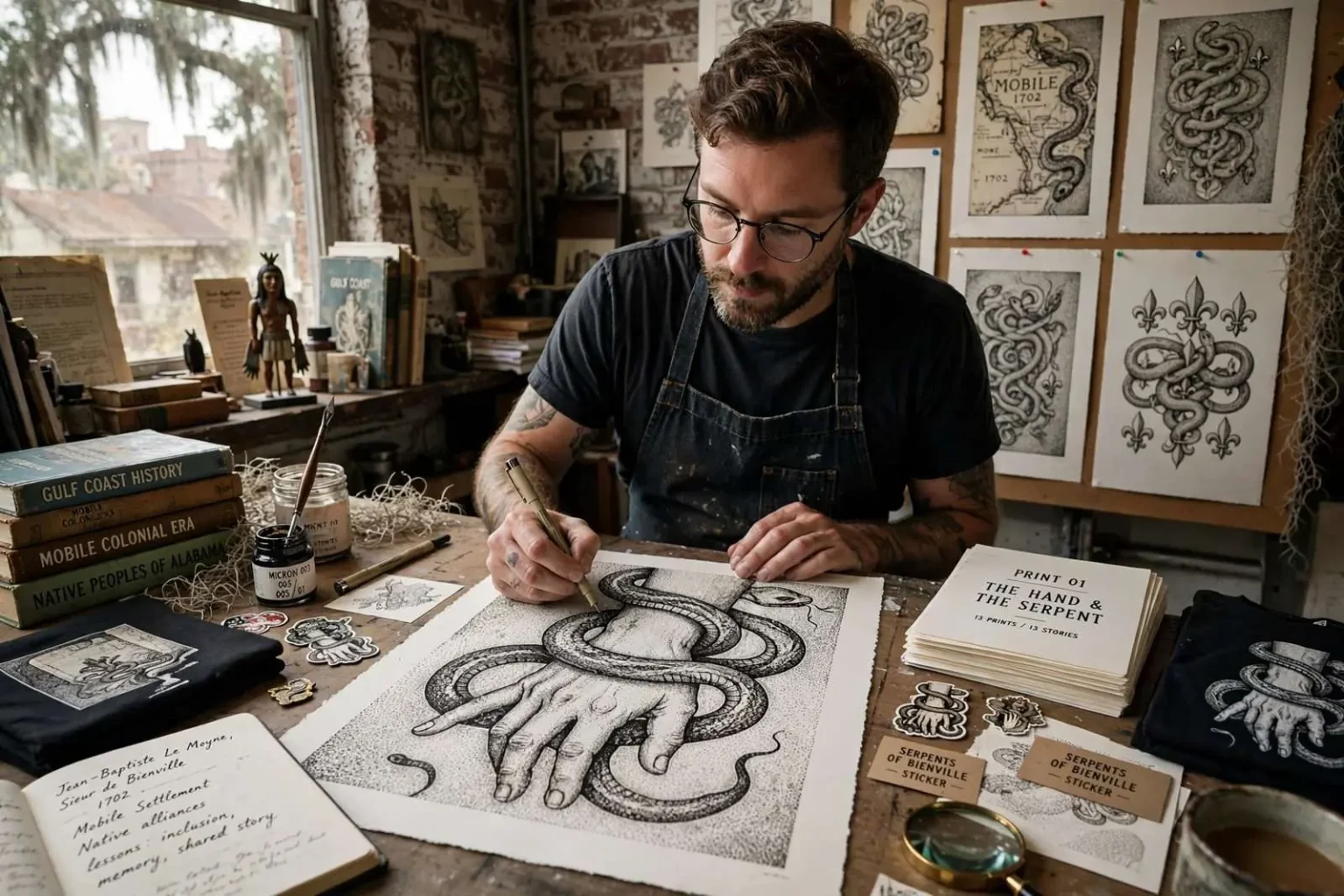
We loved the phrase and the art, so we reached out to artist Sean Herman for the story behind The Serpents of Bienville. What we found was a project that began as a name hunt for a tattoo shop and grew into a full-scale exploration of Gulf Coast history, told through pen-and-ink prints and the stories that accompany them. Like many of the region’s most interesting creative efforts, it started small, with a question about what to call a business, and turned into something much larger that connects Mobile’s colonial past to the present day.
In May 2014, Herman was opening a new tattoo shop with Peter Anderson and Pony. Wanting a name with local ties, he stumbled onto the story of Bienville being covered in tattoos of snakes, and a 1974 sculpture by Julian Rayford of an Alabama Native American that hangs at the entrance to the George Wallace Tunnel. The image of a snake and a hand lodged in his mind and kept growing. Jean-Baptiste Le Moyne, Sieur de Bienville, is one of the founding figures of the Gulf Coast, the French colonial leader whose name remains attached to streets, parks and institutions across Mobile, so any story attaching itself to him carries weight in the city’s imagination.
One early shop-name idea was “Sacred Oath,” using that image, but it did not fit. The shop became “The Bell Rose,” based on an early name for the land that became Daphne. The darker, Southern-gothic Bienville idea instead became a personal project. Herman spent months teaching himself pen-and-ink to render the hand-and-serpent image. As he researched Bienville’s history and his ties to local Native Americans, the drawing grew into a story. He decided to make a book of 13 prints and 13 stories, each tied to lessons for today.
Learning the craft one dot at a time
The prints are made mostly through stippling, a slow technique Herman taught himself; each can take 30 to 50 hours. Stippling builds an image entirely from dots, thousands of them, with density and spacing doing the work that lines and shading do in other styles. The method rewards patience and punishes haste, and it gives finished pieces a texture that is difficult to imitate, soft at a distance and intricate up close. For an artist teaching himself a new medium in adulthood, choosing one of the most demanding techniques available says something about the seriousness of the project.
Alongside the art, he is writing each chapter, and the ideas keep evolving. Each print and its accompanying story stand together, the image drawing readers in and the writing carrying the history and the meaning. That pairing, word and image, reflects the way Southern storytelling has always worked, with lessons wrapped inside tales that entertain first and teach second. Herman has described the stories as tied to lessons for today, an approach that treats local history not as a museum piece but as something with continuing relevance to how people live together on the Gulf Coast.
The project now includes a website and store offering the first run of three finished prints, plus shirts, buttons, and stickers. The merchandise is more than marketing; it spreads the iconography, the serpent and the hand, into everyday circulation, and it funds the slower work of the book. Small-run art projects live or die on this kind of grassroots support, and the print-shop and apparel model has become a familiar path for Gulf Coast artists building an audience without institutional backing.
A family and community effort
Herman’s wife, Amanda Herman, writes weekly posts about local oddities, and the team is collecting interviews with regional authors, artists, and musicians about growing up in the Deep South. Those posts have become a running companion to the main project, surfacing strange and forgotten corners of local history that rarely appear in official accounts. The interviews build a different kind of archive, one made of memories rather than documents, capturing how people who grew up in the region understand the place and its peculiarities.
Plans include reader contributions and, within a month or two, podcasting. Opening the project to contributors turns a solo art endeavor into a community platform, consistent with the name itself. The podcast plan follows a pattern familiar to regional projects of this kind, using long-form audio to carry the interviews and stories that a book alone cannot hold, and to connect with an audience beyond the Gulf Coast who are drawn to Southern history and folklore.
“WE are the Serpents of Bienville,” Herman said, describing an end goal of spreading a message of inclusion, learning, and appreciation for the area they live in. The plural in that sentence is the point. The project treats the region’s history, including its uncomfortable chapters involving colonial power and Native American displacement, as a shared inheritance that belongs to everyone living here now, whatever their background. The aim is not to gloss over the past but to learn from it, and to build a sense of common identity around honest storytelling.
The story that caught Herman’s attention belongs to the layer of lore that surrounds Bienville, the French colonial governor who established the Mobile settlement that grew into one of the Gulf Coast’s first European communities and later founded New Orleans. Whether the tale of a colonial leader covered in serpents is fact, embellishment or something in between, it has persisted because it is too vivid to forget, and it sits alongside the Rayford sculpture as a piece of iconography Mobilians pass regularly without always stopping to look. The George Wallace Tunnel, carrying traffic beneath the Mobile River into downtown, is one of the city’s most recognizable passages, and art placed at its entrance reaches nearly everyone who lives here.
Daphne’s connection to the project runs through the shop’s name as well. The Bell Rose draws on an early name recorded for the land that became the Eastern Shore city, a detail that many residents of the fast-growing suburb had likely never encountered before the shop opened. Naming a business after a piece of local history does quiet preservation work, keeping a phrase alive that might otherwise vanish, and introducing newcomers pouring into Baldwin County to the older layers of the place they now call home.
The discipline of self-teaching a technique like stippling also mirrors the project’s larger ethos. There was no formal program for what Herman wanted to do, no class in rendering colonial-era Southern gothic imagery in hand-inked dots, so he built the skill himself over months of practice. Independent artists across the Gulf Coast work the same way, learning on the job, funding their craft with day work and shop income, and slowly assembling the skills their projects demand. The 30 to 50 hours each print requires is simply the visible cost of that approach, paid willingly for work that is meant to last.
The weekly posts from Amanda Herman give the project a rhythm that solo book work rarely has, an appointment with readers every week while the larger prints and chapters take shape in the background. Local oddities are a reliable entry point into history, drawing in readers who might not seek out a formal account but will happily follow a strange photograph or an unexplained ruin to its source. Over time, those small encounters build an audience that will follow the project into its bigger undertakings, from the book to the planned podcast.
Why local projects like this matter
Mobile is one of the oldest cities on the Gulf Coast, with more than three centuries of layered history, and much of it survives only in scattered fragments: a sculpture in a tunnel entrance, a colonial anecdote, a street name, a family story. Projects like The Serpents of Bienville gather those fragments and give them a frame, which is how a community keeps its memory alive between the official markers and museum exhibits. That work usually happens in artists’ studios rather than institutions, and it often starts exactly the way this one did, with curiosity about a single image.
The project also reflects the depth of Mobile’s creative community, where tattoo artists, painters, musicians and writers cross-pollinate constantly. Herman’s collaborators in the shop, Peter Anderson and Pony, are part of that same scene, and the decision to root a business name in local history rather than something generic reflects a broader movement among Gulf Coast creatives to claim the region’s stories for their own work. The result is art that could not have been made anywhere else, which is the highest compliment a regional project can receive.
From a shop name that would not fit to a growing body of prints, stories, interviews and merchandise, The Serpents of Bienville has become one of Mobile’s more distinctive cultural efforts. With the book taking shape, interviews accumulating and a podcast on the way, the project Herman began with a snake, a hand and a colonial legend keeps expanding. For a city that has always told stories about itself, it is a welcome addition, one dot at a time.