Retired Teacher, Retired Army Sergeant Face Off for Baldwin School Board District 2 Seat
Republican Andrea Lindsey and Democrat Clyde Jones are headed to a November showdown for Baldwin County's District 2 school board seat, a race complicated by a party dismissal tied to outgoing member David Tarwater's endorsement.
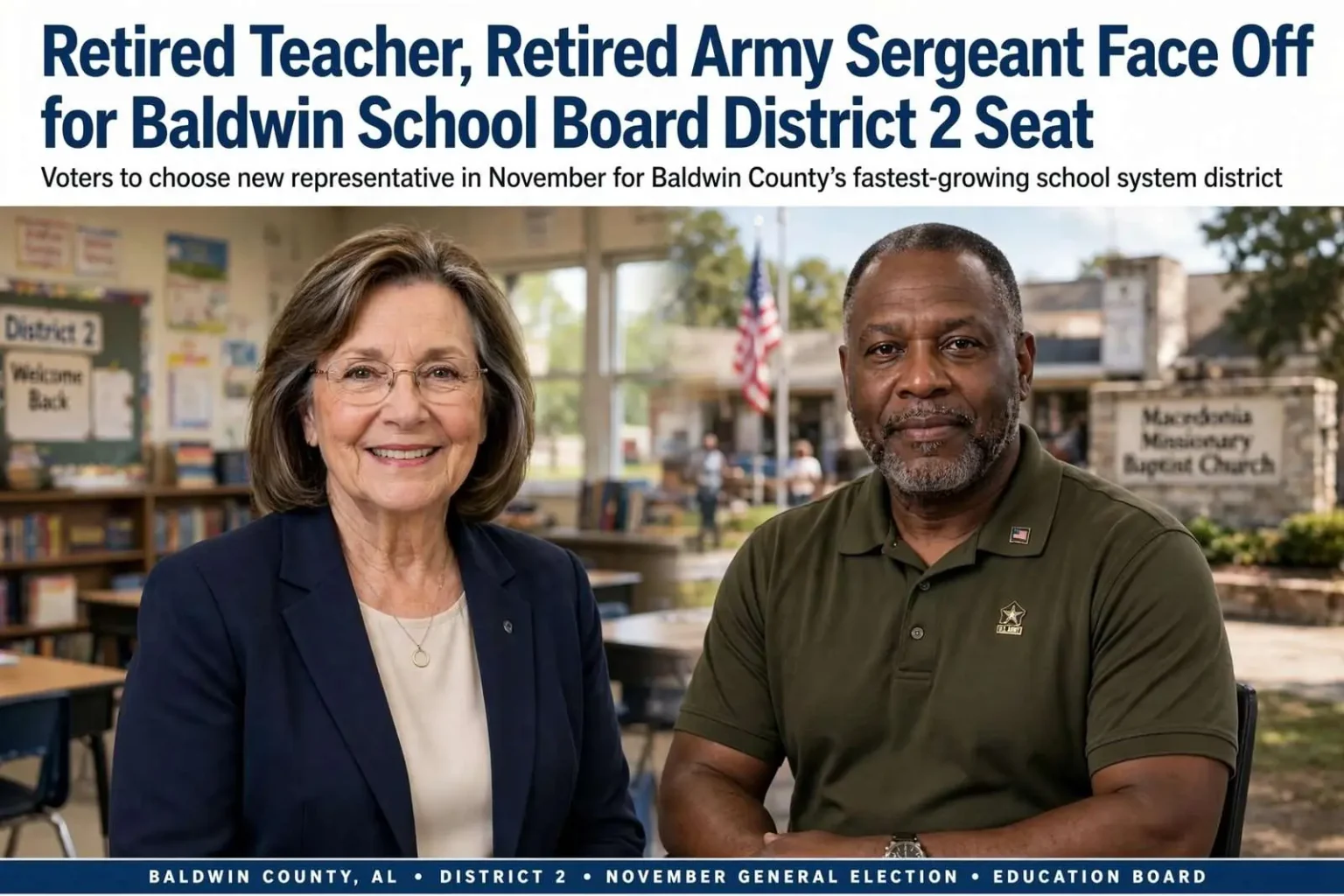
Voters in Baldwin County’s District 2 already know they will pick a new representative on the county Board of Education this November, since no primary challengers emerged to test either party’s nominee. Republican Andrea Lindsey and Democrat Clyde Jones will meet on the November general election ballot after each ran unopposed in their respective June 5 primaries, setting up a fall contest for a seat that oversees policy for one of the fastest-growing school systems in Alabama.
The race’s shape was settled months before the fall campaign began. With no primary opposition on either side, both nominees spent the spring positioning for a general election in a county where Republicans hold most offices but where school board races have traditionally turned on personal reputation and local ties as much as on party label.
The two candidates are seeking to replace Republican David Tarwater, who decided not to run for another term on the board. Tarwater’s decision to back Jones as his preferred successor, despite Jones running as a Democrat, has stirred friction within local Republican ranks. In March, Tarwater received a letter from Baldwin County Republican Executive Committee Chairman Michael Hoyt informing him that he had been dismissed from the party for supporting Jones.
The expulsion letter turned a routine open seat into a test of party discipline. Local executive committees hold wide authority over membership, and a sitting board member’s dismissal for endorsing the other party’s nominee sent a message intended for every Republican officeholder in the county watching the race.
Tarwater has defended his choice as one rooted in what is best for students rather than partisan loyalty. He has described the school board seat as the community’s “Children’s Seat,” saying his focus has been on educational outcomes rather than political alignment, and that he intends to keep that focus through the remainder of his term, which runs until November. His framing put the board race’s usual dynamics — growth, taxes, buildings — inside a argument about what a school board is for.
The candidates
Lindsey, a retired classroom teacher, has lived in Baldwin County for more than three decades after growing up in Montgomery. The District 2 race marks her first bid for elected office. She spent 23 years teaching in Baldwin County classrooms and served as a teacher representative within her school, experience she said gives her firsthand insight into the challenges facing students, teachers and administrators across the district.
Her campaign has leaned on those classroom years. Baldwin County’s school system spans more than 40 schools across a county that stretches from the beaches of Gulf Shores to the outskirts of Mobile, and a teacher who spent two decades inside its classrooms speaks to its operations from a vantage point that no policy brief can replicate. The teacher-representative role, which puts a faculty member in the channel between a school’s staff and its administration, added a dimension of institutional knowledge to her candidacy.
Jones, a retired Army first sergeant, moved to Baldwin County in 2013 for a job with DuPont and now works as a training manager at FMC Agriculture Solutions. Originally from Charles City, Virginia, he has also become active in the Daphne community as an associate minister at Macedonia Missionary Baptist Church. His background pairs a military career — first sergeant is the senior enlisted leadership rank at the company level, built on discipline, logistics and taking care of people — with a second career in industrial training management in Baldwin County’s petrochemical corridor.
The two candidacies offer voters a contrast in experience: a career educator who watched the district grow from inside its classrooms, and a retired soldier and corporate trainer who built a second life in Daphne through his church and his work. Both campaigns have treated the race as a contest of qualifications rather than ideology, in keeping with the traditionally nonpartisan character of school board service.
A district defined by growth
Both candidates point to Daphne and the surrounding District 2 area as the heart of their campaigns, and both cite the rapid population growth reshaping Baldwin County as the defining issue facing the school board in the coming term. Enrollment across the county has climbed steadily for years, straining classrooms, staffing and infrastructure alike, and school board members elected this cycle will serve six-year terms during which that growth is expected to continue.
Baldwin County’s growth has made it a perennial fixture on national fast-growing-counties lists, and the school system absorbs the consequences first. Every new subdivision in Daphne, Spanish Fort or the county’s other Eastern Shore communities arrives with school-age children attached, and each year’s enrollment count drives decisions about portable classrooms, new construction, attendance zones and staffing that the board must make a budget cycle ahead of the rooftops.
The six-year term amplifies the stakes. A board member elected this November will serve through 2026’s second half and beyond, spanning the school years when the county’s current growth pipeline reaches its campuses. Decisions about where new schools go, which existing buildings get renovated, and how attendance zones absorb new neighborhoods will be made on their watch.
What each candidate would focus on
Lindsey said she wants to see the board tackle a broad set of priorities tied to that growth, including school safety, expanded student services, attendance issues and continued gains in academic performance. She has called managing the district’s expansion the single biggest challenge facing Baldwin County’s schools in the years ahead.
Her list maps directly onto the pressures growth creates. School safety covers the physical security of campuses that are adding students faster than they were designed for. Student services address the counseling, health and support infrastructure that expands with enrollment. Attendance — chronic absenteeism in particular — has become a statewide focus as districts connect it to graduation outcomes. And academic performance remains the board’s ultimate accountability, measured in the assessments and graduation rates by which Alabama grades its systems.
Jones has focused much of his platform on facilities and teacher support, specifically pointing to Daphne High School, the oldest high school building in the county, as in need of major renovation. He has also called for increased funding for teacher professional development, arguing that additional training and resources for classroom instruction and technology use will benefit every student in the district.
The Daphne High building gives his facilities argument a concrete address. A campus that has served generations of Eastern Shore students carries decades of deferred needs — in mechanical systems, in classroom configurations, in the technology infrastructure that modern instruction assumes — and renovation on that scale requires board planning and capital budgeting that stretch across multiple fiscal years. Jones’s professional experience running training programs informs the other half of his platform: his argument that investments in teachers’ skills, particularly in classroom technology, compound across every student a teacher reaches.
The two platforms thus divide the same growth problem into different halves — Lindsey emphasizing the human and academic systems that absorb new students, Jones emphasizing the buildings and the professional capacity that serve them. In a district where the board’s practical decisions are about construction schedules, attendance zones and budget priorities, the difference is one of emphasis, and the fall campaign would be the forum where each made the case for his or her half.
A rare two-party board race
District 2 is one of only two Baldwin County Board of Education seats up for election this cycle. The District 1 seat is also on the fall ballot, with Republican Michael Johnson facing Democrat Heather Karras. Both races will be decided in the November general election rather than in the June primary, since neither seat drew a primary contest.
Two contested, two-party school board races on one general election ballot is an uncommon sight in Baldwin County, where board contests have often been decided in the Republican primary or settled without opposition. That both seats drew a Democratic nominee with no primary opposition suggests an organized effort to contest school governance in the county this cycle, whatever the outcome in November.
The partisan framing that Tarwater’s expulsion letter injected adds a layer the District 1 race does not carry. In District 2, voters will not only choose between two candidates but, in a sense, render a verdict on the question his case raised: whether a school board seat belongs to the party that holds it or to whoever the community judges best for what Tarwater called the Children’s Seat. Jones’s endorsement by the outgoing Republican incumbent has already made that question part of the campaign.
The board’s job in a growth county
The Baldwin County Board of Education sets policy for a system that has to run schools across one of the largest geographic counties in Alabama, from Gulf Shores and Orange Beach on the coast to the agricultural and industrial corridors in the north. Board members approve budgets, bond issues and construction programs, set attendance zones that shift as growth moves, and hire and evaluate the superintendent who manages the system day to day.
Those functions scale with the county’s growth. A bond program sized for one era’s enrollment is undersized for the next; an attendance zone drawn for a subdivision’s first phase becomes obsolete by its third; and a technology plan written for a slower district strains under the demand of thousands of additional devices. The board’s decisions in the coming term — whichever two candidates win the November races — will shape where Eastern Shore children attend school for the rest of the decade.
For District 2’s voters, the choice comes down to which candidate’s experience they trust with those decisions: Lindsey’s 23 years inside the system’s classrooms, or Jones’s record of managing people, facilities and training in the Army and in Baldwin County industry. Both campaigns will spend the fall making that case in the Daphne-area communities that anchor the district.
The November general election will decide both board seats, and with them the composition of a board that will steer one of Alabama’s fastest-growing school systems through the middle years of a growth wave that shows no sign of cresting. Whoever wins will take an oath to a seat whose occupant — the outgoing Tarwater — has made clear he believes belongs to the county’s children, whatever their parents’ party.