Eddie Tyler Agrees to Take Baldwin County Schools Superintendent Job
Hours after a contentious board vote, veteran educator Eddie Tyler confirmed he will return to Baldwin County as the school system's next superintendent.
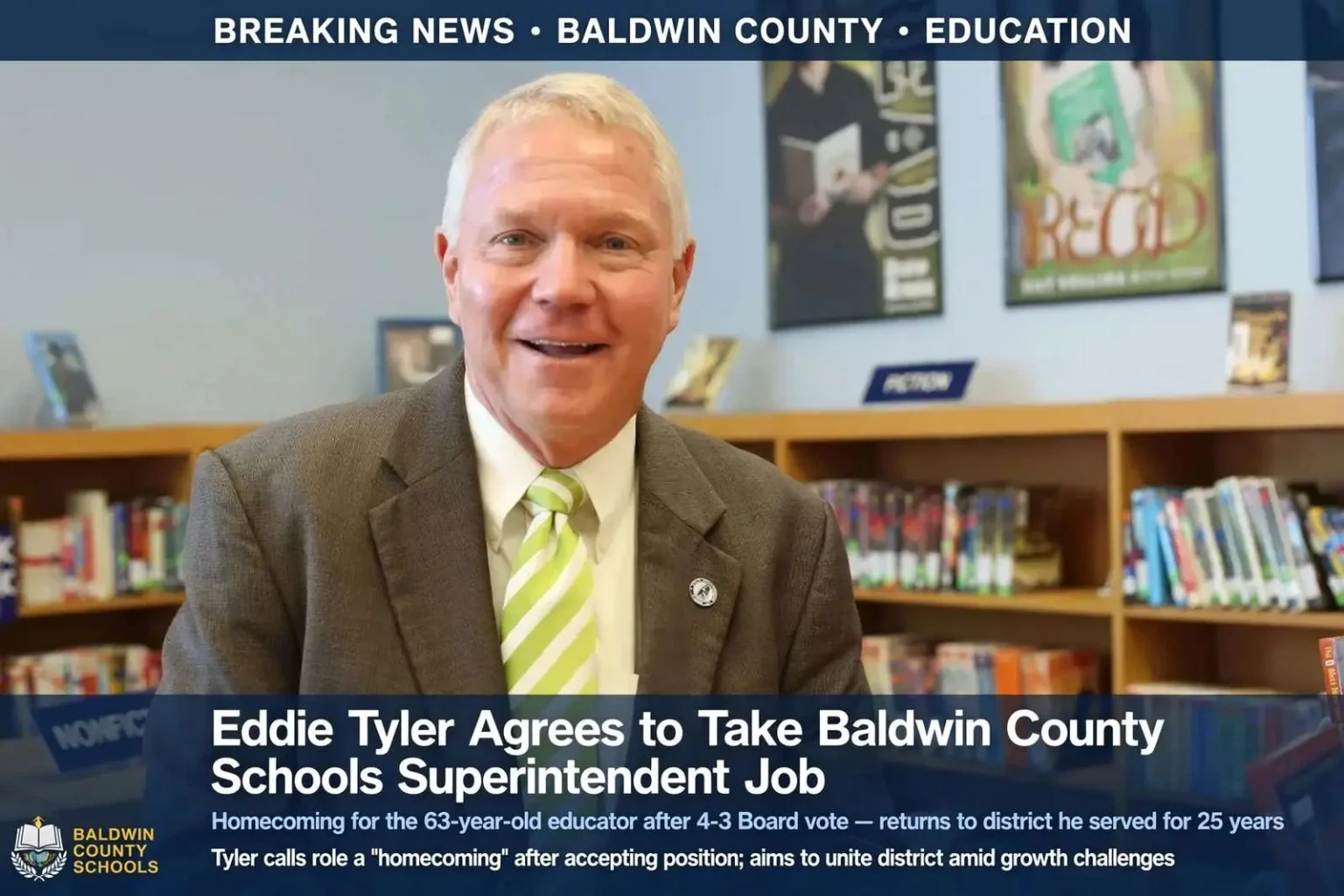
Eddie Tyler did not have long to savor the school board’s decision. Just hours after the Baldwin County Board of Education voted to offer him the district’s top job, Tyler confirmed he had agreed in principle to become the system’s next superintendent, calling the decision a homecoming after a 25-year career in the district he now returns to lead.
Tyler, 63, spent a quarter-century as an educator in Baldwin County before leaving in 2012 as an assistant superintendent to take the top job in the Eufaula City School System. His name carried instant recognition inside the county’s school community, where he had come up through the ranks and worked in central office leadership before the move south along U.S. 431 to Barbour County. That familiarity, board members said during the search process, was one of the qualities that separated him from a deep field of applicants.
The formal offer came the night of the vote, and it caught Tyler off guard. He said Board President Shannon Cauley called him while he was out picking up dinner, and that he was speechless when he saw the missed call and returned it to find Cauley on the line along with the board’s attorney. Within hours of the vote, the decision he had spent weeks awaiting was settled, and a search that had stretched across weeks of interviews and deliberations was over with a single phone call.
The board’s decision came down to a narrow 4-3 vote after members were initially split between Tyler and a competing finalist. A third candidate was also in contention during the search, giving the board a crowded bench of experienced educators to weigh against one another. The split reflected genuine disagreement about which strengths mattered most for a district of Baldwin County’s size and pace of growth, not skepticism about any single finalist’s qualifications.
A Vote That Hinged on One Switch
One board member, representing District 2, declined to back any of the finalists, saying the right candidate simply had not applied. That abstention left the remaining members to sort out the outcome among themselves, and for a tense stretch of the meeting the vote hung in the balance while observers in the room waited to see whether anyone’s position would move.
The turning point came when a board member who had originally supported the other finalist switched his vote to Tyler, tipping the outcome in Tyler’s favor. Speaking afterward, that board member said that while he believed the other finalist would have made a strong leader, the prospect of restarting the superintendent search from scratch, which could have cost the district a full year, pushed him to back Tyler instead. A search that ended without a hire would have left the district under interim leadership deep into a new school year.
He said Tyler brings a different set of strengths to the role and emphasized the importance of the board moving forward united rather than divided. “We need to do things that unify us,” the board member said, a message aimed as much at a divided dais as at the audience watching from the seats.
Tyler said he was not troubled by the closeness of the vote. “It’s not about me now, it’s about the school children and employees of Baldwin County,” he said. “However slim the margin was, that was out of my control.” By that evening, he said, several Baldwin County board members had already reached out to congratulate him, including some who had not voted for him, a gesture he took as a sign that the district could move past the contested vote quickly.
Baldwin County is one of the largest school systems in Alabama, spanning communities as different as Bay Minette, Daphne, Fairhope, Foley, Gulf Shores, Spanish Fort, Robertsdale and Elberta, and stretching from the Mobile Bay shoreline to the beaches at the state’s southern tip. Its footprint covers most of Baldwin County’s roughly 1,900 square miles, and its schools absorb thousands of new students in many years as families continue moving to the county’s booming eastern shore and beach communities. Managing growth, school zoning and classroom capacity across so many distinct towns has long been the defining challenge of the superintendency there.
Tyler’s quarter-century in Baldwin County spanned classroom, school and central office roles, culminating in his service as an assistant superintendent before the 2012 move to Eufaula. It is the resume of a homegrown administrator who rose through the district’s own leadership pipeline rather than arriving from outside, the kind of hire boards often reach for when they want continuity rather than change. His return also reunites him with veteran staff members who worked under him during those years, an advantage that outside candidates cannot replicate.
The superintendency he inherits carries both visibility and pressure. Baldwin County’s enrollment growth has driven recurring debates over attendance zoning, portable classrooms and bond-funded construction, and each new subdivision along the Eastern Shore and the Highway 181 corridor adds students faster than many districts in the state can plan for them. A superintendent who already knows the county’s geography, its municipal politics and its seven feeder patterns starts that work with months saved, which was precisely the argument his supporters made during the search.
With the hire settled, Tyler said his focus now turns to two fronts: helping the Eufaula school system prepare for his departure by supporting the appointment of an interim superintendent, and preparing for his own transition into the Baldwin County role. He said he intends to leave Eufaula in as good or better shape than he found it, a nod to the relationships he built during years of leading the smaller east Alabama district.
What Comes Next for the District
Once details of his contract are finalized with the Baldwin County board, Tyler said his first priority will be visiting principals across the district’s seven feeder patterns to introduce himself to employees as quickly as possible. Feeder patterns, the chains of elementary and middle schools that feed each high school, organize how the sprawling district communicates and plans, and a listening tour through each one is the standard playbook for a new superintendent trying to learn a system from the ground up.
Tyler described that outreach approach throughout the search process, telling board members that a superintendent’s first job is to show up in schools and listen to the people running them. Returning to a district where he already knows many veteran principals and central office staff, he argued, would shorten the usual learning curve that accompanies a leadership change of this scale.
In Alabama, most superintendents are hired by elected school boards rather than elected directly, which puts board dynamics at the center of every search. A 4-3 vote is not unusual for a district of Baldwin County’s size, where members answer to distinct geographic districts and often champion local priorities from attendance zones to new school construction. What matters most, veterans of such searches say, is whether the losing side signs on to the new administration’s agenda quickly enough to keep day-to-day operations out of the political crossfire.
The hire closes out a search that consumed weeks of board discussion and drew attention across the county, where school leadership decisions carry unusual weight. The Baldwin County system is among the largest employers in the county, and its superintendent answers to a seven-member elected board whose districts cover everything from the industrial corridor around Bay Minette to the rapidly growing Highway 181 corridor between Daphne and Fairhope and the coastal towns to the south.
For parents and teachers, the immediate questions are practical: how quickly a contract is signed, when Tyler formally takes office, and how his return reshapes priorities that have included growth management, school construction and classroom technology. Board members who backed him pointed to his long institutional memory as an asset in answering those questions, since he served in central office leadership during earlier rounds of the county’s growth boom.
For Eufaula, the departure means a second search in short order, though Tyler said he plans to stay engaged through the transition and support the board there as it names an interim leader. He built a reputation in the east Alabama district for stability and steady financial management, and he said leaving that system in capable hands matters to him as much as the new job he is about to begin.
The 4-3 margin will likely fade as the practical work of running schools takes over, but the message from the deciding board member, that the district needed unity more than a perfect process, captured the mood as the vote was announced. Tyler’s first day will begin the task of proving that the homecoming was worth the hard-fought vote.