Baldwin County School Board Votes to Offer Superintendent Post to Eddie Tyler
After a tense split vote nearly forced a search restart, the Baldwin County school board narrowly agreed to offer its top job to Eddie Tyler.
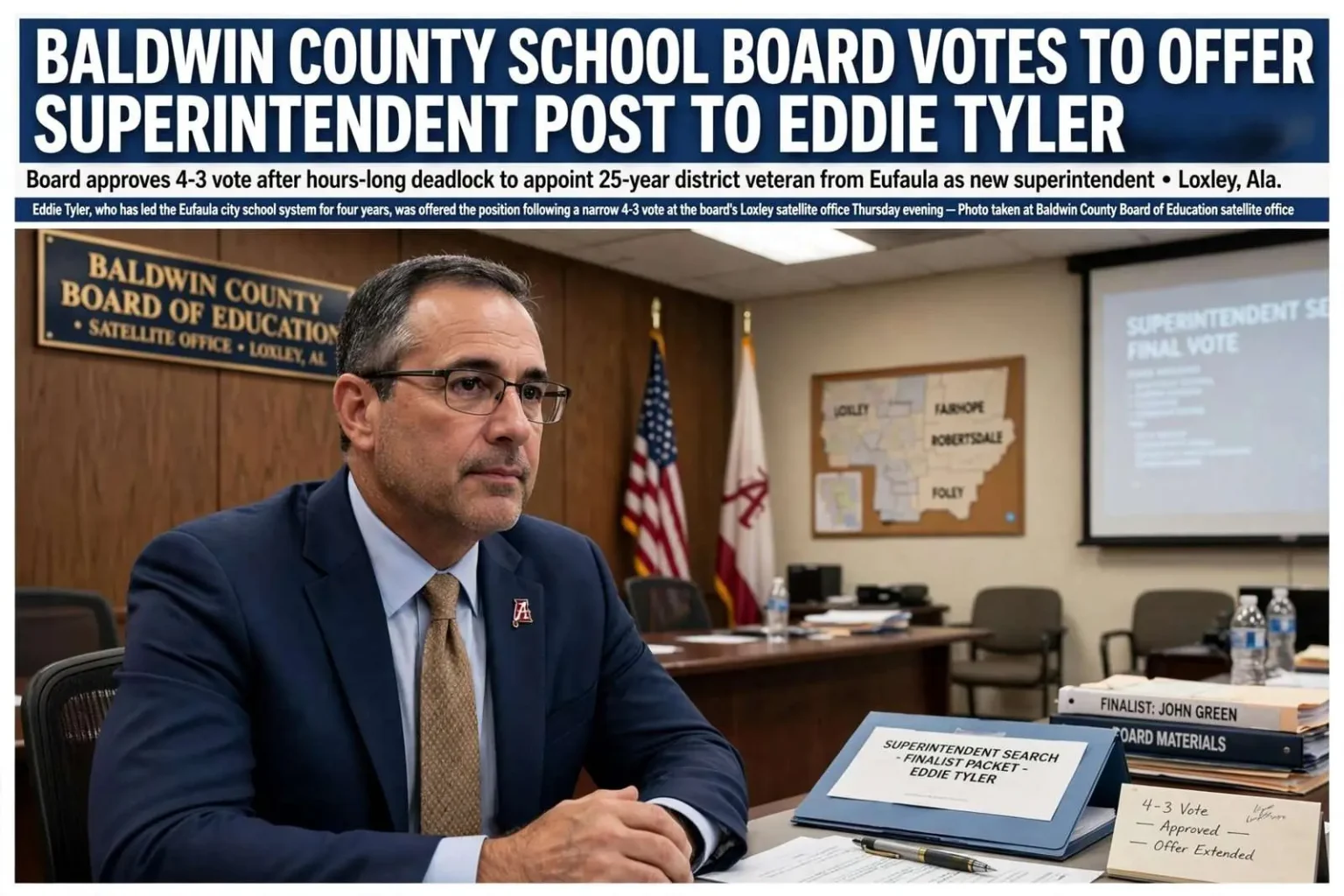
A months-long search for a new Baldwin County schools superintendent nearly ended in chaos before the school board narrowly voted to offer the job to Eddie Tyler, a 25-year veteran of the district who has spent the past four years leading the Eufaula city school system. The outcome capped a search that had stretched from summer into the school year, and the divisive vote left lasting impressions on a board that had promised a smooth process. For a district of Baldwin County’s size, the choice of superintendent shapes everything from budget priorities to campus construction for years to come.
The board met at its satellite office in Loxley to consider three finalists after completing a round of interviews. The satellite facility, which the system uses for board meetings and administrative functions, gave the seven-member board room to deliberate away from the central office in the county seat. The three finalists emerged from a pool of applicants the board had screened itself, a point of pride for members who had insisted on handling the process without outside help.
An initial vote left members deadlocked, with three board members backing candidate John Green, three backing Tyler, and one member, representing District 2, declining to support any of the three finalists. That member argued that none of the applicants was the right fit for the job. The standoff exposed the depth of feeling on a board that had spent months in shared purpose, and it sent the meeting into uncharted procedural territory.
A Search on the Brink of Collapse
The impasse briefly raised the possibility that the board would have to restart the superintendent search from scratch, a prospect that alarmed several members. Restarting would have meant new advertisements, a new applicant pool and months of additional delay, all while the district’s leadership sat in transition. Board members who had championed the search’s speed found themselves confronting the possibility that their approach had produced no result at all.
Board President Shannon Cauley suggested that a professional search firm, which could cost as much as $40,000, might need to be brought in if the board could not reach agreement. The mention of a firm amounted to a retreat from the board’s central argument for conducting the search itself. Members had spent months touting their ability to run the search process themselves, faster and more cheaply than an outside firm, and the $40,000 figure put a price tag on what that confidence had cost.
Restarting the process risked losing a year, since the pool of qualified superintendent candidates thins considerably once a new school year is underway. School leaders with sitting jobs generally prefer to make moves on the academic calendar, and a restart would have pushed the district’s timeline into another hiring cycle. For a district opening schools with an interim leadership question hanging over it, the cost of delay extended beyond money.
One board member called the situation “embarrassing,” noting that the community was counting on the board to make a decision. The remark captured the frustration of members who saw the deadlock as self-inflicted. Baldwin County residents had followed the search closely in local coverage, and the board’s inability to produce a hire from three finalists was becoming its own story.
Rather than continue polling first choices, the board shifted to a direct motion to offer the position to Tyler. That change allowed a board member who had initially supported Green to switch his vote, giving Tyler a 4-3 majority. The procedural pivot rescued the search from collapse, though the narrow margin signaled that the board’s divisions would follow the new superintendent into office.
Three members, including Cauley and the board’s vice president, voted against the offer, while the previously undecided District 2 member ultimately voiced support for Tyler once the vote was finalized. The District 2 member’s shift from refusing all three candidates to backing Tyler provided the decisive margin. Votes of that configuration, where the holdout becomes the deciding voice, tend to be remembered long after the meeting adjourns.
Cauley acknowledged after the meeting that the outcome caught her by surprise. “It made me a little nervous. I wasn’t sure the direction we were going to go in that,” she said, adding that she was relieved the board ultimately reached a decision. Her comments reflected the view of a board president who had spent the evening watching her preferred process wobble and then land somewhere she had not planned.
Why Tyler Emerged
Several board members said Tyler was popular among school system employees and had been mentioned frequently by Baldwin County residents throughout the search, which began in July after the previous superintendent announced plans to step down from the central office and return to a principal role at an elementary school. That groundswell gave Tyler’s candidacy a constituency the other finalists lacked. Employee goodwill, in a district as large as Baldwin County’s, carries practical weight in a superintendent’s first year.
Tyler’s quarter-century in the district meant he knew its campuses, its budget history and its personnel without an orientation period. His four years in Eufaula added city-system leadership experience to that institutional knowledge, a combination few other candidates could claim. Board members weighing the vote noted that he had left the district on good terms and had kept ties to Baldwin County during his time away.
The previous superintendent’s decision to return to an elementary principalship rather than retire outright made the transition unusual, placing a former central-office leader back inside the hierarchy Tyler would inherit. Such arrangements can smooth a handover or complicate it, and board members were aware of the dynamic as they deliberated. The district’s leadership structure was effectively absorbing two superintendents’ worth of experience at once.
Baldwin County’s school system spans one of the largest geographic districts in Alabama, stretching from the Mobile Bay communities across the county’s agricultural and coastal corridor to its fast-growing suburbs. Its enrollment ranks among the largest in the state, and its campuses range from small rural schools to suburban facilities managing rapid growth. The scale of the operation makes the superintendent’s office one of the most consequential jobs in South Alabama public life.
The board’s structure reflects the county’s district-based representation, with members elected from geographic districts and answerable to distinct communities. That arrangement gives every corner of the county a voice in decisions like this one, but it also multiplies the constituencies a superintendent must balance. The 4-3 vote illustrated how differently the same finalist could read to members from different districts.
Alabama school boards appoint their superintendents rather than electing them, a change adopted statewide years ago that shifted the responsibility for these hires entirely onto boards like Baldwin County’s. The appointment model concentrates attention on exactly the kind of meeting that unfolded in Loxley: seven members, one vote, and a district waiting on the result. When the process works, it looks routine; when it deadlocks, as it nearly did here, the board’s mechanics become public spectacle.
What the Deadlock Revealed
The near-collapse of the search also revealed something about the board’s self-image. Members who had argued publicly that they could run a faster, cheaper search than any firm had staked their credibility on the outcome, and the deadlock tested that wager in real time. The rescue came not from the process they had designed but from a mid-meeting change of procedure, an irony several members seemed to feel keenly.
Search firms, for all their cost, exist largely to prevent the kind of deadlock the board experienced. They screen candidates, manage expectations and give board members a professional buffer between their preferences and their votes. Whether Baldwin County’s experience will temper the board’s appetite for self-managed searches in the future is a question members themselves will answer in time.
The community’s reaction to the 4-3 outcome was shaped by Tyler’s popularity within the system. Because the deciding votes converged on a candidate with deep local roots and employee support, the narrow margin read less like a rejection of the winner and more like disagreement about process. Superintendents have taken office with less goodwill than Tyler carried into the job.
For the three members who voted against the offer, the vote represented a judgment about the candidate and the process alike. Their stated positions during the deliberations, including the District 2 member’s original objection that none of the finalists was the right fit, will be measured against Tyler’s performance in the years ahead. Board divisions of this kind usually dissolve into routine business once a hire takes office and results accumulate.
The Eufaula connection added a layer of professional scrutiny to the vote. City school systems in Alabama operate under their own boards and superintendents, and leading one is regarded as preparation for larger district work. Tyler’s four years there gave him a record as a sitting superintendent rather than a candidate promoted from central administration, which strengthened the argument for his selection among members who valued executive experience.
The Offer and What Followed
With the board’s vote, Tyler was extended a formal offer to become the district’s next leader, a decision that would soon be finalized as he prepared to take the reins of one of South Alabama’s largest school systems. Formalizing the offer involved contract negotiations, transition planning and the practical business of moving a sitting superintendent from one system to another. From the night of the vote in Loxley, the district’s leadership question had an answer.
The months-long search, which began in July with the previous superintendent’s announcement, closed with the outcome many in the community had lobbied for. Employees who had spoken up for Tyler during the search got the result they wanted, and residents who had watched the process stall got a decision instead of a restart. For the board, the vote ended the search but began the longer test of whether the hire would unify a panel that had split 4-3 to make it.
Superintendent transitions in districts of Baldwin County’s scale are watched closely across Alabama, both by educators weighing their own career moves and by county residents with a direct stake in the schools. The Loxley meeting gave outside observers a detailed look at how a large district’s board functions under pressure. What they saw was a process that bent badly, then held, and a new superintendent whose mandate rested on popularity with employees and a narrow but sufficient majority of the board.