Mobile Approves New Humana Health Plan for City Retirees
Mobile's City Council unanimously approved a new Humana supplemental health plan for about 775 retirees, aiming to save the city $1.5 million.
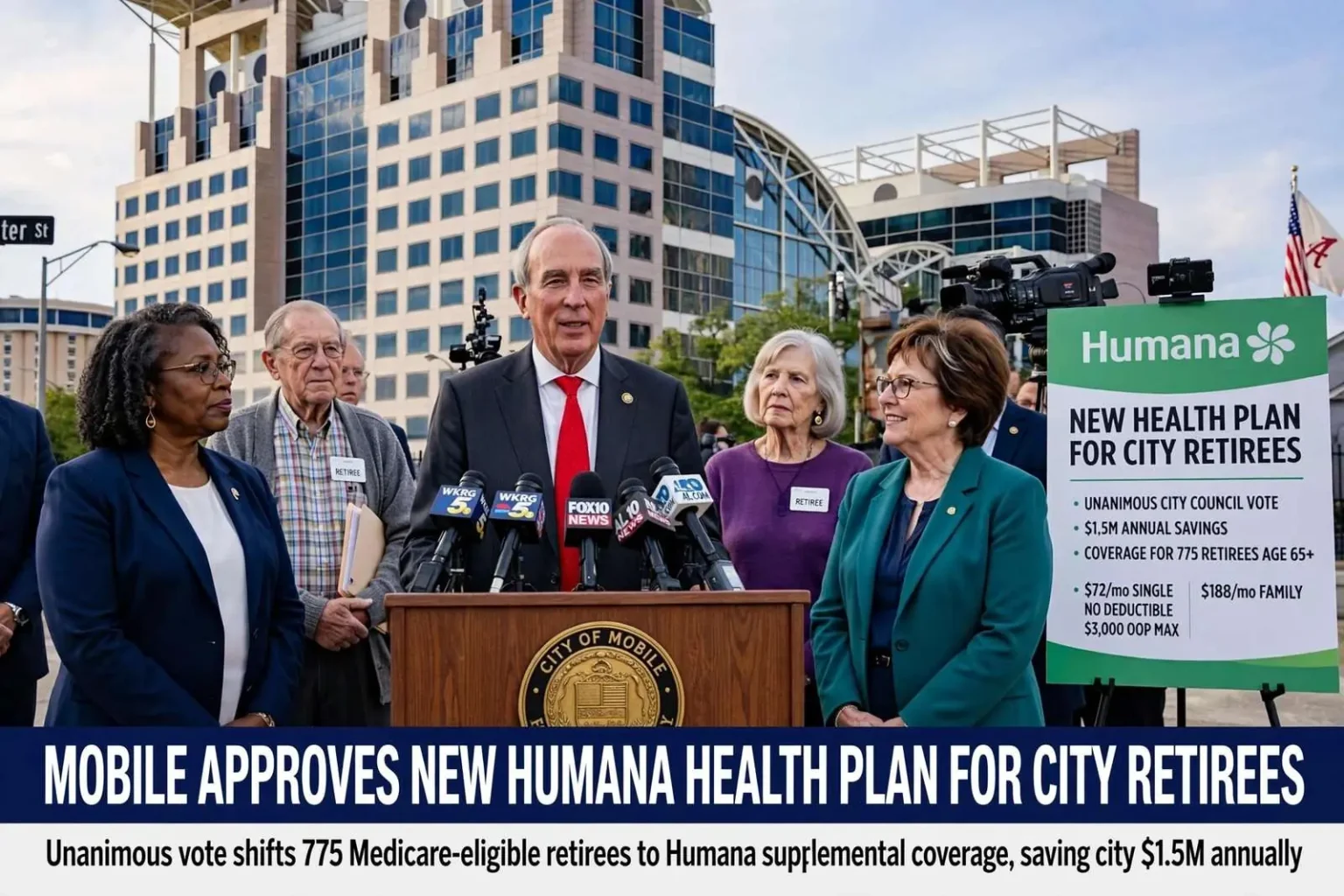
Mobile’s City Council voted unanimously to shift supplemental health coverage for roughly 775 retirees onto a new plan administered by Humana Inc., ending years of the city holding out against a trend of municipalities cutting retiree health benefits. The change applies to retirees age 65 and older who currently receive coverage through the city’s health plan, and it marks one of the most significant benefit restructuring decisions Mobile’s government has made in recent memory. Officials said the move accomplishes two goals at once: providing retirees with supplemental coverage similar to what they have had, while saving the city an estimated $1.5 million in the coming fiscal year.
The vote was the product of a long and often contentious debate inside Government Plaza over how the city should handle the rising cost of health benefits promised to its retired workforce. Council President Gina Gregory called the Humana option the strongest one available to the city, while Councilwoman Bess Rich described the previous arrangement as financially unsustainable. Both have served long tenures on the council and have been frequent participants in the city’s budget deliberations, and their willingness to back the switch signaled that the political appetite for defending the old plan had eroded as costs continued to climb.
The savings stem largely from removing Medicare-eligible retirees from the city’s own health plan and shifting them to a private Medicare supplemental option. Because federal law makes Medicare the primary payer for most people once they turn 65, cities across the country have increasingly concluded that keeping older retirees on employer plans duplicates coverage the retirees already carry, and the expense falls entirely on the local taxpayer. Mobile had resisted that logic longer than most Alabama cities, and city officials noted that the city’s retiree benefits have remained more generous than those offered in many peer communities.
Mayor Sandy Stimpson had pushed for a private alternative to reduce the city’s health care costs since taking office, framing the issue as a matter of fiscal discipline for a city that also faces competing demands for public safety, drainage, and infrastructure spending. A similar effort was blocked by the council the previous year, when retiree concerns about changes to long-standing benefits proved politically potent. The unanimous vote this time reflected months of renewed negotiation between city finance staff, benefit consultants, and the plan administrator, along with a design intended to keep retiree cost-sharing close to existing levels.
How the new arrangement works
Under the new arrangement, the city will share costs with retirees who purchase the Humana Medicare supplemental plan. Retirees will pay $72 per month for single coverage or $188 for family coverage, with the new benefits set to take effect at the start of the following year. The city’s contribution effectively subsidizes premiums that would otherwise be paid out of pocket by retirees living on fixed pensions, and officials have described the monthly rates as substantially lower than what comparable Medigap-style coverage typically costs when purchased individually on the open market.
Medicare supplemental coverage, often called Medigap, is designed to pick up the cost-sharing obligations that traditional Medicare leaves behind, including deductibles, coinsurance, and hospital charges that accumulate quickly during serious illness. For a retiree population that skews older and uses more medical services than the general population, the quality of that supplemental layer matters more than it would for a younger group, which is why the specific plan design drew close scrutiny from retirees and council members alike during the deliberations.
City finance officials outlined several differences between the old and new plans, and several of the headline numbers favored Humana. The Humana plan carries no annual deductible, compared to a $250 deductible under the previous city plan. Emergency room copays drop from $125 to $50, and ambulance rides carry no additional charge under the new coverage — a meaningful change in a sprawling city where emergency transport is common for elderly residents.
The city’s finance director said the Humana plan also caps total out-of-pocket costs for retirees at $3,000 annually, a protection the previous plan lacked entirely for copays and deductibles tied to doctor and hospital visits. An out-of-pocket maximum is widely considered one of the most valuable features a health plan can offer, because it converts the worst-case financial scenario of a major illness from an open-ended liability into a known annual ceiling. For retirees on fixed incomes, the absence of such a cap in the prior plan had been a persistent source of anxiety, particularly among those managing chronic conditions that require frequent hospital care.
A comparison with other Alabama cities
City officials repeatedly framed the decision by pointing to what other large Alabama municipalities have done, and the comparisons made Mobile’s previous posture look increasingly like an outlier. Tuscaloosa and Huntsville, for example, provide no health coverage at all for Medicare-eligible retirees, leaving those former employees to find their own Medicare supplement arrangements on the individual market. Huntsville, despite its rapid growth and expanding tax base, made its shift years ago as part of broader cost-control measures, while Tuscaloosa has similarly kept its retiree liability narrow by limiting benefits to employees before they reach Medicare age.
Birmingham offers a middle case that illustrates how expensive the alternative can be for retirees themselves. Retirees over 65 in Birmingham can pay as much as $1,000 a month for coverage, a figure that consumes a substantial share of a typical municipal pension check. Against that backdrop, Mobile’s negotiated rates of $72 for single coverage and $188 for family coverage position the city near the generous end of the spectrum among Alabama’s largest cities, even after the restructuring that produced the $1.5 million in annual savings.
That regional context mattered politically. Council members who had resisted earlier attempts to change retiree benefits were reluctant to approve anything that would leave Mobile’s retirees worse off than their counterparts in Birmingham, Huntsville, or Tuscaloosa, and the plan design ultimately presented gave them a benchmark they could defend publicly. Officials acknowledged that Mobile had, for years, offered benefits more generous than most of the state’s other major municipalities, and that the gap had become harder to justify as health care inflation pressured the city’s general fund.
Why the savings matter to the city budget
The roughly $1.5 million in annual savings is not an abstract figure in Mobile’s budget arithmetic. Health insurance costs for active employees and retirees alike have been rising faster than the city’s revenue growth in most years, and every dollar locked into legacy benefit obligations is a dollar unavailable for street repairs, drainage projects, police and fire staffing, or pay raises for the current workforce. City finance leaders said the savings generated by the switch would help address broader budget pressures facing Mobile while still preserving a benefit structure they described as more generous than what many peer cities currently offer their own retired employees.
The finance department had spent several budget cycles flagging retiree health costs as a structural concern, warning that the liability would grow as the retiree population aged and medical claims continued to rise. Removing the Medicare-eligible group from the city’s self-insured risk pool also has a compounding effect: the remaining covered population is smaller and, on average, younger, which can stabilize premium projections for the active employee plan over time. Administrators have noted that containing costs for current employees is easier when legacy retiree claims are no longer blended into the same risk pool.
For the Stimpson administration, the vote represented the completion of an objective pursued across multiple budget years. The mayor’s office had argued from the start that the city could honor its commitments to retirees without maintaining the most expensive model in the state, and the unanimous outcome — after a council rejection the year before — suggested that the negotiated terms finally crossed the threshold where cost savings and benefit protection no longer appeared to be in conflict.
Concerns from the retiree community
Not every retiree welcomed the switch, and the council heard from several during the deliberations. The most consistent complaint involved coverage gaps: some retirees raised concerns that the new Humana plan does not include dental or vision coverage, benefits some had grown accustomed to under the city’s prior arrangement. Routine dental work, dentures, eyeglasses, and vision exams are services that many older adults pay for regularly, and losing bundled coverage for them means a new recurring expense that arrives on top of the monthly premium.
City officials acknowledged the gap but maintained that the overall financial and coverage trade-offs made the switch worthwhile for both retirees and taxpayers. They pointed to the elimination of the deductible, the lower emergency room copay, free ambulance transport, and the new $3,000 out-of-pocket cap as improvements that collectively outweigh the loss of dental and vision benefits, particularly since stand-alone dental and vision policies remain available for purchase on the individual market at relatively modest cost.
Retiree advocates have long cautioned that changes to supplemental coverage tend to be scrutinized line by line, because even modest shifts in cost-sharing can matter enormously to someone managing a fixed pension and ongoing medical needs. That dynamic explains why the council proceeded carefully, insisting on a plan design that improved several key protections before agreeing to move the population off the city’s own plan. The unanimous vote suggested the concerns had been heard, even if they were not resolved to every retiree’s satisfaction.
What changes and what stays the same
For the affected retirees, the practical transition will involve enrolling in the Humana Medicare supplemental product and presenting new identification at doctor’s offices and hospitals. Because the plan is supplemental to Medicare rather than a replacement for it, retirees will continue to use the same Medicare enrollment they already maintain, and providers who accept Medicare assignment generally accept coordinated supplemental coverage without separate negotiations. City staff have worked with the administrator to communicate enrollment steps, effective dates, and the new premium schedule directly to affected households ahead of the start-of-year transition.
The benefit comparisons outlined by the finance department are expected to anchor how the change is judged going forward: no deductible instead of $250, a $50 emergency room copay instead of $125, no ambulance charge, and a $3,000 annual out-of-pocket ceiling where none existed before. Premiums of $72 for single coverage and $188 for family coverage will be the recurring figure retirees see, shared between the city and the retiree under the cost-sharing arrangement approved by the council.
The change applies only to retirees age 65 and older who were receiving coverage through the city’s health plan. Retirees below Medicare eligibility age remain under the city’s existing arrangement, and active employees are unaffected by the vote. That staging is typical of municipal benefit reforms, which usually target the Medicare-eligible population first because federal rules already make Medicare the primary payer for that group.
A signal for other Gulf Coast governments
Mobile’s decision will be watched closely by other Gulf Coast local governments facing the same demographic math. Cities and counties across the region are contending with growing retiree rolls, longer life expectancies, and medical inflation that consistently outpaces municipal revenue, and the option of a jointly funded Medicare supplement administered by a national carrier has become the standard template. The experience in Mobile — including the negotiated premium levels, the benefit enhancements, and the eventual $1.5 million in savings — offers a reference point for councils elsewhere weighing their own versions of the same choice.
For Mobile itself, officials presented the vote as a rare case in municipal finance where a cost-cutting measure also improved several concrete protections for the people affected. Whether that framing holds will depend on how the transition performs in practice, but the council’s unanimous endorsement of the Humana arrangement closed a multi-year debate over how the city balances compassion for its retired workforce with the fiscal limits of the government that promised those benefits in the first place.