Mobile woman arrested after 10-year-old left alone with loaded gun
A Mobile woman was arrested on reckless endangerment after a 10-year-old boy was left alone with a loaded gun that discharged at an apartment.
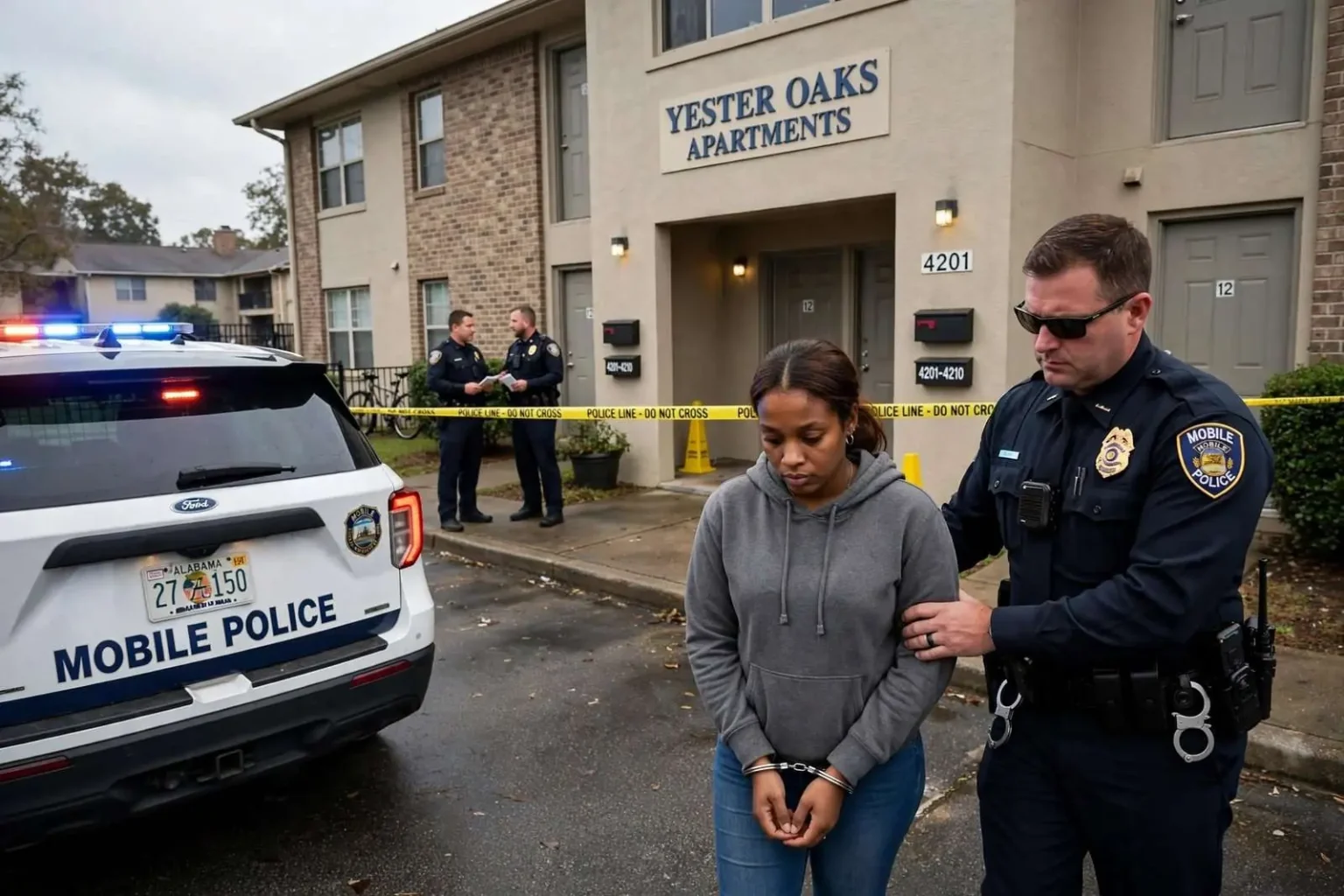
MOBILE, Ala. — A Mobile woman has been arrested after a 10-year-old boy was left alone with a loaded gun that went off inside a Mobile apartment complex, police said. Crystal Olison, 27, is charged with reckless endangerment in connection with the incident, which unfolded on a Friday afternoon at the Yester Oaks Apartments in west Mobile.
According to Mobile police, the boy was playing with the unsecured firearm when it discharged. The bullet traveled through a wall and into a neighboring apartment. Remarkably, no one was hurt — not the child, and not anyone in the unit the round entered. Police said the child had been left alone with the loaded weapon before it went off, a detail that quickly drew attention from investigators and from community members who heard the shot and its aftermath.
The arrest came after officers and detectives pieced together how a loaded gun ended up in the hands of a 10-year-old.Investigators determined the weapon had been accessible to the child and that the child was unsupervised when the gun fired, circumstances that Alabama law treats with increasing seriousness.
The Charge: Reckless Endangerment in Alabama
Reckless endangerment is defined under Section 13A-6-24 of the Alabama Criminal Code. A person commits the crime of reckless endangerment when he or she recklessly engages in conduct that creates a substantial risk of serious physical injury to another person. The offense is ordinarily a Class B misdemeanor, though it can be charged as a Class A felony when the conduct involves a deadly weapon and creates a risk of death or serious injury — a distinction prosecutors weigh when guns fire in occupied homes and apartment buildings.
In cases like this one, the legal analysis typically turns on whether leaving a loaded firearm within reach of a child created a substantial risk to others — including neighbors, as here, where the bullet crossed into another family’s living space. Because the projectile penetrated an occupied unit, the risk was not hypothetical; it was realized, and only luck separated the outcome from a tragedy.
Reckless endangerment charges tied to unsecured firearms have become a familiar feature of Alabama court dockets. Prosecutors across the state, including in Mobile County, have used the statute as one of the few straightforward tools available when a child accesses an unlocked gun, since Alabama’s penal code historically lacked a stand-alone, broadly written child-access statute comparable to those in some other states.
A Statewide Push for Secure Storage
The incident arrives as Alabama lawmakers and law enforcement leaders have sharpened their messaging on firearm storage. In 2024, the Legislature passed, and Gov. Kay Ivey signed, a safe-storage measure requiring gun owners to reasonably secure a firearm they know or should know is accessible to a minor. The law was intended to close a gap that for decades left Alabama as one of the few states without such a requirement, and it followed years of advocacy from pediatricians, sheriffs, and district attorneys who responded to a steady drumbeat of accidental shootings involving children.
Public safety agencies in Mobile have repeatedly emphasized the practical basics: store guns unloaded, lock them in a safe or use a cable lock, keep ammunition secured separately, and never assume a child cannot find a hidden firearm. Children, researchers and police alike note, are naturally curious, and a 10-year-old is old enough to find a gun but young enough not to fully grasp the danger of pulling a trigger.
What Happened at Yester Oaks
The Yester Oaks Apartments sit in a densely settled part of west Mobile, where units share walls and bullets fired inside one residence can — as happened here — pass directly into another. That geography matters: in an apartment building, an unsecured gun is not just a risk to the household that owns it. A single discharge can cross several walls before losing energy, which is precisely what police said occurred on that Friday afternoon.
Residents who spoke with police in the hours after the shot described the familiar sequence of a Mobile afternoon interrupted: a loud bang inside a building, children’s voices, then adults in hallways checking doors and knocking on neighbors’ screens to make sure everyone was all right. When officers arrived, they found the 10-year-old and the weapon that had gone off, and began the work of reconstructing how long the boy had been alone with it and where it had been kept.
Police said no one in the neighboring apartment was injured when the bullet passed through. The unit sustained damage from the round, and investigators photographed the path the projectile took as part of the case file that now supports the reckless endangerment charge against Olison.
Why These Cases Draw Renewed Warnings
Every accidental discharge involving a child prompts the same cycle from Alabama authorities: arrest where warranted, followed by public reminders that secure storage is the one intervention that reliably prevents these shootings. The warnings are not abstract. Mobile-area hospital trauma teams and pediatric offices have long counseled families about gun access, and national public-health analyses have consistently found that most accidental child shootings happen in a home, usually with a gun belonging to a parent or relative, and usually when a child is unsupervised.
For apartment-dwelling families in particular, authorities stress a few concrete habits. A gun stored in a nightstand drawer, under a mattress, or on a closet shelf is not secured — those are the first places children find. Trigger locks and lock boxes are inexpensive, and several gun shops and range operators in the Mobile area distribute or demonstrate locking devices to customers. Law enforcement agencies periodically host free gun-lock giveaways, and programs such as Project ChildSafe, run by the firearms industry’s trade association, have distributed millions of free cable locks nationally, including to departments across Alabama.
The Wider Context Along the Gulf Coast
Mobile County has confronted a series of high-profile incidents in recent years in which children found loaded firearms — in cars, closets, and purses — with outcomes ranging from narrow escapes to fatalities. Those cases have shaped how local agencies respond even to no-injury discharges like the one at Yester Oaks. Detectives treat an accidental firing by a child not as a closed-and-shrugging event but as a near miss that justifies a full investigation, and prosecutors weigh charges accordingly.
The pattern also reflects a broader Gulf Coast reality: Alabama households contain firearms at one of the highest rates in the United States, and in South Alabama hunting culture and everyday carry are woven into family life. Public safety officials in the region have generally avoided lecturing residents about gun ownership itself. Instead, their message targets storage — the difference, they say, between a firearm that is part of the household and one that is a loaded hazard a child can reach.
What Happens Next in the Case
As with any defendant, Olison is presumed innocent until proven guilty. The charge will proceed through the Mobile County court system, where a district court hearing will determine whether the case moves forward. Outcomes in similar cases have ranged from dismissed charges to plea agreements to trial convictions, depending on the facts prosecutors can establish about where the gun was stored, whether the child was supervised, and who had access to the weapon.
For the family in the neighboring apartment, the practical aftermath is likely to involve repairs to the wall the bullet traversed, and a longer conversation about how close the outcome came. For the boy’s household, the incident has already produced its most serious consequence short of injury: a criminal charge, a court case, and the attention of every neighbor in the complex.
The Standing Reminder to Gulf Coast Families
Police closed their account of the Yester Oaks shooting with the warning that follows nearly every case of its kind: firearms should be secured away from children at all times. That message carries particular weight in a city like Mobile, where warm weather keeps windows open, playgrounds sit steps from parking lots, and children are outdoors and indoors in close proximity to one another through most of the year.
The arithmetic of these near misses is sobering even without resorting to alarm. A loaded gun left accessible to a curious child is an event waiting for a moment of privacy. In this case the moment came on a Friday afternoon, in a building full of families, and the resulting bullet crossed a wall instead of stopping at a body — the only variable in the entire sequence that police, prosecutors, and the boy’s family did not control.
Practical Storage Guidance from Alabama Authorities
State and local agencies summarize secure storage in a handful of standard practices that any household can adopt the same day:
Store every firearm unloaded — chamber, cylinder, and magazine — whenever it is not in use or not physically on the owner’s person. Keep it locked in a safe, lock box, or a cabinet with a cable lock through the action. Store ammunition in a separate locked container, so that even a found-and-fired scenario fails before the trigger stage. Keep keys and combinations out of children’s reach and out of predictable places. And talk about it: families that own guns are encouraged to teach children the basic rule taught in school safety programs — if you see a gun, don’t touch it, leave the area, and tell an adult.
Those last steps draw on curricula used by schools and pediatric networks across Alabama, including programs that teach children exactly how to respond to an unexpected firearm. The Yester Oaks case is, in the end, a portrait of every safeguard absent at once: a loaded gun, a child alone, an accessible hiding place, and no conversation about what to do when the gun was found. The outcome — a bullet in a wall and no one hurt — was the exception, not the rule, in cases that follow this pattern, and it is the reason authorities renewed their warnings within hours of the arrest.
How Neighbors and Property Owners Fit In
Apartment complexes across Mobile County occupy a middle ground in firearm safety. Property owners and managers cannot regulate what tenants legally own, but they can and often do communicate with residents after incidents like this one, distributing safe-storage information and reminding tenants of community safety rules. Residents, meanwhile, are within their rights to report an unsecured or wandering firearm to police, and Mobile officers have responded to such calls by securing weapons and documenting storage conditions when children are present.
The investigation into the Yester Oaks discharge remains the template: officers documented the scene, traced the bullet’s path, identified the owner of the weapon, and presented the case to prosecutors, who chose the reckless endangerment statute as the appropriate charge. That pathway — from a single afternoon gunshot to a criminal complaint — is now the predictable course for similar incidents along the Gulf Coast, and the state’s newer safe-storage law gives authorities one more frame of reference when they evaluate whether a gun left within a child’s reach was, in legal terms, reasonably secured.
For now, the case stands as Mobile’s latest reminder that the seconds between a child finding a gun and a bullet leaving it are the only seconds that matter — and that every layer between a child and a loaded firearm, from a lock box to a conversation, is a layer the Yester Oaks Apartments did not have that Friday.