Cruisers, Officials Celebrate Carnival’s Planned Return to Mobile
News that Carnival Cruise Line plans to return to Mobile sparked excitement among longtime cruisers, hoteliers and tourism officials across Alabama.
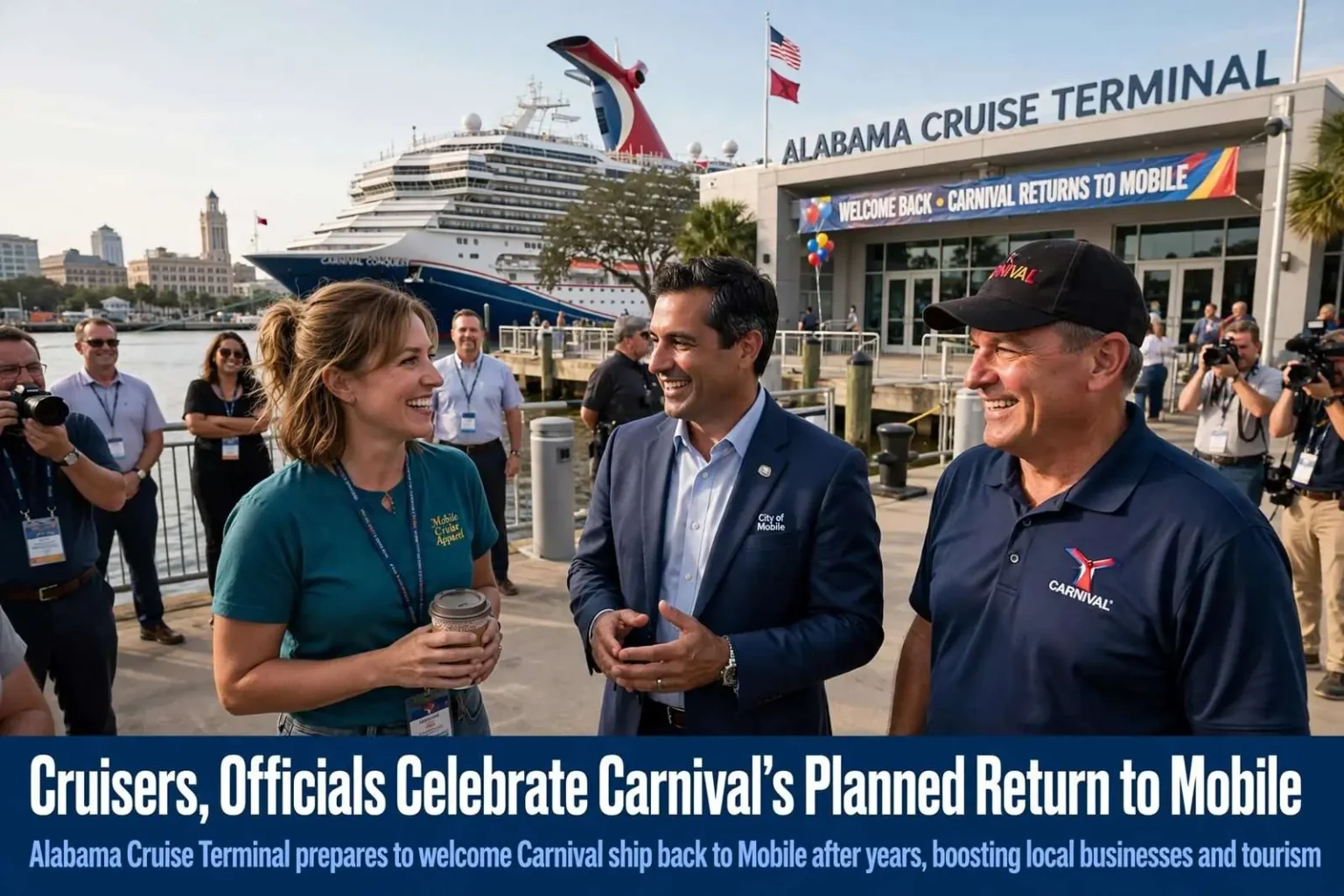
Word that Carnival Cruise Line was preparing to bring a ship back to South Alabama set off an immediate wave of enthusiasm among longtime cruisers, downtown business owners and state tourism officials, many of whom said the announcement had been years in the making. For a port city that watched its cruise industry sail away, the news landed as both an economic story and a personal one — proof that Mobile could win back a piece of the Gulf Coast cruise market it once hosted.
A Mobile resident who runs a cruise apparel business said that within 24 hours of hearing the news, she had created a Facebook group for cruisers interested in sailing out of the Alabama Cruise Terminal. The group swelled to more than 500 followers on its first day and grew to nearly 800 by the following afternoon, filled with posts about past cruises, favorite excursion stops and hopes for the returning ship’s itinerary. “Cruisers love to talk about cruising. It’s an exciting thing,” she said, adding that she had long noticed there wasn’t a dedicated online community for Mobile-based cruisers before creating the page.
The speed of that growth illustrates how much pent-up demand had accumulated since ships last sailed from the riverfront terminal. Cruising from a home-state port changes the math for Gulf Coast vacationers: no airfare, no airport parking, no baggage fees — just a drive downtown, a short check-in and a ship. The Facebook group’s early members spent their first days comparing notes on cabins, excursion packages and the logistics of boarding from Mobile, rebuilding a community that had scattered to other homeports years earlier.
The excitement wasn’t limited to social media. A managing editor at one of the largest online cruise review communities said the port’s announcement drew a surge of enthusiastic comments from users who described an emotional connection to Mobile as a cruise departure point. Review sites tend to light up when a line returns to a former homeport, and the comments about Mobile echoed a familiar theme among Gulf Coast cruisers: fondness for an easy embarkation experience and a desire to sail from close to home again.
Real Money for Downtown
For downtown Mobile, the return of cruise traffic carries real financial stakes. The general manager of a riverfront hotel said Carnival’s 2011 departure had cost the city’s hotels roughly $1 million in lost annual revenue and about 100,000 room nights combined. A 2009 economic study had found the cruise industry generated $11.6 million a year in local economic impact while ships were sailing from Mobile.
Those figures capture only part of the effect. Cruise passengers who arrive the night before a sailing fill hotels, eat in downtown restaurants and visit attractions along Dauphin Street and the riverfront, and many extend their trips to explore the Gulf Coast after disembarking. Parking revenue near the terminal, taxi and rideshare trips, and pre-cruise shopping all ride on the same foot traffic. When the ships left, those dollars shifted to New Orleans and other competing homeports; the announcement signals an attempt to bring them back across the state line and into Mobile County’s economy.
Travel Agents See a Built-In Market
Travel agents around the state also welcomed the news. Because the Alabama Cruise Terminal functions as a “drive-to” facility, appealing to vacationers within a four-to-five-hour drive who can reach Western Caribbean itineraries without flying, agents in North Alabama said they expected strong interest from customers along the Interstate 65 corridor and beyond, including neighboring states.
That catchment area is one of the terminal’s greatest assets. Birmingham, Montgomery, Huntsville, the Florida Panhandle and the Mississippi Gulf Coast all sit within a reasonable drive of the Mobile River, putting a cruise vacation within reach of families who might balk at the cost of flying a household of four to a Florida port. Drive-to cruising expanded dramatically across the industry as lines recognized the appeal of homeports near population centers without major airports, and Mobile’s location taps directly into that market.
Western Caribbean itineraries from the Gulf of Mexico typically put ships within easy sailing distance of popular ports in Mexico, Honduras, Belize and the Cayman Islands — routes that Gulf-based ships have served for decades. For the returning Mobile ship, such itineraries would recreate the product that drew repeat cruisers to the terminal before 2011, when the port hosted Carnival ships on year-round sailings.
State Leaders and the Terminal’s Story
State leaders also weighed in on the announcement, viewing the return through the lens of Alabama’s broader tourism economy. The Alabama Cruise Terminal opened on the Mobile River in downtown Mobile in the mid-2000s, part of the city’s push to revitalize its riverfront and diversify the port city’s economy beyond cargo and heavy industry. Carnival based ships there for years, carrying hundreds of thousands of passengers through the terminal before economics reshuffled the line’s fleet and the sailings ended in 2011.
The departure was a blow measured in more than hotel receipts. Cruise terminals generate steady, visible activity — Embarkation days bring thousands of visitors through downtown in a single morning, and the terminal’s schedule gives hotels a predictable midweek and weekend customer base. Local officials have spent the years since exploring ways to keep the facility in use, and the prospect of cruise operations resuming represents the highest-profile possible answer to that question.
For the cruisers who filled the new Facebook group within hours, the announcement is more personal than economic. Many described sailing out of Mobile as their introduction to cruising at all — a first vacation aboard a ship they could reach without a plane ticket. Their eagerness to book again from the same dock suggests the market that supported the terminal in its first era never disappeared; it simply had nowhere local to go. If the returning ship’s itineraries match what Gulf Coast cruisers have been asking for, downtown Mobile may soon hear the boarding announcements that went quiet in 2011.
What the Return Means Going Forward
The weeks ahead will tell whether the initial enthusiasm converts into bookings. Cruise lines measure homeport performance by load factors — how full each sailing runs — and a strong start from Mobile would strengthen the case for keeping a ship based there long term. Travel industry watchers note that Carnival has returned to former homeports before when demand justified it, and the surge of online activity following the Mobile announcement is exactly the kind of signal lines look for.
For local businesses, the practical preparation has already begun. Hotels near the terminal will market cruise-park-and-sleep packages, restaurants plan for embarkation-day crowds, and the apparel seller whose Facebook group grew overnight expects demand for Mobile-branded cruise gear to follow. If the ships return as planned, the measure of success will look much like it did before 2011: full decks on Saturday afternoons, a busy riverfront, and the $11.6 million annual footprint the study once documented returning to downtown Mobile.
City officials have long argued that a cruise ship’s presence also raises Mobile’s visibility as a visitor destination in its own right. Every embarkation day puts thousands of out-of-town drivers on the downtown streets, many of whom arrive early to explore the USS Alabama Battleship Memorial Park across the bay, the historic districts and the museums that anchor the city’s tourism offerings, then return home planning a longer visit.
The Broader Cruise Picture on the Gulf
Mobile’s re-entry into cruising comes as Gulf homeports have become some of the busiest in the industry. Galveston, New Orleans and Tampa collectively host millions of cruise passengers a year, serving the same drive-to population that once boarded in Mobile. The competition among Gulf ports for ships and itineraries is constant, and ports that let a homeport relationship lapse often find the capacity reallocated elsewhere. Mobile’s announcement reflects a deliberate effort to re-enter that contest with the market fundamentals — location, highway access, terminal infrastructure — that made the port viable in the first place.
The timing also coincides with strong industry-wide demand, with cruise lines adding capacity and travelers showing sustained appetite for Caribbean itineraries. A renewed Mobile deployment would tap into that demand while offering something the larger ports cannot: a smaller, easier embarkation experience with shorter lines and a terminal minutes from downtown lodging.
Whether the Facebook group’s 800 members represent the vanguard of a sustained booking wave remains to be seen, but the first-day numbers caught the attention of local tourism watchers. Community organizing around a homeport — sharing cruise tips, coordinating group sailings and swapping excursion reviews — has historically extended far beyond the initial core of enthusiasts, and Mobile cruisers now have a gathering place they lacked during the years without local sailings.