Six Months Later: Mobile Family Shares Journey with Baby Born Without a Nose
A Mobile family marks six months since their son Eli was born at a Baldwin County hospital with an exceptionally rare condition, congenital arhinia.
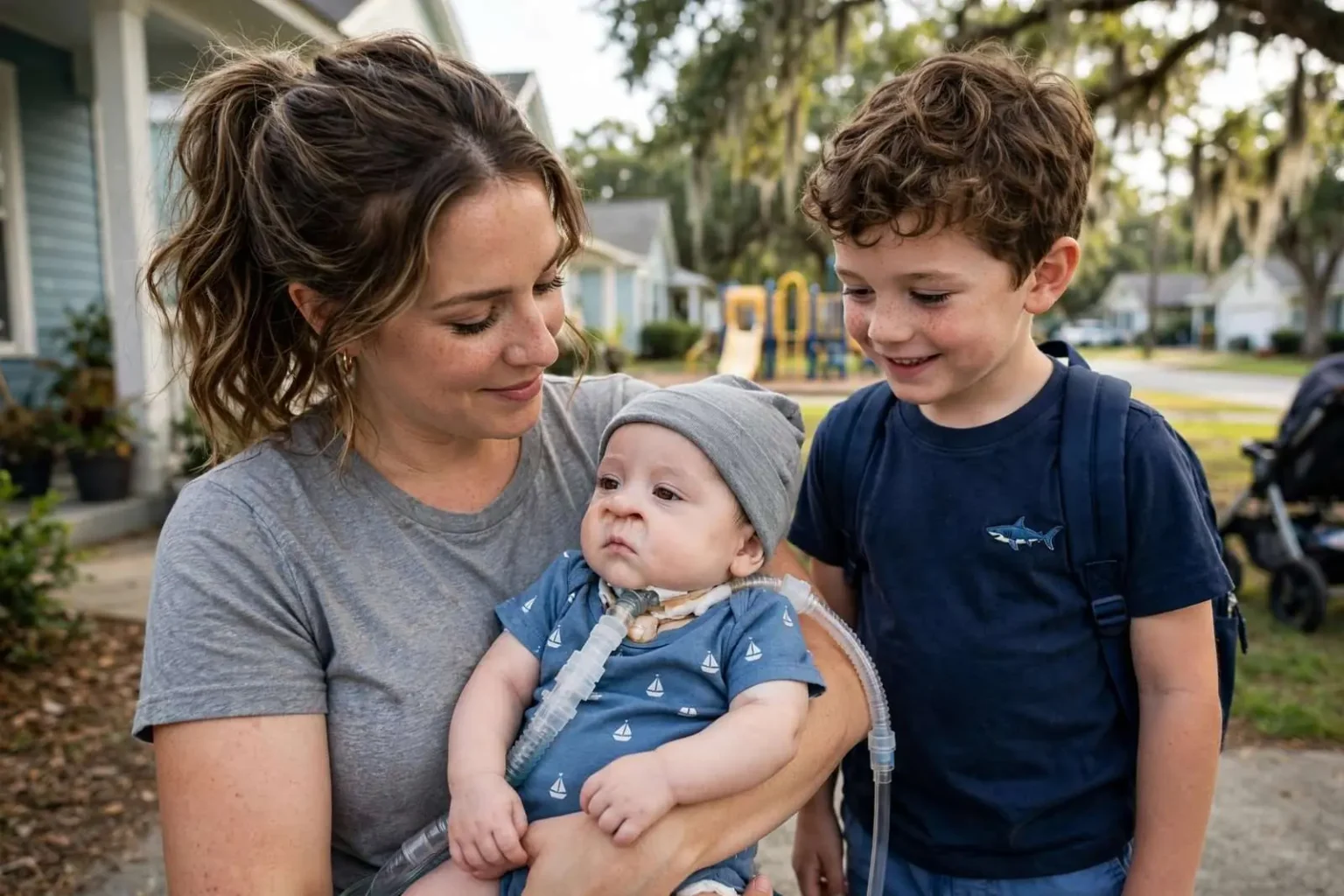
A Mobile-area family is marking a milestone this month as their infant son reaches six months old, continuing to defy the odds tied to an exceptionally rare medical condition. Timothy, called Eli by his family, was born March 4 at South Baldwin Hospital in Foley, and doctors and his own mother were stunned to discover the otherwise healthy newborn did not have a nose.
Brandi McGlathery, Eli’s mother, said her pregnancy seemed typical aside from unusually persistent morning sickness. Routine prenatal scans gave no indication anything was wrong, and it wasn’t until delivery that anyone realized her son had complete congenital arhinia, a condition so uncommon that medical literature places the odds at roughly one in 197 million births, with only a few dozen documented cases worldwide.
A Condition Few Doctors Ever See
Congenital arhinia is the absence of the nose at birth, an anomaly so rare that most physicians will never encounter a single case in an entire career. Because the nasal passages play a central role in breathing, feeding and even the sense of smell, babies born without a nose face immediate challenges in the delivery room and require specialized care to establish a safe airway. Medical literature describes only a small number of documented cases around the world, and each family’s course is different, depending on which related structures are affected.
For the first hours of Eli’s life, his care team at the Foley hospital worked to stabilize him and arrange the specialized treatment he would need. South Baldwin Regional Medical Center in Foley serves the growing southern end of Baldwin County, but the rarity of the condition meant Eli’s care would quickly move beyond what a community hospital could provide.
Within days of his birth, Eli was transferred to a Mobile children’s hospital, where surgeons performed a tracheotomy to help him breathe. A tracheotomy creates a direct opening in the windpipe below the level of the nose and mouth, bypassing the upper airway entirely and allowing the baby to breathe safely despite having no nasal passages. He spent more than three weeks in the hospital before he was well enough to go home.
A Family Rebuilt Around a New Routine
Since then, the family has relocated from Summerdale to Mobile, settling into a neighborhood McGlathery chose partly for its central playground, where Eli’s older brother, Brysen, can play. The move put the family closer to the hospitals and specialists Eli will rely on as he grows, an increasingly common calculation for families of medically complex children across the Gulf Coast, where sub-specialty pediatric care is concentrated in the Mobile area.
Life with a tracheotomy requires constant attention. Families in this situation learn to manage the airway at home, keeping suction equipment on hand and watching for any sign of blockage, and the routine reshapes nearly every part of daily life, from sleep to travel to childcare arrangements. Despite the demands, McGlathery has described her son as a happy, growing baby who is meeting milestones in his own way.
Brysen recently celebrated his fifth birthday and started kindergarten, a milestone his mother said the family celebrated alongside Eli’s own steady progress. The two brothers anchor a household that has been thrust into public view over the past several months, first through local coverage of Eli’s birth and then through the online following that grew out of it.
McGlathery, who works as a bartender in downtown Mobile, said she hopes to eventually train as a neonatal intensive care nurse, drawing on her family’s own experience navigating a hospital stay with a medically complex baby. Parents of children with rare conditions often describe the weeks spent at a hospital bedside as an education of their own, and for McGlathery the experience has pointed toward a career caring for newborns facing their first fights.
A Following That Spans the World
Eli’s story drew wide attention earlier this year after local coverage of his birth, and a Facebook page McGlathery created to document his progress has since grown to more than 167,000 followers from around the world. Supporters regularly check in for updates on Eli’s development, from small victories to more difficult stretches.
The page has become a daily habit for thousands of families, many of them parents of children with rare diagnoses who say seeing Eli thrive offers hope for their own journeys. Online communities built around rare conditions frequently serve that dual purpose, giving the family a way to share news on their own terms while connecting with others who understand the unique pressures of caring for a medically fragile child.
Among the milestones the family has celebrated: Eli tried solid food for the first time in late May, managing applesauce despite the feeding challenges that come with his anatomy. Introducing solids is a cautious, closely watched process for any baby, and for a child with congenital arhinia the swallowing and breathing coordination involved makes each new food a genuine accomplishment.
Six months in, the family measures progress in increments outsiders might overlook. A settled night of sleep, a new sound, a steady gain at a checkup, each carries weight in a household where the first weeks of Eli’s life were spent in a hospital. McGlathery has used the page to share both the hard days and the good ones, a candor that followers often say is part of why they keep coming back.
What Comes Next for Eli
Long-term, children with congenital arhinia typically work with teams of specialists as they grow, with decisions about any reconstruction or airway management made over years rather than months. Surgical options exist but are approached carefully and staged over a childhood, and families generally balance medical interventions against quality of life as their child develops. Eli’s own path will be shaped by how he grows and what his care team recommends along the way.
For now, the family is focused on the present: a brother adjusting to kindergarten, a mother balancing work and caregiving, and a six-month-old whose progress continues to draw an audience far beyond Mobile. As one milestone gives way to the next, the followers who have watched since March will be checking in, and the family says the support has carried them through the stretches when the days were hardest.
Word of Eli’s birth spread quickly through Baldwin and Mobile counties in the days after March 4, and the family soon found itself fielding calls and messages from news outlets far beyond the Gulf Coast. The attention brought practical help along with it, from words of encouragement to offers of support, but it also meant the family’s most private moments were suddenly matters of public interest. McGlathery has managed that balance through the Facebook page, choosing what to share and keeping the focus on her son’s day-to-day progress rather than on the spectacle of his diagnosis.
The rarity of congenital arhinia means there is no established playbook for families in McGlathery’s position. A condition that affects one in roughly 197 million births produces, statistically, only a handful of cases per generation worldwide, so each family essentially builds its own network of surgeons, therapists and fellow parents. The internet has changed that equation in recent years, allowing scattered families to compare notes on everything from tracheotomy care to feeding strategies that no single hospital could offer on its own.
Medical literature on the condition remains thin for the same reason. Documented cases number in the few dozen worldwide, and much of what doctors know comes from individual case reports rather than large studies. That reality shapes the care Eli receives: his specialists in Mobile are building his treatment plan case by case, drawing on the general principles of pediatric airway management while adapting to the specifics of his anatomy as he grows.
Baldwin County, where Eli was born and where the family lived in Summerdale before the move, sits across Mobile Bay from the city where his care is now centered. The drive between the two is a familiar one for thousands of Baldwin families who rely on Mobile’s hospitals for specialized care, and the McGlatherys’ decision to relocate reflects a practical trade-off many parents of medically complex children eventually face, trading a shorter commute to work or familiar surroundings for proximity to the doctors their child depends on.
As Eli moves into the second half of his first year, the family’s calendar will fill with the routine appointments that structure life for children with significant medical needs, from checkups with his airway specialists to developmental visits that track his progress against typical milestones. Babies with tracheotomies can and do grow into active toddlers, and many eventually have the tube removed once their airway is secure, though the timeline varies widely from child to child.
Whatever comes, the family says the six-month mark is a moment to pause and take stock. Six months ago Eli was a newborn fighting to breathe in a Foley delivery room; this month he is a growing baby trying applesauce, watching his brother head off to kindergarten, and charming a following that spans continents. For the community that has watched his story unfold since March, each update from the family is measured against where he started, and by that standard the milestones keep coming.