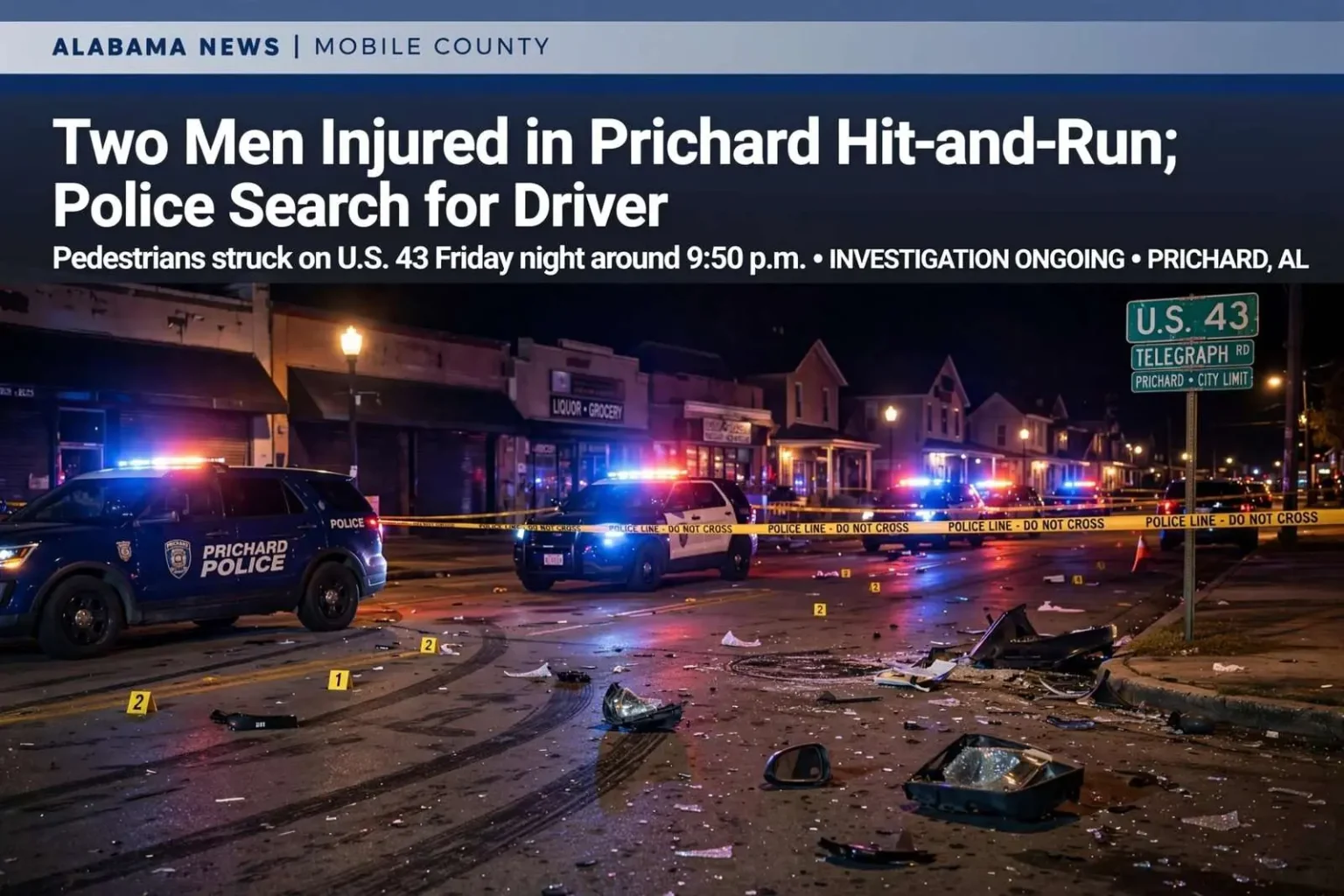
Two men were struck in a hit-and-run in Prichard on Sept. 5 around 9:50 p.m. Both men were injured in the accident, according to police. Prichard police are investigating and are still searching for the driver who hit the men. Officials described the case as a developing story and said they will provide more information as it becomes available.
The incident occurred on a Friday night in Prichard, the Mobile County city of roughly twenty thousand residents that sits just north of Mobile along the U.S. 43 corridor. Officers responded to reports of two pedestrians struck by a vehicle shortly before ten o’clock, and by the time they arrived the driver involved had already left the scene, setting off both a medical response and a search for whoever was behind the wheel. The two injured men received treatment for their injuries, though police have not released details about their conditions or where they were taken for care.
Hit-and-run investigations present some of the most difficult challenges in municipal policing. With the vehicle and driver gone, detectives must build the case from what remains: debris from the striking vehicle scattered along the roadway, skid marks or scuffs that indicate direction and speed, camera footage from businesses and residences nearby, and statements from anyone who witnessed the moments before and after the impact. Each fragment narrows the search for the vehicle involved, and investigators in the Mobile County area have solved cases on the strength of a single bumper fragment or a partial license plate caught by a doorbell camera.
How Investigators Track a Driver Who Left the Scene
The first hours matter most in a hit-and-run case. Patrol officers canvas the area for witnesses and canvas nearby streets for damaged vehicles that may have been abandoned or parked behind a residence. Detectives then request surveillance footage from businesses along the route, since commercial camera systems in the Prichard area frequently cover parking lots that border the main corridors. Paint transfer, grille pieces, mirror housings and headlight fragments can identify a vehicle’s make and model with precision, and body shops in the Mobile area are sometimes alerted to watch for cars arriving with fresh damage that matches the crash.
Legal consequences in Alabama give drivers strong reason to stay on scene, and investigators emphasize that point whenever they appeal for information. Leaving the scene of an injury crash is a felony under state law when someone is hurt, and the penalties rise sharply if a victim dies. A driver who remains, renders aid and calls 911 faces a far lighter path through the courts than one who flees and is later identified. In cases like this one, the search for the driver continues alongside the investigation into the crash itself, and prosecutors treat the flight from the scene as an aggravating circumstance when charges are filed. Officers also note that panic, not malice, drives some drivers to leave, which is why every public appeal includes the same instruction: if you were involved, contact investigators now, because coming forward voluntarily is always treated differently than being found after a manhunt.
Prichard’s Roads and Nighttime Risks
Prichard’s street grid includes busy commercial arteries such as U.S. 43 and Telegraph Road, industrial corridors, and long stretches of residential streets where lighting is sparse outside the main intersections. Nighttime pedestrian crashes are a persistent risk in communities of this profile, where sidewalks are inconsistent and residents walk along road shoulders to reach bus stops, stores and jobs. Traffic safety researchers note that most fatal pedestrian strikes occur in darkness, and that visibility, both the driver’s ability to see and the pedestrian’s chance of being seen, is the decisive factor in many of these collisions.
For the neighborhood where Friday night’s crash occurred, the immediate aftermath brings patrol presence and questions. Residents who live along the route often hold details that seem too small to matter, a car speeding past with a dragging bumper, the sound of impact followed by footsteps, a vehicle seen turning onto a side street with its hazard lights on. Police departments in the Mobile area repeatedly credit those small observations with identifying drivers in pedestrian cases, and investigators will be following up on any reports that come in during the days ahead.
The timing of the crash, shortly before ten on a Friday night, is itself a line of investigation. Investigators map what was happening along the corridor at that hour, which businesses were still open with cameras running, which churches or events had just dismissed crowds, and what traffic patterns might have put the victims on foot near the roadway. Establishing the victims’ own movements before the crash, where they were coming from and where they were headed, helps detectives confirm the location of the impact and the direction the striking vehicle would most plausibly have taken afterward. In pedestrian cases, that timeline of ordinary movements frequently provides the breaks that the physical evidence alone cannot.
The Victims’ Path After a Pedestrian Crash
Pedestrian strikes produce injuries that range from broken bones and road rash to head trauma and internal injuries, and recovery timelines stretch from weeks to years depending on the severity. For the two men hurt in Friday night’s crash, the practical road ahead likely includes emergency treatment, follow-up specialist care and time away from work, and the absence of an identified driver complicates the financial side of that recovery. Until the vehicle’s insurer is known, victims in hit-and-run cases often turn first to their own auto policies, which can include uninsured motorist coverage that applies to pedestrian victims, and to the Alabama Crime Victims’ Compensation Commission, which assists with certain out-of-pocket costs for victims of violent crime.
When the driver is identified, criminal charges typically follow in parallel with the civil process. Prosecutors weigh the injury severity, the driver’s conduct before the crash, and the flight itself when deciding what counts to file, and a conviction for leaving the scene of an injury crash carries prison exposure along with license revocation. Victims and their families are entitled to input at sentencing under state law, and the criminal case’s outcome frequently shapes the civil claims that follow against the driver and the vehicle’s owner.
What Police Are Asking From the Public
Officials characterized the case as developing, which means the information released so far is limited and will grow as the investigation progresses. Prichard police will update the public as they identify the vehicle, locate the driver or learn more about the victims’ conditions, and the department’s investigators remain the central point of contact for anyone with information. Witness statements can be provided directly to the department, and tipsters in Mobile County cases can also route anonymous information through Crimestoppers, which offers rewards for tips that lead to arrests.
The questions that help most in a pedestrian hit-and-run are specific: the direction the striking vehicle traveled before and after the crash, its color and approximate size, any visible damage, and the exact time a resident heard the impact or noticed unusual activity outside. Vehicle parts found near the scene, even fragments picked up by a passerby days later, can hold paint or manufacturing marks that identify the car involved. Investigators urge people not to assume a detail is too minor to report.
Preventing the Next One
Pedestrian safety advocates in the Mobile area have pressed for years around the kinds of improvements that reduce nighttime strikes: better street lighting on residential corridors, marked crosswalks and lighting at bus stops, and enforcement of speed limits on the arteries where pedestrians are most exposed. Drivers, for their part, are reminded to slow down in rain and darkness, to watch for pedestrians on shoulders in areas without sidewalks, and to stay at any crash scene no matter how minor it appears, since the decision to flee converts an accident into a felony investigation.
A Developing Story in a Close-Knit City
Prichard’s residents follow local cases closely, and hit-and-run investigations in the city have historically benefited from community engagement. Neighborhood associations and church groups along the affected corridor often organize to share official updates, and word of mouth moves quickly in the city’s tight residential districts. Police said they will provide more information as it becomes available, and the department’s public appeals will likely grow more specific as investigators firm up their description of the vehicle involved. Residents are encouraged to monitor official channels rather than rely on speculation, since accurate details released by investigators are what generate useful tips.
For now, the focus in Prichard remains on the two injured men and on identifying the driver who left them on the roadway Friday night. Police said they will provide more information as it becomes available, and residents of the neighborhoods along the corridor will be watching for those updates, hoping for word of both a recovery and an arrest.