House Budget Plan Keeps Three Littoral Combat Ships on Track for Austal USA
A House subcommittee budget proposal continues funding for three Littoral Combat Ships, sustaining work at Mobile's Austal USA shipyard.
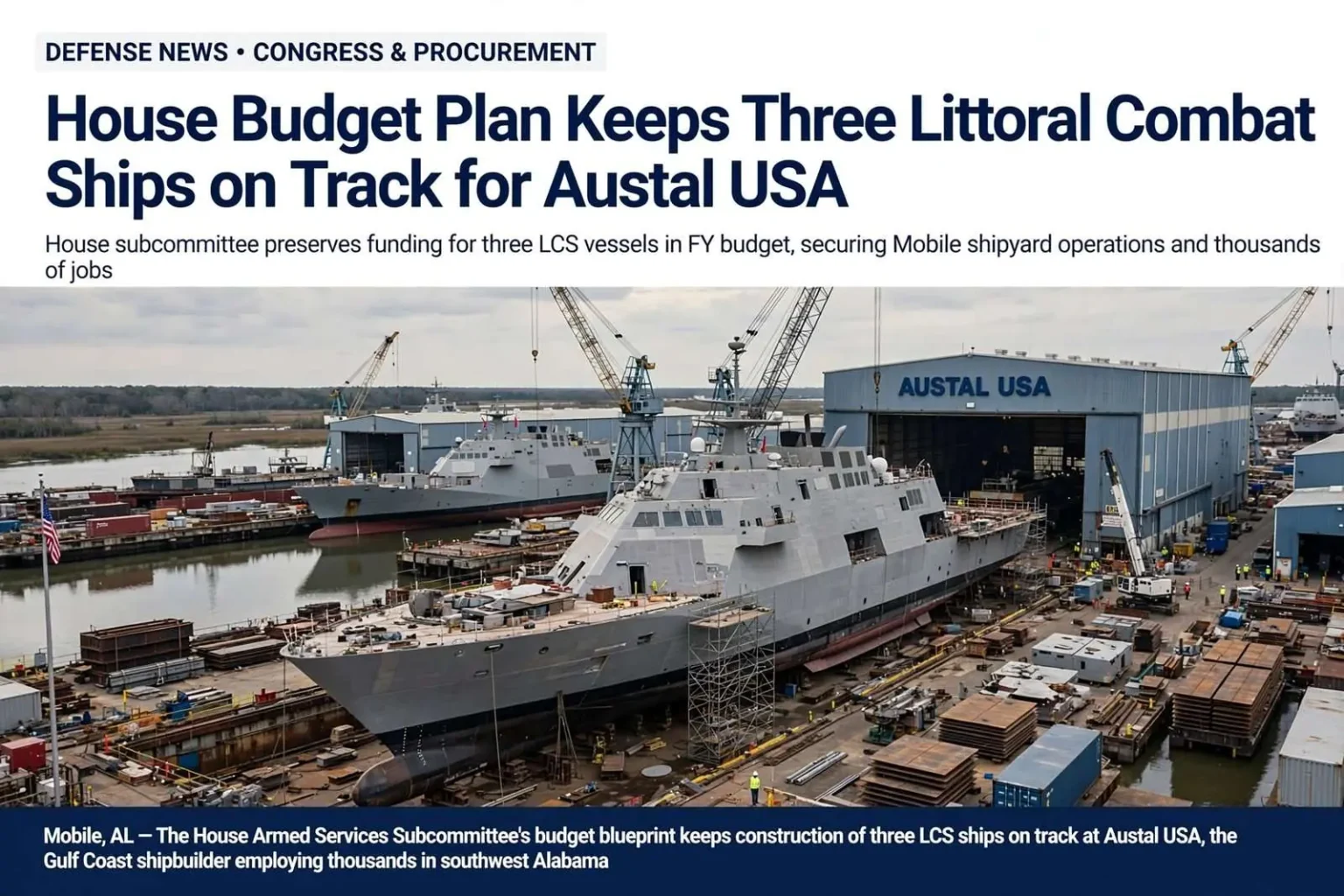
A U.S. House of Representatives subcommittee released a defense budget blueprint this week that keeps funding in place for three littoral combat ships in the fiscal year beginning in October, a move with direct consequences for Mobile’s largest private shipbuilder.
The House Armed Services Subcommittee on Seapower and Projection Forces was scheduled to formally discuss the proposal the following day. The document calls for continuing construction of three LCS vessels, matching the current fiscal year’s total — a steady drumbeat that, for the shipyards involved, is the difference between planning a future and preparing for a layoff.
Mobile-based Austal USA is currently building two of the three ships slated for this fiscal year, with the Navy expected to determine next year’s shipyard allocation by March. The split between the program’s two builders — Austal on the Gulf Coast and rival Lockheed Martin, whose LCS variant is built at a shipyard in Wisconsin — has been decided year by year through the budget process, making every spring’s allocation announcement the most anticipated date on Mobile’s shipbuilding calendar.
Why Mobile watches the defense budget
Keeping full funding intact for the LCS program has been a priority for U.S. Rep. Bradley Byrne, R-Fairhope, who sits on the subcommittee and represents the Mobile area in Congress. The program directly supports thousands of jobs at Austal’s Mobile River shipyard, making the annual defense budget process closely watched locally each year.
Byrne’s seat on the panel that drafts Navy shipbuilding accounts gave southwest Alabama an unusually direct line to the decisions that keep its shipyard busy. In a region where a single industrial employer can anchor thousands of households, the congressman’s annual advocacy for the LCS line item functioned as local economic policy conducted through the appropriations process — and local officials tracked each subcommittee mark, committee vote and floor amendment with the attention other districts reserve for a plant closing.
The shipyard’s footprint on the Mobile River had grown into one of the largest industrial operations on the Gulf Coast. Austal’s facility — a complex of fabrication halls, outfitting piers and workforce training operations — rivaled the region’s traditional industries, and its supply chain stretched across hundreds of vendors in Alabama and neighboring states. Economists who studied the shipyard’s impact counted not just direct employees but the electricians, pipefitters, transport firms and service businesses that depend on the yard’s payroll cycling through the regional economy.
A program under scrutiny
The littoral combat ship program has had a rocky recent history. Former Defense Secretary Chuck Hagel raised concerns about the vessel’s design and combat capability during a Pentagon review, casting some uncertainty over its future. After that lengthy review concluded, the Defense Department announced in December that it would move forward with an upgraded version of the ship, effectively preserving continued production by both LCS contractors: Austal in Mobile and Lockheed Martin at a facility in Wisconsin.
The review’s conclusion mattered enormously for Mobile. Hagel’s skepticism — questioning whether the lightly armed, fast, modular LCS could survive and contribute in a era of more capable naval rivals — had opened the possibility of capping the program far short of its planned fleet, a scenario that would have left both shipyards without a product line. The December decision to continue with an upgraded design preserved the production line and the workforce, pending the annual funding fights.
The upgraded version addressed the core criticisms: improved warfare capabilities in the hulls’ mission packages, better self-defense systems and refinements drawn from the first ships’ early operations. The Navy’s strategy for the class — a fast, flexible surface combatant that swaps mission modules for mine countermeasures, surface warfare or anti-submarine work — remained debated among analysts, but the Pentagon’s decision ended the immediate question of whether the ships would be built at all.
The rest of the Navy’s wish list
Beyond the littoral combat ships, the subcommittee’s broader budget blueprint touches on several other major Navy programs. It continues support for the Ford-class aircraft carriers that are gradually replacing the older Nimitz-class fleet, backs the purchase of two new Arleigh Burke-class destroyers and two Virginia-class submarines, and funds an afloat forward staging base along with a new amphibious ship design.
Each line item carries its own industrial story. The Ford-class carriers, the most expensive warships ever built, sustain the Virginia shipyard workforce and a national supplier base. The Arleigh Burke destroyers, the Navy’s workhorse surface combatant, run at two shipyards on the Atlantic and Gulf coasts. The Virginia-class submarines are built jointly by two yards, and the afloat forward staging base — a converted commercial vessel type that extends the Navy’s reach in coastal waters — has its own building history involving Gulf Coast yards. The proposed new amphibious ship design, if it advances, would open another competition that yards like Austal’s, experienced in high-speed aluminum vessel construction, would watch closely.
The plan also proposes increasing Tomahawk cruise missile purchases to nearly 200 and would maintain 11 cruisers in the fleet while limiting their maintenance periods to two years. The cruiser question was a live one in fleet planning — the aging Ticonderoga-class ships had been slated for retirement in waves, and Congress had repeatedly pushed back, reluctant to retire missile defense capacity the Navy considered surplus to requirements. The two-year maintenance cap addressed a different complaint: ships that sat in extended overhauls for years, consuming modernization money without deploying.
For defense-minded members of Congress, the blueprint’s overall shape reflected a familiar tension: a Navy shrunk from its Cold War size, facing expanding commitments in the Pacific and the Middle East, trying to preserve both current fleet strength and the shipbuilding industrial base that would be nearly impossible to rebuild if it collapsed. That second consideration — industrial base preservation — is the argument that most directly protects programs like the LCS, and it is the argument Mobile’s representatives make most consistently.
What it means for the Gulf Coast
For Mobile, the headline item remains the LCS program. Continued production keeps Austal’s workforce busy and preserves the shipyard’s role as one of the two national suppliers of the vessel class, a status that has become an economic anchor for the region since Austal began building ships in Mobile years ago.
The yard’s presence has reshaped Mobile’s industrial identity in a single generation. A city whose shipbuilding memory ran through the World War II-era yards that once lined the river — yards that built vessels at a pace the modern Navy can scarcely imagine — had watched heavy industry drift away before the Australian shipbuilder’s arrival restored the trade. By the time this budget cycle arrived, Austal’s operation stood among the largest aluminum shipbuilding facilities in the world, and the pipeline of skilled welders, fabricators and shipfitters it trained had become a regional asset in its own right.
The workforce numbers explain the local intensity. A shipyard’s hires run to thousands at full production, with wages above the regional industrial average and apprenticeship programs that give workers without college degrees a path to a skilled trade. Each year of the LCS program represents not just ships but a hiring class, a training pipeline and a supply chain — and each gap in production risks sending those workers to other industries, other cities, or out of the workforce altogether. Shipbuilding workforces, industry officials warn, cannot be reassembled quickly once dispersed.
That is why the March allocation announcement looms as large as the budget itself. The Navy’s decision on how next year’s three-ship buy divides between Austal and Lockheed Martin determines hiring plans in Mobile and Marinette, Wisconsin, alike. A split favors both yards’ continuity; a concentration in either direction raises the stakes for the yard left short. Local economic development officials in Mobile had learned to parse the signals — Navy testimony, contract awards, steel and aluminum orders — months before any formal announcement.
The road through Congress
As the subcommittee’s proposal moves through the broader defense appropriations process in Washington, local officials and shipyard workers alike will be watching to see whether the funding survives further budget negotiations before the fiscal year begins.
The path from subcommittee mark to enacted budget runs through the full House Armed Services Committee, the House floor, the Senate’s parallel process and a conference committee reconciling the two chambers — with the possibility of a continuing resolution, or worse, extending past the October 1 fiscal year start and freezing new starts. Shipbuilders plan production schedules around the assumption of on-time appropriations; a late budget ripples through material orders and hiring the same way a delayed tide ripples through a harbor.
The subcommittee’s blueprint, by preserving three LCS ships and the wider Navy accounts, gave Mobile’s shipyard the clearest signal it could ask for at this stage. Whether the number holds through the Senate, the conference and the president’s signature will be measured in Mobile not by headlines but by the steady rhythm of a working shipyard: steel moving through the fabrication halls, hull sections joining on the ways, and the launch calendar that turns a budget line into a ship on the Mobile River. For the city that built the Liberty and Cargovec ships of another era, the annual defense budget is not an abstraction in Washington — it is the year’s most important industrial forecast, delivered in October and watched from the dockside all year long.