Mobile NAACP Launches ‘Mass Meetings’ on Policing and Community Power
The Mobile County NAACP launched a series of community meetings on policing, urging residents to pursue change locally through voter engagement.
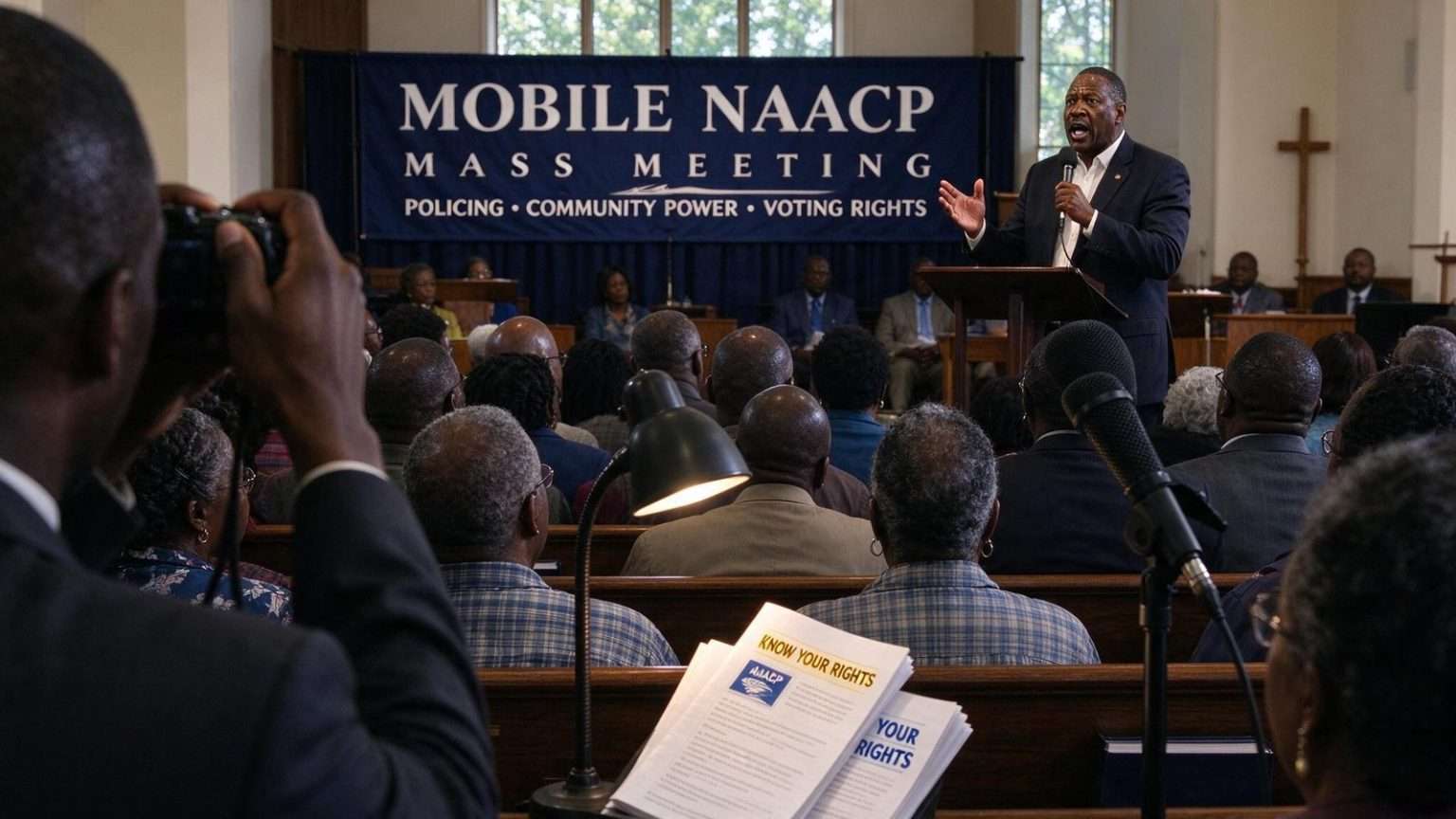
MOBILE, Alabama — Dozens of residents packed Grace and Truth Fellowship Church this week for the first of what organizers say will be a series of NAACP mass meetings focused on how communities interact with police and how voters can influence local law enforcement policy. The gathering filled pews with residents from across Mobile County, part of a wave of community forums that swept the country amid a national debate over policing.
Mobile County NAACP President Ronald Ali told the crowd the gathering was meant to spark change, framing the conversation around a string of high-profile police killings of unarmed Black men and women nationally, including Michael Brown, Eric Garner and Walter Scott. Those cases — in Ferguson, Missouri, on Staten Island, and in North Charleston, South Carolina — had ignited protests and a national conversation about use of force, and Ali told the audience that the issues behind the headlines had arrived at Mobile’s doorstep.
Redress Co-Chair Richmond Henderson argued that much of the tension between residents and police stems from a broader culture of aggressive policing nationally, one he said too often frames encounters as a matter of officer survival rather than community service. Henderson cited data suggesting at least 14 unarmed people had died at the hands of police nationally since early 2012, and urged attendees to pursue change through the ballot box rather than confrontation.
As he spoke, branch secretary Mary Walker distributed pamphlets outlining residents’ rights and offering guidance on how to interact safely with law enforcement during a stop, including reminders that everyday items can be mistaken for weapons. The pamphlets walked through the basics of a traffic stop — keep hands visible, ask before reaching for documents, remain calm and polite — and the constitutional protections that apply when police question or search a person.
Political Engagement as the Path to Change
Prichard City Councilman Lorenzo Martin told the crowd that political engagement, not protest alone, offers the clearest path to changing how police operate locally, noting that police chiefs are hired by mayors and confirmed by city councils, officials chosen directly by voters.
Martin’s point was structural: the people who set policing policy in Mobile County’s municipalities are on the ballot every few years, and departments take their direction from the officials who hire their chiefs and approve their budgets. A community that wants different policing, he argued, needs to elect different councils and mayors — and hold the ones it elects accountable between elections.
Martin, drawing on his own upbringing in Mobile County’s Trinity Gardens neighborhood, argued that conditions in Black neighborhoods across the county remain remarkably similar regardless of city limits, and said that reality helps explain why so many young men end up in trouble with the law. Trinity Gardens, a community inside Mobile’s city limits, and Prichard, the small city just to its north, share economic struggles that do not stop at a municipal line — and neither, he said, do the policing problems that grow out of them.
A Branch Rebuilding Its Tradition
The mass meeting format is a deliberate callback for the NAACP, which built much of its 20th-century organizing strength in the South around church gatherings just like this one. Mass meetings were where communities heard reports, planned legal challenges, registered voters and rehearsed the speeches that would carry their grievances to city hall. Reviving the format in Mobile is both practical and symbolic — a way to reach residents where they already gather, and a reminder that the organization’s local muscle was built in rooms like Grace and Truth Fellowship.
The Mobile branch is one of the oldest continuously operating NAACP units in Alabama, part of a civil rights infrastructure in the city that stretches back generations. Its redress committee, which Henderson chairs, is the mechanism through which the branch fields discrimination complaints and pushes institutions for correction, and meetings like this one serve as both a listening session and a recruitment drive.
Organizers said the series is intended to move beyond talk. Each meeting is designed to leave attendees with something concrete — the rights pamphlets Walker distributed, registration information, and a clearer map of which elected officials control which lever of policing policy. The branch’s leadership has framed voter registration and turnout as the through-line of the series, connecting every discussion of police conduct back to the ballot box.
The National Moment Behind the Meetings
The meetings arrive at a moment when police-community relations have dominated national news. The deaths of Michael Brown in Ferguson, Eric Garner in New York and Walter Scott in North Charleston prompted Department of Justice investigations, consent decrees and body-camera mandates in departments across the country, and they pushed concepts like community policing and use-of-force reform into city council agendas far beyond the cities where the cases arose.
For local branches of the NAACP, the national conversation is both an opening and an obligation. National attention brings resources and allies, but it also brings expectations: residents want to know what their local branch is doing, and local officials face pressure to show they are responsive. The Mobile branch’s answer has been to build a sustained local forum rather than a single, cathartic rally — hence the plan for a series of meetings across the county.
Organizers said the Mobile branch intends to hold similar meetings in other parts of the county in the coming months, though a specific schedule had not yet been finalized. Potential sites include Prichard, where Martin serves on the council, and communities across the county where branch leaders say the same concerns about policing and political voice are shared.
Trinity Gardens, Prichard and the County’s Shared Struggles
Martin’s biographical argument carried particular weight in the room. Trinity Gardens, where he grew up, is one of Mobile’s historic Black communities, and its economic conditions — like those of Prichard, the neighboring city he now represents — have been shaped by decades of disinvestment, industrial encroachment and the slow erosion of stable jobs. Speakers at the meeting said those conditions feed directly into the policing dynamics the branch is organized around: communities with few economic ladders produce more contact between young men and law enforcement, and more of that contact turns dangerous.
Prichard’s own story illustrates the point. Once a manufacturing and shipbuilding hub, the city has struggled for decades with the loss of industrial employment, shrinking tax revenues and repeated fiscal crises, even as Mobile and the Eastern Shore have grown around it. City leaders there have juggled public safety needs against budgets that can barely sustain basic services, and the police department’s staffing and resources have reflected that strain.
The county’s map makes the problem structural rather than local. Mobile County contains the city of Mobile, a cluster of smaller municipalities like Prichard, Chickasaw, Saraland, Satsuma, Creola, Mount Vernon and Theodore-area unincorporated communities, each with its own police force or sheriff’s coverage. Conditions in Black neighborhoods repeat across those lines — and so, Martin argued, does the remedy: voters in every one of those jurisdictions hold the power to change who leads their police.
What the Branch Hopes to Build
Between the historical framing and the structural argument, the branch has laid out a clear theory of change: inform residents of their rights in encounters with police, register them to vote, and organize them around the elections that determine who hires police chiefs and sets department policy. The mass meetings are the engine for all three.
The pamphlet distribution that Walker led is a piece of that strategy that costs nothing and travels easily — copies change hands at churches, barbershops and family gatherings long after the meeting ends. Branch leaders said they plan to keep the materials flowing at each stop of the series, and to pair them with voter registration tables at future meetings.
For Ali, the series is also about sustaining momentum between crises. National headlines bring crowds; the branch’s work happens in the months between them. If the meetings in Prichard, Semmes, Saraland and elsewhere in the county draw even half the crowd that packed Grace and Truth Fellowship, organizers said, the branch will finish its series with a wider network of engaged voters than it started with — and a longer list of residents who know their rights, and know which ballot they count on.
The meeting closed with the practical business that NAACP branches have always handled in such gatherings: sign-up sheets for membership, announcements of upcoming county commission and city council meetings where policing budgets would be discussed, and reminders about the state’s voter registration deadlines ahead of the next municipal elections. Branch officers said turnout at the first meeting exceeded expectations, and they credited the church setting and word-of-mouth promotion through the county’s Black churches for the packed house.
Grace and Truth Fellowship’s role reflects the historical partnership between Alabama’s churches and the civil rights movement, a relationship that stretches back to the Montgomery Bus Boycott and the mass meetings of the 1950s and 1960s. Churches provided meeting places that were relatively safe from interference, communication networks that reached every corner of the Black community, and moral leadership that sustained organizing through difficult years.
Branch leaders said the series will return to that playbook deliberately. Each meeting will combine the informational core — rights materials, political education, updates on branch activity — with the fellowship that keeps people coming back, and each will be hosted in a different part of the county so that the burden of travel falls on the organization rather than the community.
For now, the branch is counting the first meeting as a start: dozens of residents informed of their rights, dozens more registered or reminded to check their registration, and a county that will see the NAACP’s mass meetings again in the months ahead — in Prichard, in north Mobile County and wherever the branch finds a church with room for the crowd.