Orange Beach Officials Rebuke Wharf Over Widespread Panic Booking
Orange Beach leaders criticized The Wharf's decision to book jam band Widespread Panic, citing past strain on police and fire resources.
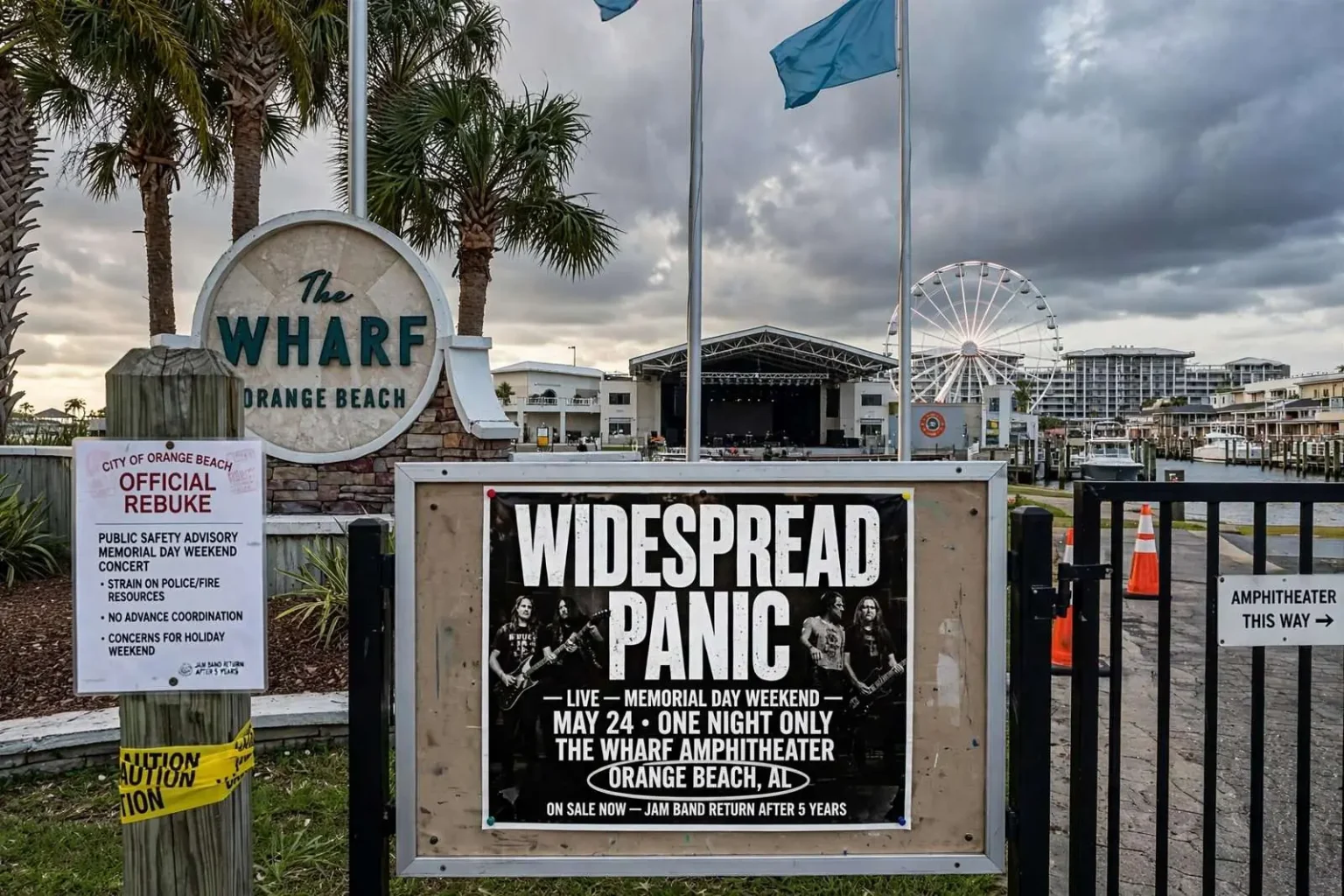
Orange Beach officials publicly criticized management at The Wharf’s amphitheater this week after learning the venue had booked jam band Widespread Panic for a Memorial Day weekend show, five years after the group’s last appearance in the city. The announcement set off an unusually public confrontation between city hall and one of the resort town’s premier entertainment venues, laying bare a long-running tension between Orange Beach’s efforts to market itself as a family destination and the demands placed on municipal services when the band’s famously devoted following comes to town.
Birmingham-based Red Mountain Entertainment announced the band’s return for a one-night performance in May, prompting a pointed exchange at a city council meeting between Mayor Pro Tem Jeff Silvers and The Wharf’s general manager. Silvers said the band’s fan base has historically pushed local police and fire departments to their limits, describing a previous multi-night run as “pure mayhem” for city resources. According to Silvers, Orange Beach Mayor Tony Kennon had already emailed the promoter and the property’s ownership roughly two weeks before the announcement to express concern about a potential booking, but the message apparently did not prevent the show from being scheduled.
Silvers told the venue’s general manager that the added strain on police and fire staffing during a peak holiday weekend was unacceptable, describing behavior tied to past shows that included fans camping in vacant garages and bathing at the beach. Memorial Day weekend is already among the busiest stretches of the year along the Alabama Gulf Coast, with beaches, restaurants, roads and lodging near capacity before a single concert ticket is sold. Layering a large, multi-day influx of concertgoers on top of the holiday crowd, council members argued, leaves little margin for the department staffing and emergency response the city normally depends on during the unofficial start of summer.
A contentious history with the band
The amphitheater’s history with the band dates back to 2007, when a two-night engagement became the 10,200-seat venue’s first sellout. The shows cemented the open-air venue’s reputation as a regional concert destination and demonstrated the drawing power the band commands along the Gulf Coast, where its followers will travel from multiple states for a run of shows. But the same loyalty that fills seats also brings challenges of a kind few other acts present, because fans routinely arrive days early and stay days late, treating a concert weekend as a full vacation.
A three-night run in 2008 proved to be the most demanding for local police, resulting in 147 arrests ranging from underage drinking to felony drug charges. The volume of incidents tied to a single band’s engagement was unlike anything else on the venue’s calendar, and it became the reference point city officials have cited ever since when discussing the costs of hosting the group. A similar three-night stand in 2009 saw far fewer arrests, suggesting that lessons from the prior year had changed something in the planning or the policing, and a two-night show in 2010 did not sell out, a stretch coinciding with the uncertainty of the Deepwater Horizon oil spill, which clouded the entire summer tourism season across the Alabama and Florida coasts.
An understanding the city believed was in place
Since that last appearance, city leadership believed an informal understanding was in place with venue management that acts drawing the same crowd as Widespread Panic would no longer be booked in Orange Beach. Mayor Kennon reiterated that stance at the meeting, saying the city has worked to brand itself as a family-friendly destination, a reputation that drives the coastal economy through beach tourism, boating, fishing and sports tournaments that fill hotels with parents and children rather than festival crowds. The decision to book the band without a resolution of the city’s concerns struck council members as a breach of that understanding, and the public dressing-down of the venue’s manager reflected years of accumulated frustration rather than a single dispute over one show.
The Wharf occupies a central place in Orange Beach’s entertainment economy. The mixed-use development along the Intracoastal Waterway includes the amphitheater, shops, restaurants, condominiums, a marina and the Ferris wheel that has become a landmark visible from the Foley Beach Express approach. Concerts there bring significant business to surrounding restaurants and retailers, and the city does not dispute the value of a healthy live-music calendar. The dispute is narrower: which acts, on which dates, and with what advance coordination about public safety staffing. Council members emphasized that their objection is not to concerts generally but to the specific strain this band’s appearances have historically produced during an already congested holiday weekend.
The economics of a Memorial Day weekend show
A Memorial Day date carries both promise and peril for a coastal resort town. On the promise side, holiday weekends bring the largest available audience, with visitors already in town and lodging occupied, which is precisely why promoters prize the slot. On the peril side, emergency services have no spare capacity to lend. Police departments along the Baldwin County coast routinely bring in extra officers for holiday weekends, and fire and rescue units run at full stretch with the beach crowds. A concert that generates its own surge of visitors, including some who camp in vacant garages, bathe at the beach and congregate in parking areas around the venue, multiplies call volumes in a weekend when every available responder is already committed.
City officials’ frustration centered on communication as much as on the booking itself. The mayor’s advance email to the promoter and the property’s ownership was, in the council’s view, an opportunity for the venue to raise the issue, adjust the date, or work out a staffing plan before the announcement went public. The decision to proceed anyway, announced by the Birmingham-based promoter without prior resolution, is what turned a routine booking into a public confrontation at a council meeting.
What happens next
The show remains scheduled, and the public dispute leaves open questions about how the weekend will be managed. Options discussed in similar situations along the Gulf Coast include coordinated police details around the venue, agreements with the venue’s private security, and advance planning with neighboring jurisdictions for mutual aid. The city’s experience from the 2009 run, when arrests dropped sharply from the 2008 levels, suggests that planning and staffing decisions make a measurable difference, even for the most demanding acts on the calendar.
For residents, the episode is a reminder of the balancing act that defines life in a resort city: the same visitors who sustain the economy test its infrastructure at peak moments, and the decisions about which events to host — and when — shape both the tax base and the quality of life in the neighborhoods around The Wharf. Council members made clear that they expect a seat at the table for future bookings of this magnitude, and the venue now knows that its schedule will be read as closely at city hall as it is by concertgoers across the region.
The broader context matters for understanding the city’s position. The amphitheater’s 2007 sellout marked a turning point for the young venue, proving it could host national touring acts at scale, and the years that followed built a calendar heavy on classic rock, country and jam-band audiences who travel well. Orange Beach has grown alongside it, from a small fishing and beach community into one of the fastest-growing cities in Alabama, with a permanent population that swells dramatically in summer. Growth of that kind raises the stakes of every weekend: what a small town could absorb informally, a city of tens of thousands of seasonal visitors must plan for formally.
Whether the informal understanding between the city and the venue survives this episode may shape the amphitheater’s calendar for years to come. Promoters value predictability on both sides of the equation, and a public rupture makes future negotiations harder for everyone. If the two sides can convert the dispute into a working protocol — advance notice, joint staffing reviews for high-demand acts, and honest accounting of the costs past shows have imposed — the city may find that its objection was less about one band than about establishing who decides what the busiest weekend of the year looks like in Orange Beach.
For now, the announcement stands, and fans who have waited five years for the band’s return will get their show. The city’s council members, for their part, have served notice that hospitality and public safety will be negotiated together going forward — and that in a town whose identity rests on its family beaches, the memory of a 147-arrest weekend carries more weight than any single night at the box office.
Residents and business owners around the development will be watching the holiday weekend closely, both for the traffic the show brings and for the example it sets about how the city and its venues share the burden of big events.