Pentagon backs upgraded combat ship, securing Austal shipbuilding jobs in Mobile
Defense Secretary Chuck Hagel endorsed an upgraded littoral combat ship design, ensuring continued production at Mobile's Austal USA, the county's largest employer.
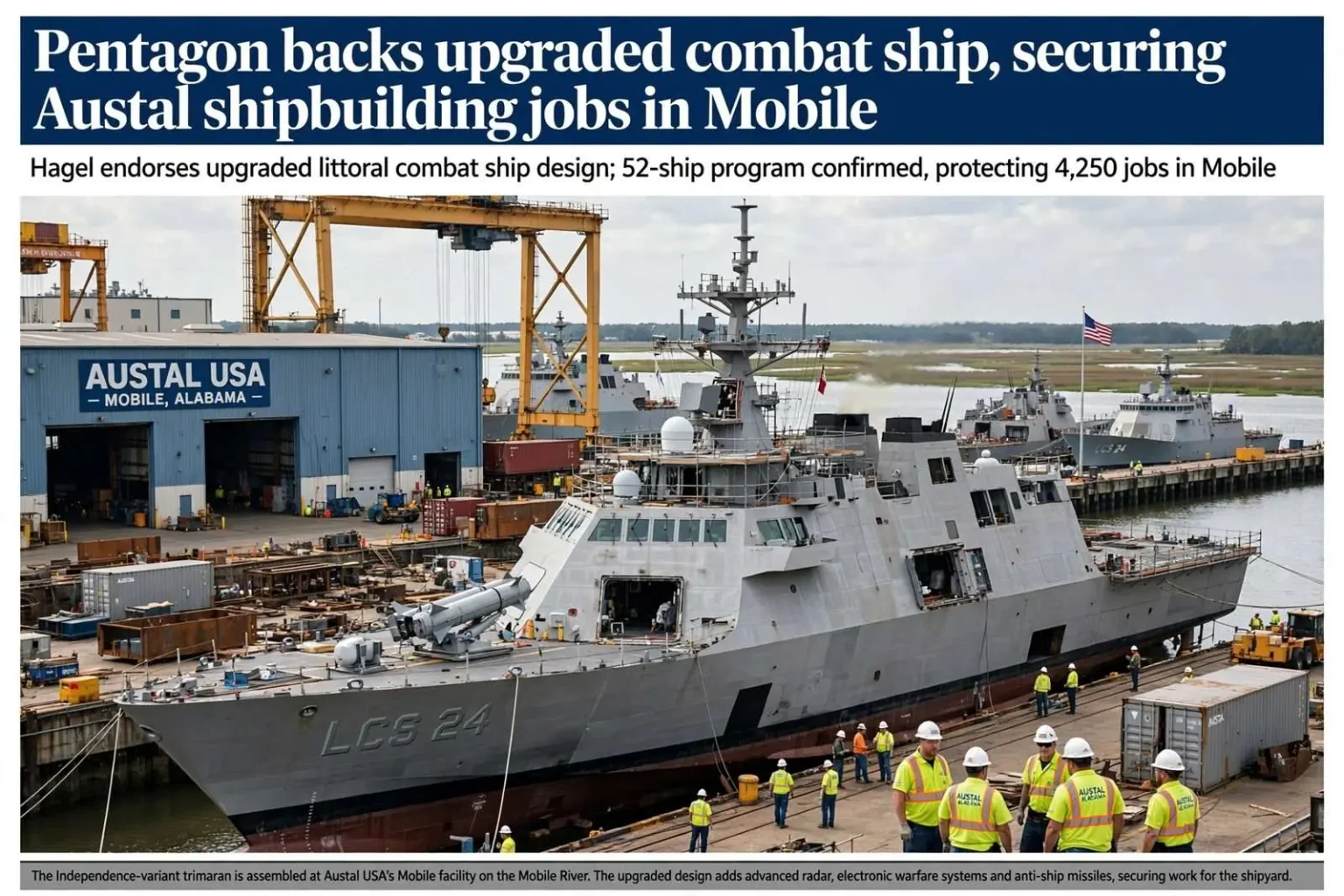
A key decision out of the Pentagon promised to keep shipbuilding jobs flowing at Mobile’s Austal USA, as Defense Secretary Chuck Hagel endorsed a plan to build an upgraded version of the littoral combat ship. The move offered reassurance to one of Mobile County’s largest employers and the thousands of workers who depend on the program.
Hagel had ordered a top-to-bottom review of the LCS earlier in the year after critics raised questions about the small, fast vessel’s firepower and its ability to survive enemy attack. During that review, the Pentagon froze production at 32 ships while military leaders weighed the program’s future, leaving some uncertainty hanging over the yards that build the vessels.
A more lethal, more survivable ship
The announcement resolved much of that uncertainty. Hagel said the Navy would stick with its planned 52-ship order, with the exact split between the original LCS and a new, more capable “small surface combatant” to be worked out based on the Navy’s future needs. The upgraded design was slated to include an improved air-defense radar, better electronic warfare systems, an over-the-horizon anti-ship missile and other enhancements aimed at making the ship more lethal and more survivable.
Austal, one of two shipyards building the LCS, welcomed the news. In a prepared statement, the company said it was excited to be part of the program and believed the Navy could more fully tap the capabilities of its Independence-variant design while meeting the fleet’s needs for years to come. Company officials said they planned to meet with the military in the following days to learn exactly how the transition would work, though it appeared the new features would need to be folded into the ship’s design at both Austal and a partner shipyard in Wisconsin.
A major Mobile employer
The stakes were especially high along the Mobile River. Since its modest start in 1999, Austal had grown into Mobile County’s largest industrial employer, with a workforce of roughly 4,250 at the time, much of that expansion driven by the LCS contract. A decision to abandon the program in favor of an entirely new ship could have disrupted that industrial base.
U.S. Rep. Bradley Byrne, a Republican from Montrose who had made protecting the LCS a priority since taking office, praised the decision. He called the ship “the future of the naval fleet” and argued that upgrading the existing variants would preserve the industrial base while avoiding the costs of launching a brand-new program. Byrne, who had pressed Hagel on the issue at a congressional hearing earlier in the year, framed the outcome as validation of a long campaign to shore up support for the vessel.
For the shipbuilders and their families on the Gulf Coast, the practical message was clear: the work was set to continue, and the region’s growing role in the Navy’s fleet appeared secure for the foreseeable future.
Why the program’s future mattered so much
The littoral combat ship program had become the backbone of Austal’s Mobile operation. The yard’s Independence-variant hull, a distinctive trimaran design, is built in modules that flow through giant fabrication halls before final assembly and launch on the Mobile River. Each ship represents years of sustained work for welders, pipefitters, electricians and engineers, and a steady production rhythm is what allows the company to keep hiring and training new workers.
That rhythm was precisely what the Pentagon’s review put at risk. When Hagel froze production at 32 ships early in the year, defense analysts openly discussed options that ranged from capping the fleet at that number to canceling the remaining ships outright and starting over with a new design competition. Either path would have thinned the workload at Mobile and at the Wisconsin yard, where a competing design, the Freedom variant, is built by a different shipbuilder for the same program.
What the upgrade means for Mobile’s shipyard
Folding new combat systems into an existing design is a major engineering task, but it is far less disruptive than designing a new ship class from a blank page. Austal’s Independence variant carries the internal volume and electrical capacity to host additional sensors and weapons, which company officials have long argued makes it a natural fit for the upgraded small surface combatant role. The work ahead involves integrating the new radar and missile systems into the hull’s arrangement without disturbing the production flow that keeps roughly 4,250 workers employed.
The transition also has scheduling implications. Ships already under construction will continue in their current configuration, while later hulls in the 52-ship order are expected to incorporate the upgraded features. Navy and industry officials were expected to work out those details in meetings in the days after the announcement, determining how many of the remaining ships would be built to the enhanced standard and how the work would be divided between Mobile and the Wisconsin yard.
Local economic development officials followed the Pentagon’s review closely for exactly those reasons. Austal’s growth since 1999 has transformed the Mobile River waterfront, drawing suppliers, subcontractors and skilled workers to the area and anchoring a broader Gulf Coast shipbuilding cluster that also includes major Navy and Coast Guard work nearby. Studies of the region’s maritime economy have consistently identified the yard as an anchor employer whose contracts ripple through trucking, fabrication, hospitality and housing across Mobile County.
Byrne’s campaign on Capitol Hill
Byrne had been among the loudest voices on Capitol Hill arguing against any retreat from the program. At a congressional hearing earlier in the year, he pressed Hagel directly on the review’s scope and on the consequences of cutting the fleet, warning that abandoning a production line mid-build is one of the most expensive mistakes the Pentagon can make. The workforces in Mobile and Wisconsin had become a recurring talking point in the debate, cited by lawmakers from both coasts of the shipbuilding divide.
The congressman’s argument carried extra weight because it was rooted in cost arithmetic rather than sentiment. Killing the LCS and launching a replacement program would mean years of design work, new tooling and a gap in production before the first replacement hull took shape, all while the Navy faced shrinking budgets. Upgrading the existing design, by contrast, preserved the industrial base and kept delivering ships to the fleet during the transition.
Byrne’s statement after the announcement called the upgraded ship “the future of the naval fleet” and cast the decision as vindication for the yards and their workers. For a first-term congressman whose district includes the yard, the outcome was also a concrete demonstration that the region’s delegation could move Pentagon policy, a point local officials noted as they looked ahead to future budget fights.
For now, the immediate uncertainty that hung over the Mobile River for most of the year has lifted. Production continues, hiring continues, and the Navy’s order book still runs to 52 ships. The harder question, how quickly and how smoothly the upgraded design takes shape, will be answered on the waterfront over the years ahead, one module at a time.
Critics of the LCS had focused on two vulnerabilities: the ship’s light armament compared with larger Navy destroyers, and questions about whether an aluminum-hulled, high-speed vessel could survive damage in a combat environment. Supporters, including the Alabama congressional delegation, countered that the ship’s speed, shallow draft and modular mission packages made it a uniquely flexible tool for operations close to shore, from counter-piracy patrols to mine countermeasures.
Hagel’s decision essentially split the difference. The Navy keeps the ships it has ordered, but the follow-on versions will be built to a tougher specification, with the radar, electronic warfare and missile upgrades meant to answer the survivability critique without starting from scratch. For the shipyards, the message was that their production lines stay open while their product evolves.
What the upgrade means for Mobile’s shipyard
Folding new combat systems into an existing design is a major engineering task, but it is far less disruptive than designing a new ship class from a blank page. Austal’s Independence variant carries the internal volume and electrical capacity to host additional sensors and weapons, which company officials have long argued makes it a natural fit for the upgraded small surface combatant role. The work ahead involves integrating the new radar and missile systems into the hull’s arrangement without disturbing the production flow that keeps roughly 4,250 workers employed.
The transition also has scheduling implications. Ships already under construction will continue in their current configuration, while later hulls in the 52-ship order are expected to incorporate the upgraded features. Navy and industry officials were expected to work out those details in meetings in the days after the announcement, determining how many of the remaining ships would be built to the enhanced standard and how the work would be divided between Mobile and the Wisconsin yard.
Local economic development officials followed the Pentagon’s review closely for exactly those reasons. Austal’s growth since 1999 has transformed the Mobile River waterfront, drawing suppliers, subcontractors and skilled workers to the area and anchoring a broader Gulf Coast shipbuilding cluster. Studies of the region’s maritime economy have consistently identified the yard as an anchor employer whose contracts ripple through trucking, fabrication, hospitality and housing across Mobile County.
Byrne’s campaign on Capitol Hill
Byrne had been among the loudest voices on Capitol Hill arguing against any retreat from the program. At a congressional hearing earlier in the year, he pressed Hagel directly on the review’s scope and on the consequences of cutting the fleet, warning that abandoning a production line mid-build is one of the most expensive mistakes the Pentagon can make. The workforces in Mobile and Wisconsin had become a recurring talking point in the debate, cited by lawmakers from both coasts of the shipbuilding divide.
The congressman’s argument carried extra weight because it was rooted in cost arithmetic rather than sentiment. Killing the LCS and launching a replacement program would mean years of design work, new tooling and a gap in production before the first replacement hull took shape, all while the Navy faced shrinking budgets. Upgrading the existing design, by contrast, preserved the industrial base and kept delivering ships to the fleet during the transition.
Byrne’s statement after the announcement called the upgraded ship “the future of the naval fleet” and cast the decision as vindication for the yards and their workers. For a first-term congressman whose district includes the yard, the outcome was also a concrete demonstration that the region’s delegation could move Pentagon policy, a point local officials noted as they looked ahead to future budget fights.
For now, the immediate uncertainty that hung over the Mobile River for most of the year has lifted. Production continues, hiring continues, and the Navy’s order book still runs to 52 ships. The harder question, how quickly and how smoothly the upgraded design takes shape, will be answered on the waterfront over the years ahead, one module at a time.