Irvington Democrat Scott Buzbee Launches Challenge to State Sen. Ben Brooks
Scott Buzbee of Irvington announced a Democratic bid against Republican Sen. Ben Brooks in District 35, arguing south Mobile County has gotten talk instead of results in Montgomery.
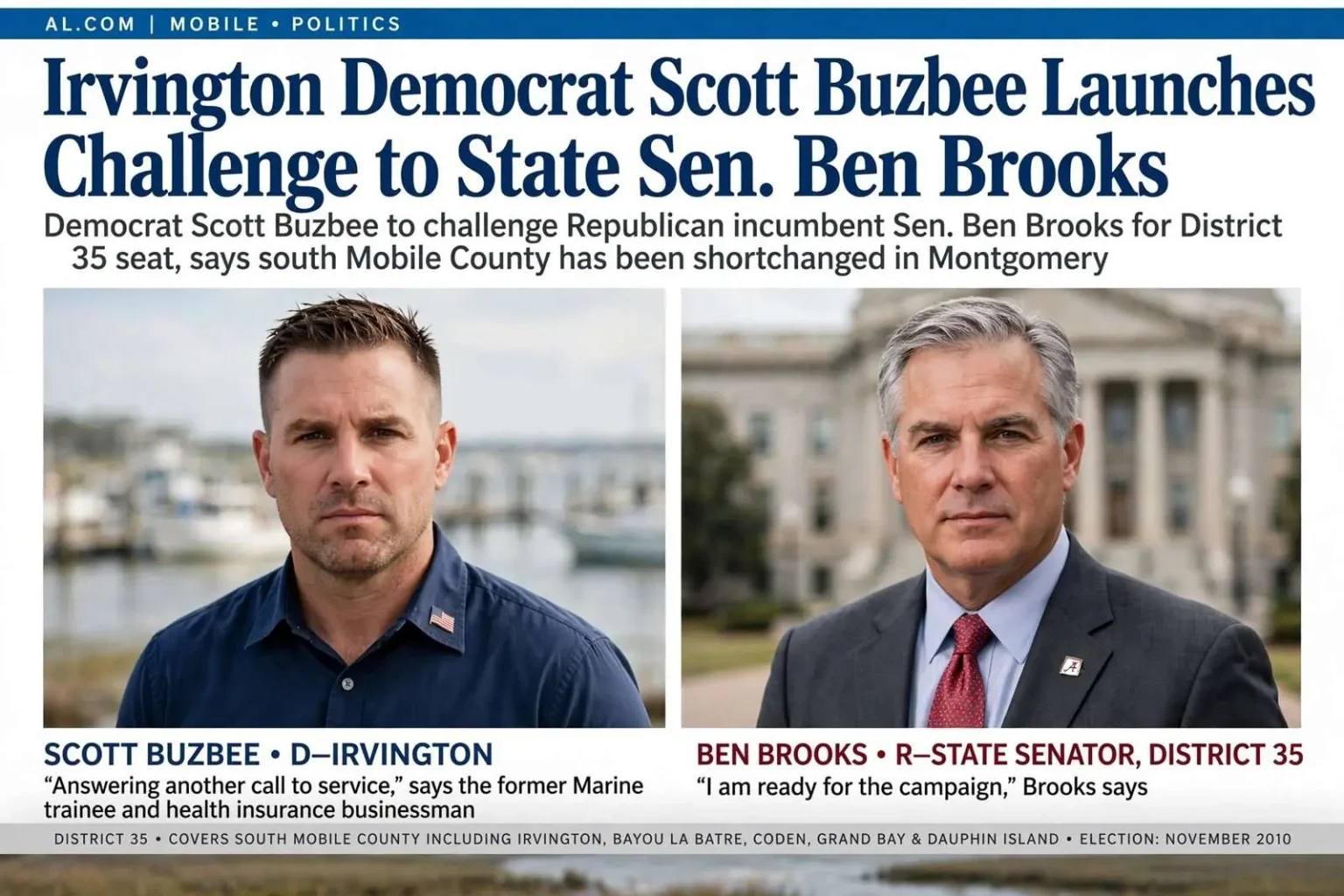
Democrat Scott Buzbee of Irvington announced he will challenge Republican state Sen. Ben Brooks for the District 35 seat in this fall’s elections, framing his campaign around a claim that south Mobile County has been shortchanged in Montgomery.
Buzbee, who describes himself as a fiscal and social conservative motivated by family and faith, said in a news release announcing his candidacy that he was answering another “call to service.”
A campaign built on service and frustration
An injury during training with the U.S. Marine Corps kept him from deploying overseas after the Sept. 11 attacks, Buzbee said, but it did not dampen the impulse that sent him to a recruiter in the first place.
“I looked on TV, saw America under attack, saw our police and firemen and military putting their lives in harm’s way, and was led to answer the call of duty for our nation,” Buzbee said.
His run for the Legislature, he said, grows out of a different sense of threat: “the professional politicians who are more interested in serving themselves and playing politics than standing up for the people.”
The framing was deliberate. Candidates who cannot claim military service often borrow its vocabulary — duty, sacrifice, answering the call — but Buzbee’s version was grounded in his own attempt to serve: a young man who went to a recruiter after the attacks, trained, and was injured before he could deploy. The story gave his candidacy a biography of attempted service that few challengers can match, and it connected directly to the district’s deep military ties, from the shipyard workers of Pascagoula across the bay to the veterans scattered through every south Mobile County community.
Taking aim at the incumbent
Buzbee’s criticism of Brooks was direct. He called the senator “a professional politician who has been totally ineffective at getting results for South Mobile County.”
“Whether it’s the economy, jobs, support for our schools, or even the problem of insurance reform there has been more talk than results,” Buzbee said. “Many good bills for South Mobile County have passed the House only to see Sen. Brooks ineffective in passing them in the Senate. That must change.”
The charge was a standard one in legislative challengers’ playbooks — blame the incumbent for the district’s unmet needs — but Buzbee sharpened it with a procedural claim: bills for the district had cleared one chamber and died in the senator’s own. The claim invited voters to evaluate Brooks not on visibility but on legislation delivered, a standard against which any senator in a minority party faces structural headwinds.
Insurance is a live wire in the district. Coastal homeowners in Irvington, Bayou La Batre, Coden, Grand Bay and Dauphin Island have watched wind and hail premiums climb sharply since Hurricane Katrina, and legislation aimed at the insurance market has been a recurring — and recurringly stalled — topic in the State House.
No issue was better suited to the challenger’s argument. After Katrina, private insurers retrenched across the Gulf Coast, dropping policies and raising rates, and south Alabama’s coastal communities found themselves in a tightening market where a wind policy could cost several times what it had before the storm. Homeowners insurance became, for coastal residents, both a household crisis and a proxy for whether state government cared about their corner of Alabama. Legislative sessions produced proposals — state-backed wind pools, premium relief, regulatory changes — that moved slowly and satisfied no one, leaving every coastal incumbent exposed to the same charge Buzbee leveled: more talk than results.
Brooks, for his part, offered a short reply: “I am ready for the campaign and I look forward to the campaign.”
The brevity was itself a message. An incumbent facing a little-known challenger in a favorable district has no reason to engage on the challenger’s terms — no rebuttal of specific claims, no debate about the record, nothing that would elevate the race beyond its natural handicap. Brooks’s one-sentence response signaled that his campaign would run on incumbency, party advantage and the district’s Republican lean, not on a counter-attack.
A candidate who criticizes both parties
Notably, Buzbee did not limit his complaints to Republicans. He accused politicians in both parties of taking pay raises while constituents lose jobs, and he made an explicit appeal to voters drawn to the tea party movement then gaining momentum across south Alabama.
“Some say wait four years, but I don’t know that our state and our country can wait for four more years,” Buzbee said. “The politicians are doing what they do best which is to play politics, take pay raises despite people losing jobs, and that goes for many in both parties. I believe with all my heart that Democrats, Republicans, Independents and the many good people in the Tea Party want a change.”
The strategy was unusual for a Democratic nominee in south Alabama and entirely conscious of the district he was running in. District 35 stretches across some of the most conservative territory in Mobile County, where the Democratic Party’s national brand was, in 2010, an active liability. The only way a Democratic label could be survivable there was to make the campaign about something other than party — and the tea party wave, which had begun organizing across the Gulf Coast in the months after the 2009 healthcare debates, supplied both the mood and the vocabulary.
Buzbee’s appeal to “Democrats, Republicans, Independents and the many good people in the Tea Party” was an attempt to stand in the middle of that current. He criticized the national Democratic Party by implication, embraced the insurgents’ anti-establishment argument, and positioned himself as a conservative who happened to carry the wrong label rather than a liberal running in the wrong district.
He said his platform would be pro-life, low tax and in favor of less government — a positioning that places him well to the right of his party’s national brand and reflects the political geography of a district that stretches through some of the most conservative precincts in Mobile County.
That platform — social conservatism fused with fiscal conservatism — was less a departure than a restoration in the context of south Alabama Democratic politics. The party’s conservative wing had historically dominated local offices across south Alabama, and even as the region’s voters shifted Republican at the top of the ticket, conservative Democrats continued to hold legislative seats by running on the same values as their Republican neighbors. Buzbee’s candidacy was a bet that the tradition still had life in it, one more cycle at least.
The candidate
Buzbee attended Theodore High School before graduating from Alba High School in Bayou La Batre, and later graduated from the University of Mobile. He and his wife, Brandie, have four children. He and his father have worked together in the health insurance business for many years.
The biography was built for the district. Theodore and Bayou La Batre — the fishing village that Katrina had devastated and that shrimpboats built — are communities where local roots count for more than credentials, and a candidate who crossed between their schools carried a story every south Mobile County family recognized. The University of Mobile, a private Baptist institution, added a faith-inflected credential that fit the self-description of a man motivated by family and faith.
He and his father have worked together in the health insurance business for many years.
That experience as a small businessman, Buzbee said, will prove valuable in confronting government spending — a claim that gives him a way to talk about insurance costs, a signature coastal grievance, from the standpoint of someone who sells policies rather than merely buys them.
The health insurance background was the quiet asset in the campaign. Every coastal homeowner in the district lives inside the insurance question — wind policies, premiums, cancellations — and a candidate who had spent years in the industry could claim fluency in the mechanics of the problem: how rates are set, why carriers leave, what regulatory levers actually exist in Montgomery. Whether that fluency translated into a legislative program was a question for the campaign, but the credibility it conferred was Buzbee’s to spend.
The stakes in District 35
Senate District 35 covers a broad swath of Mobile County, and Brooks has held it as a Republican in a legislature where the Democratic Party still controlled both chambers. The 2010 general election will test whether that map holds — and whether a conservative Democrat can still win a coastal seat by running against professional politicians of every stripe.
The structural context framed everything. Democrats held the Senate and the House in Montgomery through 2010, meaning a Republican senator from Mobile operated in the minority — which made Buzbee’s “ineffective in the Senate” charge easier to make and harder to answer, since party control determined which bills reached the floor. But it also meant Republicans statewide were campaigning on the promise that flipping the legislature would flip the state’s priorities, and the 2010 midterm environment — nationally and in Alabama — was building toward one of the party’s strongest years in a generation.
Into that environment walked a conservative Democrat from Irvington arguing that party labels were the problem and that south Mobile County needed results — on insurance, on jobs, on schools — more than it needed another party’s majority. The election would answer whether the old conservative-Democratic tradition of south Alabama could still produce a winner, or whether the realignment that had swept the region’s federal and statewide offices had finally arrived at the statehouse door.