
City of Mobile Quietly Removes Admiral Raphael Semmes Monument Overnight
Mobile quietly removed the 120-year-old Raphael Semmes monument overnight. Mayor Stimpson called it a step past a distraction toward One Mobile.
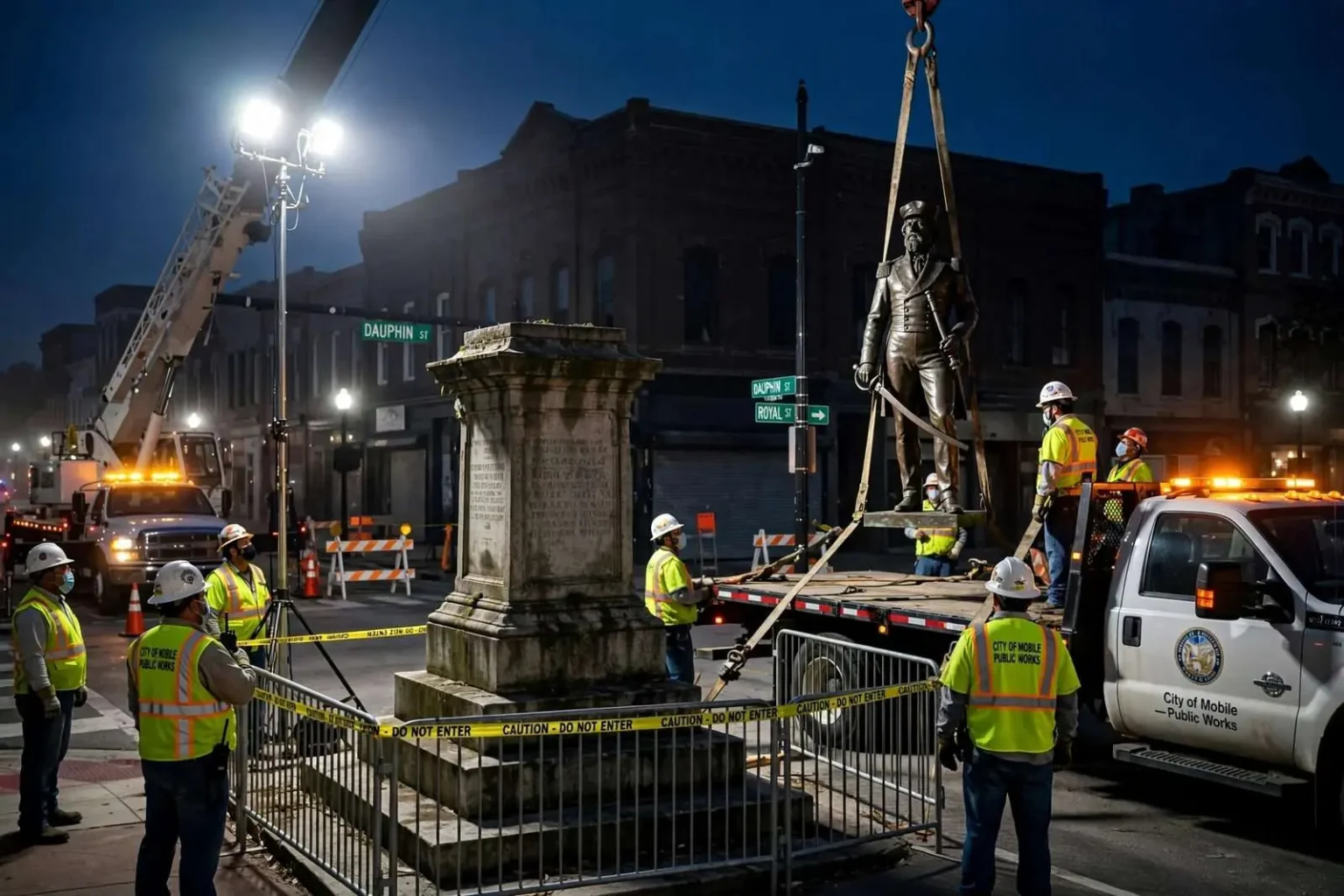
MOBILE — Workers took down Mobile’s 120-year-old monument to Admiral Raphael Semmes in the early morning hours of June 5, 2020, days after the downtown statue was vandalized. The removal, carried out with a crane and a small crew under streetlights in the pre-dawn darkness, ended more than a century in which the bronze figure of the Confederate naval officer overlooked one of the city’s busiest downtown corners.
Mayor Sandy Stimpson confirmed the removal in a statement issued the same morning, saying the statue had been placed in a secure location. The mayor moved quickly to frame the decision, saying it was about the city’s path forward rather than a judgment on the man the monument honored. “To be clear: This decision is not about Raphael Semmes, it is not about a monument and it is not an attempt to rewrite history,” Stimpson said. “Moving this statue will not change the past. It is about removing a potential distraction so we may focus clearly on the future of our city. That conversation, and the mission to create One Mobile, continues today.”
City Communications Director George Talbot confirmed the city carried out the removal overnight and said later that morning that both the removal and the statue’s location were temporary, with no return date announced and a further city statement expected. That carefully limited language reflected the delicacy of the moment: the city was declining to declare the statue’s permanent fate while acknowledging that it would not be returning to its pedestal anytime soon.
Who Semmes was, and why the statue stood there
Raphael Semmes was a career naval officer and the captain of the CSS Alabama, the Confederate raider that swept Union shipping from the seas during the Civil War. His exploits made him one of the South’s most celebrated figures of the war, and Mobile — the port with which his ship was most closely associated — honored him with a monument that was dedicated in 1900, when the generation that fought the war was passing from the scene. The statue stood in downtown Mobile for roughly 120 years, becoming as much a part of the city’s streetscape as a landmark and a meeting point for generations of residents.
The monument’s meaning, however, was contested long before 2020. To some, it was history — a marker of Mobile’s maritime past and the memory of its most famous naval son. To others, it was a tribute to the Confederacy erected in the era of segregation, a statement about whose heritage the city’s public spaces honored. That debate played out in cities across the South for decades, and Mobile was among the communities where petitions, public comments, and city council discussions kept the question alive without resolving it.
The week that led to the removal
The immediate trigger came in the spring of 2020, when protests over racial injustice swept the nation and reached downtown Mobile. Amid that unrest, the Semmes monument was vandalized earlier that week, an incident that led to an arrest. City officials faced a choice that many Southern municipalities confronted that season: guard the monument, clean it and leave it in place, or take it down before it became a flash point for further confrontation.
The overnight removal answered that question in the way many cities had — quietly, quickly, and before daylight. Workers arrived in the early morning hours, closed the surrounding area, rigged the statue, and lifted it from its base. By the time most of downtown woke up, the corner that had held the admiral’s figure for 120 years held only an empty pedestal. The decision to act at night drew some criticism, but city leaders pointed to the practical logic: a crane operation in the middle of a downtown intersection is safer and easier without crowds or traffic.
A mayor’s argument for moving on
Stimpson’s statement was notable for what it rejected. The mayor explicitly refused the framing that the removal was an erasure of history, insisting instead that the statue had become an obstacle to the city’s civic conversation — a “potential distraction” in his words — at a moment when Mobile needed to focus on its future. The phrase “One Mobile,” which the mayor invoked, was the name of his administration’s long-running initiative around race, equity and unity, a program that had grown out of earlier community discussions and that Stimpson cast as the continuing work the monument dispute had complicated.
The statement also reflected a pattern Mobile’s leaders had followed through 2020: acknowledging the emotion on both sides of the monument question while trying to keep the city out of the destructive confrontations that had broken out elsewhere. Removing the statue in a controlled operation, rather than seeing it pulled down in disorder, allowed the city to control both the process and the message. The mayor’s decision to speak the same morning — rather than let the removal speak for itself — was part of that effort to set the terms.
What “temporary” meant
Talbot’s insistence that both the removal and the statue’s location were temporary left open every practical question. Would the monument return to its downtown pedestal, be placed in a museum or a cemetery, or pass into the hands of a private heritage group? The city was not saying, and the absence of a return date suggested that officials themselves had not settled the question. What was clear was that the statue would be stored securely while the city decided, and that a further statement was expected once officials had worked through the options.
That caution mirrored the legal and logistical realities surrounding Confederate monuments in Alabama. State law had, in the years before 2020, placed restrictions on the removal of long-standing monuments, exposing cities that took them down to potential fines and lawsuits. Municipal leaders across the state weighed those constraints against public pressure and safety concerns, and the calculations shaped how and when each monument came down. The details of Mobile’s approach — the overnight timing, the careful “temporary” language, the pledge of a future statement — reflected a city navigating between those pressures.
The larger moment
The Semmes removal occurred during one of the most concentrated re-examinations of public monuments in American history. In the weeks surrounding June 2020, cities from Richmond to Birmingham to Jacksonville re-evaluated or removed Confederate symbols, sometimes overnight, sometimes after votes, and sometimes under court challenge. Each community’s decision turned on local history, local law, and local politics, but the pattern was unmistakable: symbols that had stood for a century were suddenly in motion.
For Mobile, the empty pedestal at one of downtown’s most visible corners became a physical marker of the moment. Residents who had grown up meeting “at Semmes’ feet,” photographing children beside the admiral, or simply passing him on the daily commute found the landmark gone — and found the debate about what should replace or restore it carried on in City Council chambers, on social media, and in conversations across the city.
What the city promised was continued conversation. What the morning of June 5 delivered was a fact: the 120-year watch of Admiral Raphael Semmes over downtown Mobile had ended, removed in the dark by a city that said it wanted a clearer view of its future.
How the city got here
The June 2020 removal did not come out of nowhere. Mobile had debated the Semmes monument for years, with petitions and public comment periods putting the question before city government well before the events of that spring. The city had also confronted the monument question at other sites, and the Stimpson administration had built its “One Mobile” initiative in part to create a standing forum for exactly these conversations. What changed in 2020 was urgency: national protests turned a long-simmering civic question into a daily, visible one, and the vandalism of the statue compressed the city’s timeline from months to days.
Officials chose an operation that minimized risk to people and property. A controlled, professional removal — crane, crew, closed streets, and a secure storage destination — avoided the damage that can come when monuments fall in uncontrolled circumstances, and it spared the city the images that other communities produced when crowds pulled statues down themselves. The trade-off, as some critics noted, was that the decision was made without a public vote or a public hearing. Supporters of the mayor’s approach answered that the city had debated the question for years, and that the emergency of the moment justified acting on the authority he already held.
What happens to a monument after it comes down
Once a statue leaves its pedestal, its future typically follows one of several paths. Some cities place removed monuments in museums, where interpretive exhibits can supply the historical context that a street corner cannot. Others relocate them to cemeteries or battlefields, sites whose character changes how the monument reads. Still others transfer them to heritage organizations or store them indefinitely, which in practice is what “temporary” often becomes. Each option carries costs — physical, legal, and political — and each draws its own supporters and opponents.
Mobile’s officials declined to pick a path that morning, and their refusal to do so was itself informative. A city that intends to return a monument announces a date; a city that intends to remove it permanently often says so plainly. “Temporary, with no return date announced and a further statement expected” was the language of an administration buying time — keeping its options open while the immediate tensions of the summer cooled and the practical questions of law, cost, and location could be worked out behind the scenes.
For residents, the practical effect was immediate and visible. The corner where the admiral had stood was open ground again, and the daily rhythm of downtown absorbed the change quickly, the way street-level cities do. The longer conversation — about memory, about public space, about what Mobile chooses to honor — was the part the mayor asked the city to continue.


