Gulf Shores Police Warn Public Against Using Uber, Draw Pushback
Gulf Shores police called ride-hailing service Uber 'highly dangerous' in a social media post, sparking public criticism as Baldwin County cities debate ridesharing rules.
A blunt social media warning from the Gulf Shores Police Department has ignited public debate over ride-hailing service Uber, as Baldwin County’s beach communities continue wrestling with how to regulate the growing service.
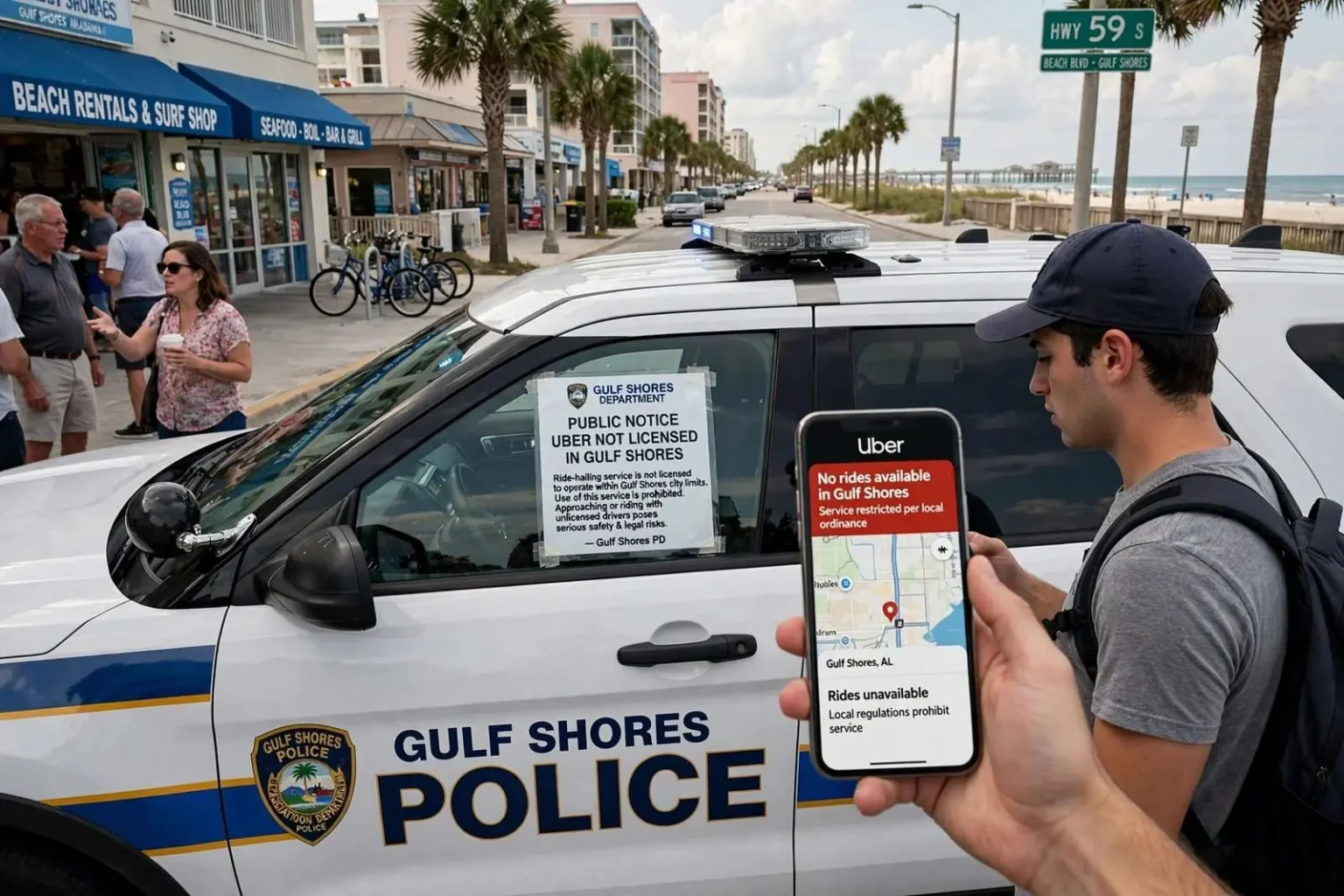
The department posted a statement on social media declaring that Uber is not licensed to operate in Gulf Shores and warning that officers would take appropriate police action against anyone found using the service within city limits. The post described Uber as functioning like an unlicensed taxi service and cautioned that getting into a vehicle with an unfamiliar driver is highly dangerous and could expose riders to a serious crime.
The warning landed in a city whose economy runs on tourism. Gulf Shores swells each summer with visitors who arrive expecting the conveniences of bigger cities, and ride-hailing apps had become part of that expectation in destinations across the country. The Police Department’s message, posted where thousands of followers — many of them frequent visitors — would see it, effectively told tourists that the app they relied on at home was off-limits on the beach.
Pushback From Riders and Residents
The post drew immediate pushback online, with some residents accusing the department of overreacting without adequate research into how the company vets its drivers. Several commenters pointed out that licensed taxi drivers are not inherently safer simply by virtue of holding a local business license.
The debate played out in comment threads that stretched for hundreds of responses, a pattern that has followed Uber’s expansion into cities across the South. Supporters of the company argued that the app’s design — GPS-tracked trips, driver identification, fare records and two-way ratings — creates a record that a traditional cab ride leaves behind only loosely. Critics of the company, including some longtime residents, countered that a local taxi company can be inspected, sued and shut down by the city that licenses it, while a multinational app’s obligations to an individual rider are less clear.
The department responded that cab operators are required to be licensed within the city and have their information on file with local authorities, a step Uber has not taken in Gulf Shores. In other words, the department said, the issue was not the technology but the absence of any local record of who is driving — and no agreement about who answers when something goes wrong.
Police officials have made similar arguments in cities across the country as ride-hailing expanded faster than municipal codes could be updated. Traditional taxi ordinances typically require vehicle inspections, chauffeur’s permits, background checks filed locally and insurance verification — all enforceable at the counter of a local licensing office. An app-based fleet that registers nowhere in the city fits none of those categories, leaving officers with the awkward question of what, exactly, to cite a driver for.
A Debate Across Baldwin County
The dispute reflects a broader, unresolved debate playing out across Baldwin County’s coastal cities. Orange Beach officials raised similar safety and licensing concerns about Uber operating without a local business permit, with that city’s council expected to take up the issue in the coming weeks.
Gulf Shores occupies a particular place in that debate. The city’s year-round population is modest, but its summer population multiplies several times over, and its Police Department is scaled for that surge. Taxi service in a resort town is not a sideline — it is part of the tourism infrastructure, moving visitors from condos to restaurants to nightlife districts along Highway 59 and the beach boulevard. Any disruption to how visitors get around ripples straight into the business community, which is why the city’s taxi regulations have historically been enforced seriously and why the arrival of an unlicensed competitor drew a response so quickly.
The Police Department’s willingness to warn riders — not just drivers — set the Gulf Shores statement apart from most city-level pushback on ride-hailing. In most disputes, enforcement attention falls on drivers, who face fines and impoundment; riders are treated as innocent customers. By cautioning riders directly that the service was dangerous and off-limits, the department turned every tourist with the app on their phone into a participant in the controversy, and the online reaction followed.
City officials have not said what penalties, if any, drivers or riders would actually face, and no arrests or citations connected to the post have been reported. That ambiguity has fueled much of the online criticism, with commenters asking what “appropriate police action” means when the underlying ordinance predates the technology.
Fairhope, by contrast, has signaled a more welcoming approach, with city officials saying they plan to model new local ridesharing rules on an ordinance recently approved by the Mobile City Council. Mobile’s ordinance created a regulatory category for transportation network companies, requiring permits, insurance and driver screening without banning the service outright — the compromise formula that has let ride-hailing operate legally in cities from Nashville to New Orleans.
Fairhope’s openness reflects its own circumstances. The Eastern Shore city’s downtown draws weekend crowds from Mobile and Baldwin County for its restaurants and shops, and the city has marketed itself as a walkable, visitor-friendly destination. A functioning rideshare option fits that image, and Fairhope’s officials have said publicly that regulating the service sensibly beats pretending it does not exist — a stance that has put the city on the opposite side of the question from its beach neighbors.
The split among Baldwin County’s municipalities illustrates a problem that tourism-dependent areas face with the sharing economy: neighboring cities can reach opposite conclusions, leaving visitors to figure out where the app works and where it does not as they drive from Gulf Shores to Orange Beach to Fairhope over the course of a vacation. Business owners along the beach highway watched the debate with interest, since evening restaurant and bar traffic has long depended on customers having a safe ride home.
County and state officials have watched the municipal patchwork develop with some frustration. A single statewide framework for ride-hailing — as many states have adopted — would replace city-by-city negotiation, but until the Alabama Legislature acts, each municipality retains the authority to set its own terms, and each negotiation starts from scratch.
Uber Responds
A spokeswoman for Uber pushed back on the safety characterization, telling reporters the company believes its drivers offer a safe, reliable way to move around town. She said all drivers using the platform undergo background checks performed by a third-party firm accredited by a national association of professional screening companies, following a similar process to the one Uber uses elsewhere.
She added that the company’s technology is designed to prioritize rider and driver safety throughout each trip and said Uber welcomes the opportunity to work with additional Alabama municipalities on a path forward following its recent agreement with Mobile. The company’s playbook in disputes like this one has been consistent: operate, negotiate, and push for city-level rules modeled on agreements reached elsewhere, while its local supporters — often younger residents and frequent travelers — make the case on social media.
Insurance has been the stickiest point in negotiations nationwide. Uber maintains a layered commercial policy covering drivers during app use, but cities and states have pressed for clarity about coverage gaps between trips — the moments when a driver has the app on but has not accepted a fare. Regulatory schemes like Mobile’s address that question directly, which is why other Alabama cities have studied the ordinance rather than writing their own from scratch.
The company also argues that its model expands transportation access for people the taxi industry has underserved — late-shift workers, residents without cars in areas with thin cab service, and visitors arriving without a rental. In tourist towns, drivers themselves are often locals looking for flexible income during the season, a point Uber’s supporters in Gulf Shores raised repeatedly as the debate grew heated.
Whether the city and the company end up at the table or in court, the Gulf Shores dispute has become a test case that other small Alabama cities are watching. If the parties reach Mobile-style terms, the beach towns’ approach will likely become the template; if enforcement escalates, the fight could be the one that finally pushes the Legislature to settle the question statewide.
For now, the legal status of Uber rides in Gulf Shores remains unsettled, with the company continuing to operate in the area even as city officials maintain it lacks proper authorization. Both sides have left room for a negotiated outcome, and city leaders have said the goal is an arrangement that protects riders without pushing a popular service out of a tourist economy that depends on convenience. Until one is reached, riders and drivers in Gulf Shores operate in the gray zone between a police department’s warning and an app that keeps working.