Daphne Fire Station No. 3 Repairs Approved After Year-Long Closure
Daphne's City Council approved a $414,500 contract to repair Fire Station No. 3, closed over a year for mold and safety issues.
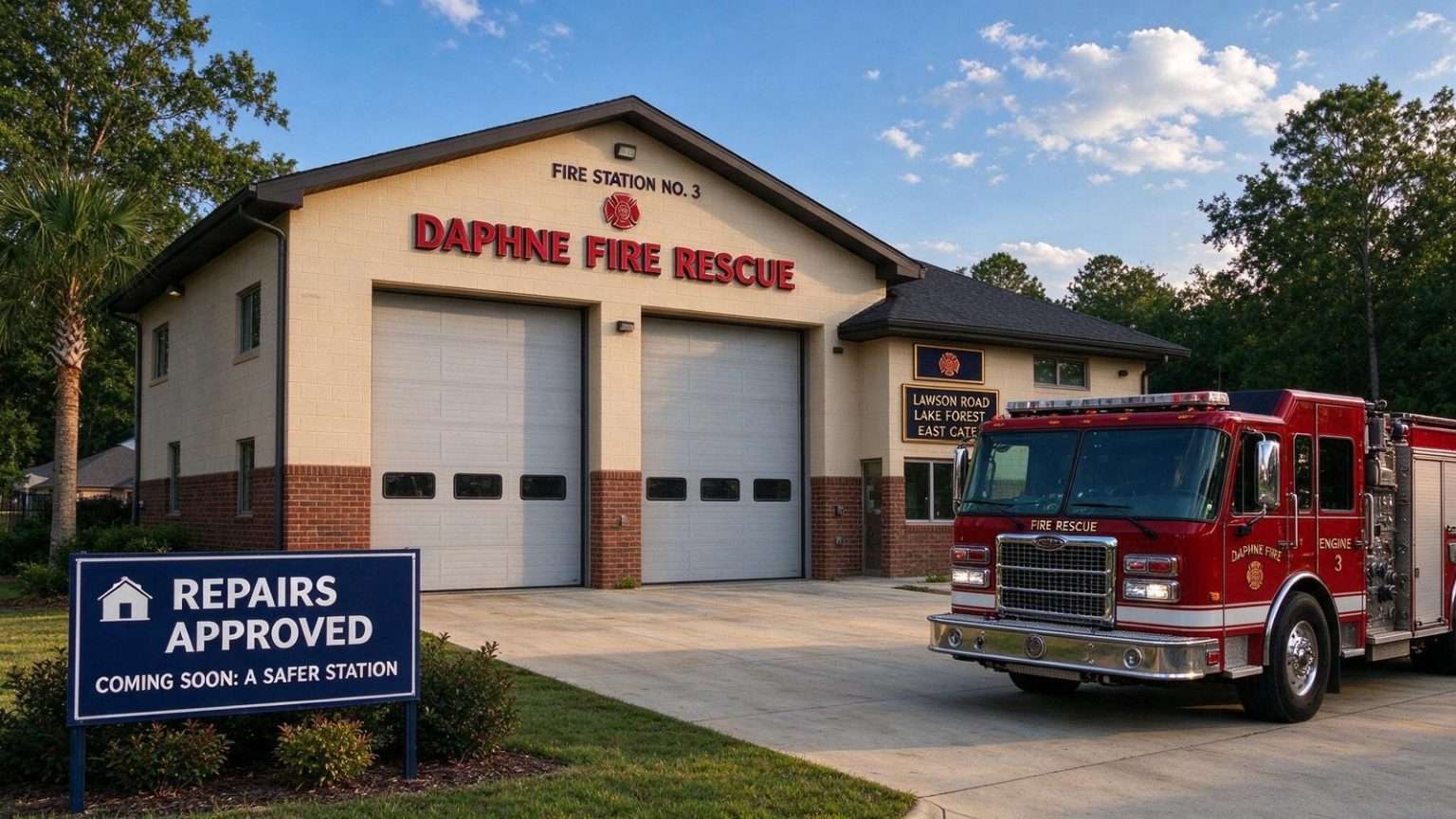
Daphne’s City Council has approved a construction contract to repair and reopen a fire station that has sat closed for more than a year, ending a stretch during which one of the city’s four fully staffed stations was out of service. The unanimous vote closed a frustrating chapter for the city’s fire department, which had been covering a growing corner of the city from a temporary location while the dispute over repair costs played out in bid documents and council agendas.
Fire Station No. 3 sits on Lawson Road near the east gate of the Lake Forest subdivision and close to Daphne High School. The building was shut down in February 2014 after officials found mold and air quality problems that made it unsafe for firefighters to occupy. Mold in a fire station is more than a comfort issue — crews live in these buildings around the clock, sleeping, eating and working shifts of twenty-four hours or more, and contaminated air poses a direct health risk to the very personnel the city depends on in emergencies.
Since then, the station’s crew has operated out of a facility on Main Street, roughly four miles away through the winding streets of Lake Forest. That distance matters in a fire district. Lake Forest, one of Daphne’s largest and oldest planned subdivisions, is built around a golf course and a network of lakes, with narrow, curving residential streets that slow any vehicle moving through them. Every additional mile of travel adds to response times for house fires, medical calls and wrecks in the eastern part of the city.
The cost of getting it right
The council initially sought bids for the repair work last year, but the lowest offer came in around $550,000, far above the $200,000 to $300,000 range city officials had expected for the roughly 20-year-old building. Rather than accept the high bid, the council sent the project back out for rebidding in January. The decision reflected a cautious approach to spending that has defined much of the city’s recent budgeting — Daphne, like its Baldwin County neighbors, has grown rapidly but keeps a close watch on capital costs, and accepting the first bid would have meant paying hundreds of thousands more than anticipated.
This week, council members voted unanimously to award a $414,500 contract to a Daphne-based construction firm. An additional $24,870 was set aside for architectural fees and $10,000 for replacement furnishings, bringing the total project cost to about $449,370. Keeping the construction contract with a local firm kept some of that spending inside the city, a point not lost on council members who had spent a year explaining the expense to constituents.
Council members acknowledged the price tag was higher than they had hoped but said the ongoing public safety concerns of operating with a station down left little room for further delay. The finance committee chairman noted that construction costs have risen since the city built its most recent station, and that simplifying the scope of the project helped bring the bid down from the rejected proposal. Across the Gulf Coast, post-recession construction demand had been pushing material and labor prices upward, and officials knew waiting for a better market carried its own risks.
The response-time toll
Daphne’s fire chief said running one of the city’s four staffed stations short has taken a toll on emergency response, particularly for residents living deep in the Lake Forest subdivision, where narrow, winding streets already add time to any call. The chief said crews are eager to get back into a station built specifically for that part of the city. Fire departments measure their performance in minutes, and national standards for first-response times become difficult to meet when the nearest engine starts its run four miles from the neighborhood it serves.
The problem was compounded by the geography of Lake Forest itself. Developed in the 1970s around an eighteen-hole golf course and a chain of lakes, the subdivision funnels traffic onto a handful of entrances and forces every response vehicle along residential curves that were never designed for apparatus at speed. A crew based on Main Street had to either thread the neighborhood or loop around it, and in either case residents at the far end of the development waited longer than their neighbors near US 98.
Daphne, a city of more than 23,000 residents in Baldwin County, also operates a fully staffed station on Profit Drive that opened in 2013 and another off Green Court in the Timbercreek subdivision north of Interstate 10. A fifth station, staffed by volunteers, operates out of Olde Towne Daphne behind City Hall. The mix of career and volunteer coverage reflects the city’s layered growth — an historic core around the bayfront, expanding subdivisions to the north and east, and commercial corridors along US 98 that pull increasing call volume each year.
Insurance ratings add another layer of urgency. Fire protection classifications used by insurers weigh station distribution, staffing and water supply, and an extended station outage in a growing subdivision risks pushing premiums up for homeowners in the affected area. City officials rarely say so explicitly, but the argument for reopening Station No. 3 promptly was written into every homeowner’s policy in the eastern districts.
The closure also strained the department’s internal arithmetic. Covering a district from a temporary quarters means adjusting shift assignments, overlap schedules and mutual-aid expectations with neighboring departments. Crews adapted — as fire crews do — but adaptation has a cost in fatigue and in coverage gaps that only become visible on the worst days, when two calls arrive at once and the fourth engine is four miles farther away than it should be.
What the renovation includes
As part of the renovation, the three-bedroom station will be expanded to four bedrooms to match the layout of the city’s newer facilities. The change brings the older building up to the staffing configuration the department now uses, allowing four firefighters to bunk at the station on each shift instead of three. Dormitory space, decontamination areas and air handling are the unglamorous parts of a fire station, but they are precisely the systems that failed when mold took hold in the Lawson Road building.
City officials said the contractor has 90 days to complete the work once it begins, with the mayor’s office targeting a reopening in June. That timeline puts the station’s return within roughly four months of the contract award — a pace officials considered achievable given that the scope had been streamlined during rebidding. The 90-day window also gives the city a clear benchmark for holding the contractor to account, with penalties and inspection milestones built into the agreement.
Officials said the improvements, while not a full rebuild, should restore the station to full service and address the safety issues that forced its closure in the first place. Remediation of mold and replacement of compromised air systems formed the core of the work, supplemented by the bedroom expansion and new furnishings. When crews finally turn the trucks around in the Lawson Road bays again, the building they return to will be healthier to live in and better matched to the department’s current operations than the one they left behind in February 2014.
For Lake Forest residents, the reopening will be felt one call at a time. A fire engine stationed a mile inside the neighborhood’s east gate can reach a burning house minutes faster than one sent across the subdivision from Main Street, and in a medical emergency those minutes are often the difference between a close call and a tragedy. Community leaders in Lake Forest had pressed the city throughout the closure to prioritize the repair, reminding officials that the subdivision’s several thousand residents were paying for city fire protection like everyone else.
The episode also left the city with lessons about its building inventory. Station No. 3 was one of the younger facilities in Daphne’s fleet, and its failure after roughly two decades of service prompted officials to think harder about preventive maintenance in the other stations — particularly the older volunteer house in Olde Towne Daphne. Mold and air quality failures rarely announce themselves; they build in humid Gulf Coast climates where buildings breathe damp air for months at a time, and catching them early costs a fraction of a full remediation contract.
For now, the council’s vote ends a year of improvisation. The four-mile detour through Lake Forest’s winding streets is scheduled to end in June, and the city’s fire crews — who have kept serving the eastern districts from borrowed quarters all along — will get back a station built for their part of the city, with an extra bedroom, cleaner air and a council that, after a year of sticker shock and rebidding, decided the waiting had gone on long enough.