Bay Minette Woman Killed in ATV Crash Near Millry
A 22-year-old Bay Minette woman died Tuesday night when her ATV collided with another off-road vehicle on Millry Buckatunna Road in rural South Alabama.
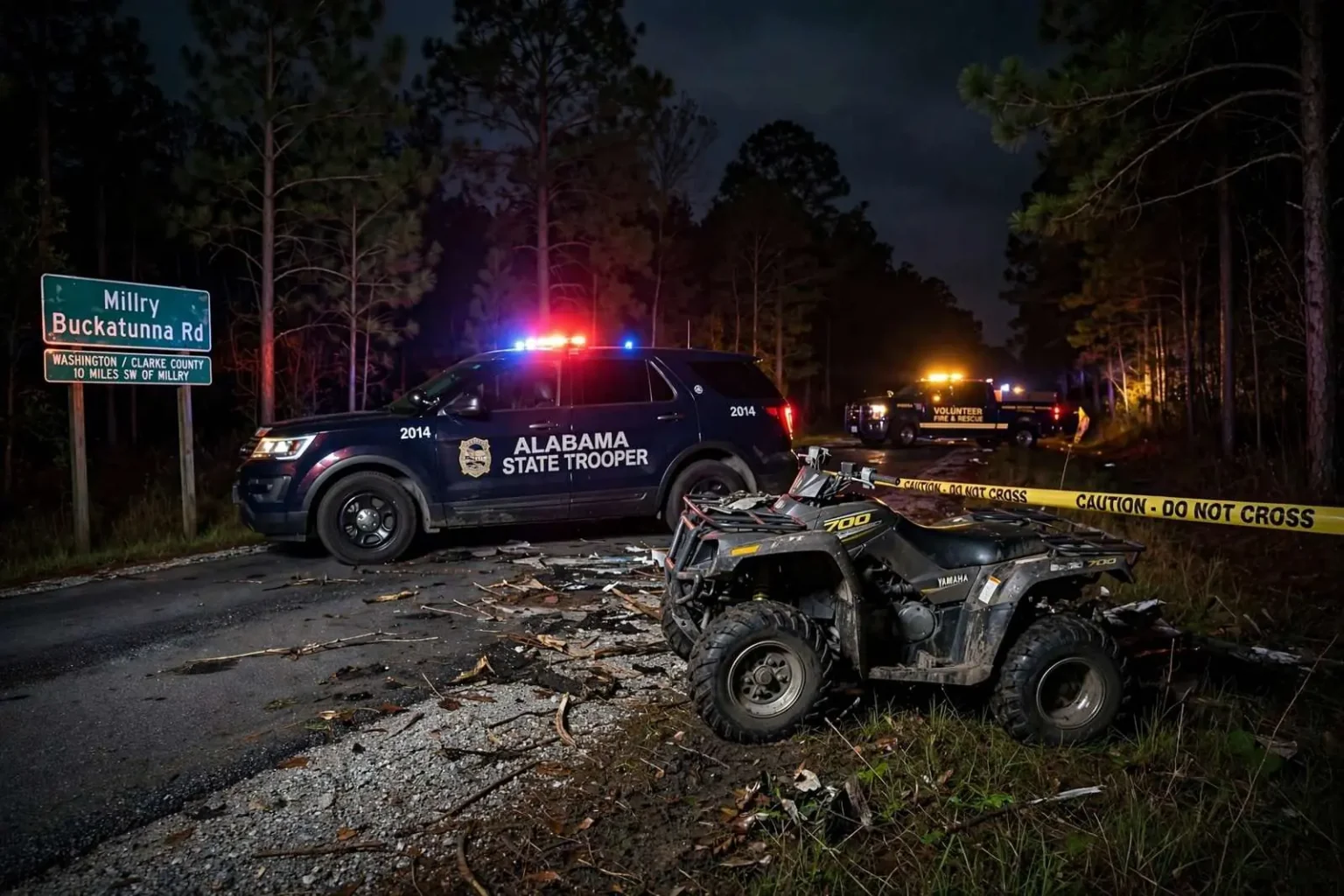
A Bay Minette woman was killed Tuesday night when the all-terrain vehicle she was driving collided with another ATV on a rural road near Millry, according to Alabama State Troopers. Troopers identified the victim as 22-year-old Raven Angelique Graham. Trooper Jamie Maloy said Graham was driving a 2014 Yamaha 700 ATV on Millry Buckatunna Road just before 9 p.m. when it collided with a second ATV. The collision on the narrow country road, far from streetlights and emergency services, left Graham with injuries that proved fatal at the scene.
The crash happened roughly 10 miles southwest of Millry, a small community that straddles Washington and Clarke counties in rural South Alabama. Emergency medical personnel who responded to the scene pronounced Graham dead there. First responders from surrounding volunteer departments covered the distance over darkened backroads to reach the site, a reminder of how geography shapes emergency response in this part of the state. The area where the crash occurred is sparsely populated, with the road winding through timberland and farmland between small communities.
Troopers said they continued investigating the crash the following day, working to determine exactly how the two ATVs came to collide on the rural roadway. Investigators have not said whether either vehicle was traveling at an unsafe speed, whether visibility was a factor, or whether either driver took evasive action before impact. Those questions are standard in any two-vehicle fatal crash, and answering them in a case with no traffic cameras and few potential witnesses depends heavily on the physical evidence left on the roadway.
A Rural Road, a Deadly Collision
Millry Buckatunna Road runs through some of the most remote terrain in Washington County, connecting Millry toward the Buckatunna community to the southwest. Roads like it carry a mix of traffic that surprises newcomers: log trucks, farm equipment, passenger cars and, frequently, off-road vehicles. ATVs are a common sight in the area, used for hunting trips, checking cattle, riding to a neighbor’s house and other everyday tasks that would require a car in a city. That mixing of slow-moving off-road vehicles and standard traffic on narrow, unlit roads is exactly the environment safety officials warn about.
State troopers have not released additional information about the driver of the second ATV involved in the collision, nor have they indicated whether any citations are expected once the investigation concludes. The second driver’s condition after the crash has not been made public. In fatal crashes involving ATVs, investigators typically examine both operators for impairment, check the mechanical condition of both vehicles and reconstruct the point of impact to determine which vehicle crossed into the other’s path. None of those findings has been released.
ATV-related crashes remain a recurring safety concern in the rural stretches of Washington and Clarke counties, where off-road vehicles are commonly used both for recreation and for everyday transportation on unpaved backroads that connect small communities like Millry to larger routes. Unlike passenger vehicles, ATVs generally lack seatbelts, airbags and enclosed frames, which can make crashes at even moderate speeds far more dangerous for riders. A collision that would dent a car’s fender can throw a rider from an ATV, and the vehicle itself — weighing several hundred pounds — can pin or crush a rider in a rollover.
Why Rural ATV Crashes Are Harder to Reconstruct
Crash investigations involving ATVs on rural roads can take longer than standard vehicle-crash investigations, since troopers often must reconstruct the incident using physical evidence at the scene rather than relying on traffic cameras or witness accounts, which are less common in sparsely populated areas. Investigators measure skid and gouge marks, document the final resting positions of both vehicles, and examine debris patterns to work backward toward the moment of impact. In a case like this one, where the collision happened around 9 p.m. on a dark road, lighting conditions and line of sight become central questions that must be answered from the scene itself.
Alabama law allows ATVs to be operated on certain public roads under specific conditions, though safety advocates have long urged riders to wear helmets and use caution when operating alongside oncoming traffic, particularly after dark when visibility is reduced. The rules vary by local jurisdiction, and enforcement on remote county roads is limited. Unlike motorcycles, ATVs are not designed for roadway travel — their low-pressure tires, short wheelbase and handling characteristics are built for trails and fields, not pavement or hard-packed road surfaces, and they do not turn or brake like a street vehicle when riders encounter oncoming traffic.
Nighttime ATV crashes, like the one that killed Graham, are frequently cited by highway safety officials as being more severe than daytime incidents due to reduced visibility for both riders and any other vehicles sharing the roadway. Many ATVs carry limited lighting, designed for trails rather than two-way traffic at highway-adjacent speeds, and riders in dark clothing on an unlit road can be nearly invisible until a closing vehicle is suddenly upon them. National safety data consistently shows that a large share of fatal ATV incidents occur after dark, and rural Southern counties record some of the highest rates of ATV deaths in the country.
Safety organizations, including the Consumer Product Safety Commission, have documented hundreds of ATV-related deaths nationwide in recent decades and recommend that no rider under 16 operate adult-sized machines, that all riders wear Department of Transportation-approved helmets, and that ATVs never carry passengers on single-rider models. Those recommendations are widely ignored in rural areas, where ATVs are woven into daily life. Helmet use among adult riders on rural Alabama roads is uncommon, and the machines themselves are sold and used without the licensing, registration and insurance requirements that apply to street vehicles.
The Victim and the Community
Graham was from Bay Minette, the Baldwin County seat some 70 road miles southwest of where the crash occurred, making the journey to the Millry area a substantial trip — the kind of distance that suggests the visit had a purpose, whether family, work or recreation. Bay Minette sits at the northern end of Baldwin County, a growing city that nonetheless remains tied to the rural lands and timber country that surround it. Young riders from town often travel to rural counties like Washington for the open land and trails that suburban Baldwin no longer offers.
News of the crash moved quickly through the Millry community, where fatal incidents are rare enough that they remain topics of conversation for years. Millry’s schools, churches and volunteer fire department form the backbone of civic life in the town, and area residents know the roads involved in serious crashes personally. Emergency responders from the region are largely volunteers, and calls like Tuesday night’s draw on the same small pool of neighbors who will later attend the funerals of those involved.
The Alabama State Troopers’ investigation into the fatal crash remained open as of Wednesday, and no further details had been released about the circumstances that led to the collision. Troopers’ findings will ultimately determine whether the second driver faces any charges or citations, and those findings could take weeks to finalize depending on reconstruction work and any toxicology testing. Until then, investigators are asking anyone who traveled Millry Buckatunna Road that evening or who may have witnessed either ATV before the crash to come forward with what they saw.
The crash also underscores a gap that rural county officials across South Alabama have grappled with for years: the absence of dedicated off-road riding areas close to home. In counties where virtually all land is privately held — timber company parcels, family farms, hunting clubs — riders who want legal, maintained trails often have nowhere to go, and public roads become the default. Where designated riding parks exist in other states, they concentrate off-road traffic away from vehicle traffic and provide rules, signage and emergency access. South Alabama has few such facilities, leaving families to choose between limiting riding to private land or accepting the risks of roads like Millry Buckatunna Road.
Emergency response times in the area where the crash occurred illustrate the other side of the risk equation. The crash site sits roughly 10 miles from Millry, and medical personnel who reached the scene pronounced Graham dead — meaning that even the fastest possible response could not have changed the outcome once the collision occurred. Rural counties across the Black Belt and southern Alabama depend on volunteer EMS units and fire departments that can be 20 minutes or more from any given address, a reality that safety advocates say should inform how riders assess the risk of high-speed or nighttime operation far from town.
Troopers continue to ask that anyone with information about the crash contact the Alabama Law Enforcement Agency. The findings of the investigation — including whether impairment, speed, visibility or right-of-way violations played a role — will determine whether the case ends as a tragic accident with no charges or becomes a criminal matter. For two families, one in Bay Minette and one closer to Millry, the waiting is the hardest part of a crash that took a 22-year-old woman’s life on a dark country road.