Prichard’s Juneteenth Celebration Draws Hundreds for Music, History and Family
Hundreds gathered in downtown Prichard for a Juneteenth celebration filled with gospel music, family heirlooms and reflection on history.
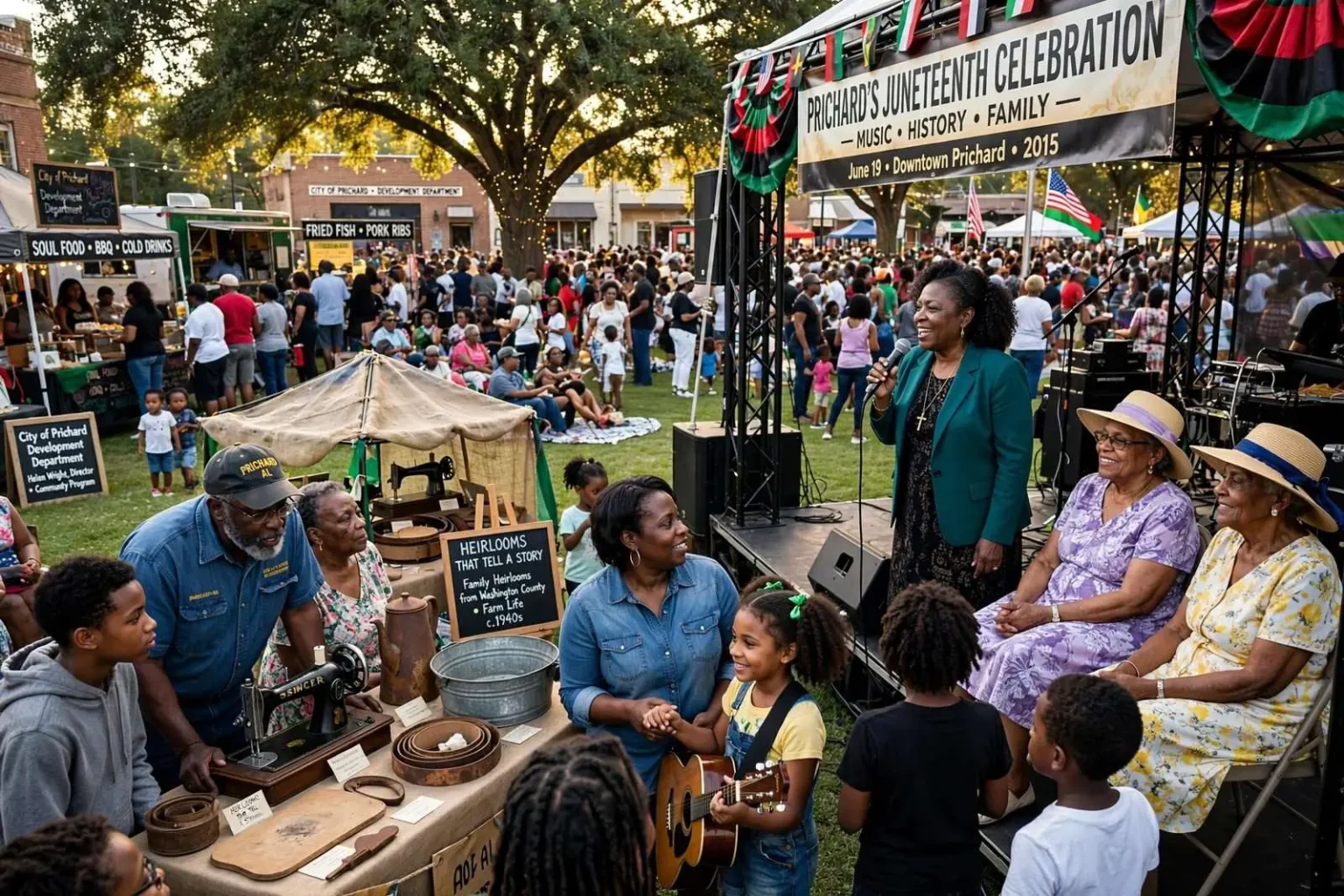
Downtown Prichard filled with music, food and family reunions on a Saturday afternoon in June as several hundred residents gathered for the community’s annual Juneteenth celebration, an event organizers say has grown into one of the city’s most meaningful cultural gatherings. The lawn-turned-festival-ground drew visitors of all ages, from toddlers dancing near the stages to grandparents trading stories beneath the shade.
Juneteenth marks June 19, 1865, the day enslaved people in Galveston, Texas, learned of their freedom more than two years after the Emancipation Proclamation was signed. The delay, historians note, stemmed largely from the limited presence of Union troops in Texas at the time, which allowed the news of emancipation to arrive only when federal authority finally reached the far edge of the former Confederacy. The holiday has long been observed by Black communities across the South as a day of remembrance, faith and celebration, and it holds particular resonance in a city like Prichard, where generations of Black families built homes, churches and businesses after leaving the surrounding rural counties.
In Prichard, the celebration featured two music stages, food vendors and a steady stream of gospel performances that drew visitors of all ages onto the lawn. Pastor Faye Woods of True Praise Deliverance Tabernacle Holiness Church was among those who took the stage, leading the crowd in praise as her mother and sister watched from folding chairs nearby, both dressed for the occasion in wide-brimmed straw hats. The gospel lineup gave the afternoon its emotional center, blending the holiday’s historical gravity with the celebratory spirit of a family reunion.
City of Prichard Development Department director Helen Wright, who helped organize the event, said the day was about more than music and food. She described it as a chance to teach younger generations about the history and resilience of Black families in the South. “We want them to understand how powerful they are and how much we still have to give,” Wright said, watching as her granddaughter performed original songs on one of the stages. The image of three generations — performer, organizer and elder — captured in a single afternoon was, attendees said, exactly what the day is meant to be about.
Heirlooms That Tell a Story
Elsewhere on the grounds, a group of men shared a table of hot dogs and cold drinks while examining a collection of family heirlooms brought by one attendee from his grandparents’ farm in Manila, a small community in Washington County. The display included an antique Singer sewing machine, a cotton gin belt, a scrub board and wash tub, and a rusted teakettle once used to heat bathwater before indoor plumbing was common in rural Alabama households. The items, he said, were meant to give younger visitors a tangible sense of what daily life looked like for their ancestors.
The exhibit drew a steady stream of curious onlookers, many of whom lingered to share memories of their own grandparents’ farms and kitchens. A cotton gin belt — the leather and canvas loop that once connected a gin’s engine to its machinery — carried particular meaning in a region where cotton shaped nearly every rural household’s work, and where the descendants of those who planted, picked and ginned the crop are only two or three generations removed from it. The scrub board and wash tub prompted stories of washdays that consumed entire mornings, while the teakettle reminded older attendees of homes where hot water itself was a small production.
Such displays have become a quiet tradition at Juneteenth gatherings across the South, where families increasingly treat the holiday as an occasion to pass down objects and oral histories alongside food and music. In Prichard, where many residents trace family roots to Washington, Clarke, Monroe and Wilcox counties, the connection between the city’s present and the rural Black experience of earlier generations is a living one, carried in church pews, surname lines and family plots of land that remain in use today.
A Celebration in the Shadow of Charleston
The celebration took place just days after a mass shooting at a historic Black church in Charleston, South Carolina, and several attendees said the tragedy weighed on their minds even as they marked a day meant for joy. The attack, which claimed the lives of nine members of a Bible study at Emanuel African Methodist Episcopal Church, reverberated through Black congregations across the country in the days that followed, and its shadow reached even the lawn in Prichard.
One man from the Toulminville area of Mobile said the news made him lean harder into prayer, while Wright reflected that hatred exists but is outweighed by the number of people who choose love and community instead. That tension — between mourning and celebration — gave the afternoon’s gospel music and fellowship an added weight, as attendees described the gathering itself as an answer of sorts to the violence that had dominated the week’s headlines.
Black churches have long anchored community life in Prichard and across Mobile County, serving not only as houses of worship but as meeting halls, organizing centers and safe spaces through decades of segregation and change. The Charleston attack struck, in that sense, at an institution every family on the lawn knew intimately, and the decision to sing, pray and gather publicly just days afterward struck many attendees as its own form of testimony.
A Fixture on the Summer Calendar
Prichard’s Juneteenth gathering has become an annual fixture on the city’s summer calendar, drawing families from across Mobile County for an afternoon that blends historical reflection with celebration. Prichard, a city of roughly 22,000 residents just north of Mobile, has deep roots in the region’s Black history, and events like the Juneteenth celebration have served as both community reunions and an assertion of the city’s cultural identity within the larger metropolitan area.
Organizers say the event will continue to grow as more residents learn about its significance and make it part of their yearly traditions. Interest in Juneteenth has been rising nationally in recent years, with observances spreading beyond the states with long-standing traditions and cities adding educational programming, vendor markets and youth activities to the familiar mix of food and music.
For Prichard, the 2015 edition offered a template that organizers hope to build on: two stages of music, vendors serving Southern staples, a children’s audience learning family history from heirlooms on display, and a civic message about resilience delivered without a podium or a lecture. The combination of remembrance and joy, attendees said, is what distinguishes Juneteenth from an ordinary festival — a holiday born from the worst chapter of American history that has become, on a June lawn in Prichard, one of its most affirmative annual gatherings.
As the afternoon light faded and the last gospel sets gave way to pack-up crews, the scene that remained was the one organizers had aimed for: families lingering over shared meals, grandchildren asking questions about sewing machines and teakettles, and a community marking, together, a freedom delayed but never forgotten.
Juneteenth’s Long Journey to the Mainstream
The story the holiday commemorates is one of the most striking episodes in the end of American slavery. Though President Lincoln signed the Emancipation Proclamation effective January 1, 1863, it could only be enforced where Union arms reached, and Texas — remote from the major fronts of the Civil War — remained outside that reach for more than two years. When Union troops finally landed at Galveston in June 1865 and announced that the enslaved were free, the announcement came two and a half years after the proclamation itself, giving the holiday its defining theme of freedom delayed but ultimately delivered.
Freed communities in Texas held the first known Juneteenth celebrations in 1866, and the observance spread through the South as families migrated, carried by church calendars, fraternal lodges and community picnics. In Alabama, Juneteenth events have historically combined political speeches, prayer services and family gatherings, with the balance shifting over the decades as each generation put its own stamp on the day. What has remained constant is the pairing of history with celebration — a day meant to teach as much as to enjoy.
In recent years, that teaching mission has grown more deliberate. Cities across the region now pair their Juneteenth festivals with exhibits, storytelling hours and youth programs designed to make the history accessible to children who encounter slavery mostly through textbooks. The Prichard heirloom display fits squarely within that trend, letting young visitors handle the ordinary objects of an extraordinary era and hear, from family members rather than strangers, what those objects meant.
Community, Faith and the Year Ahead
The breadth of the crowd on the lawn — families from Prichard, Mobile, Toulminville and beyond — reflected the city’s role within the metropolitan area. Prichard’s neighborhoods are knit together by dozens of congregations, and events hosted under the city’s umbrella tend to draw parishioners from across those churches, making municipal celebrations like this one a rare occasion when the whole community appears in a single place at a single time.
Food vendors served the staples of such gatherings all afternoon, and the two music stages alternated between gospel sets and community performances, including the original songs performed by Wright’s granddaughter. The programming gave young performers a public stage and gave the audience a glimpse of the next generation the organizers say the day is intended for — children learning where they come from while watching their own family members lead.
Organizers say the event will continue to grow as word spreads, and this year’s combination of historical exhibits, music and quiet tribute to the Charleston victims offered a picture of what that growth looks like: a celebration confident enough to hold grief and joy in the same afternoon. For the families who filled the lawn, the message of Juneteenth needed no elaboration — freedom remembered, community renewed, and a promise made to the next generation that the story will be told again next June, on the same grass, in the same city.