Mobile Seeks Federal Grant to Revive Broad Street Corridor
Mobile leaders are again pursuing a competitive federal TIGER grant to fund a long-planned overhaul of the Broad Street corridor circling downtown Mobile.
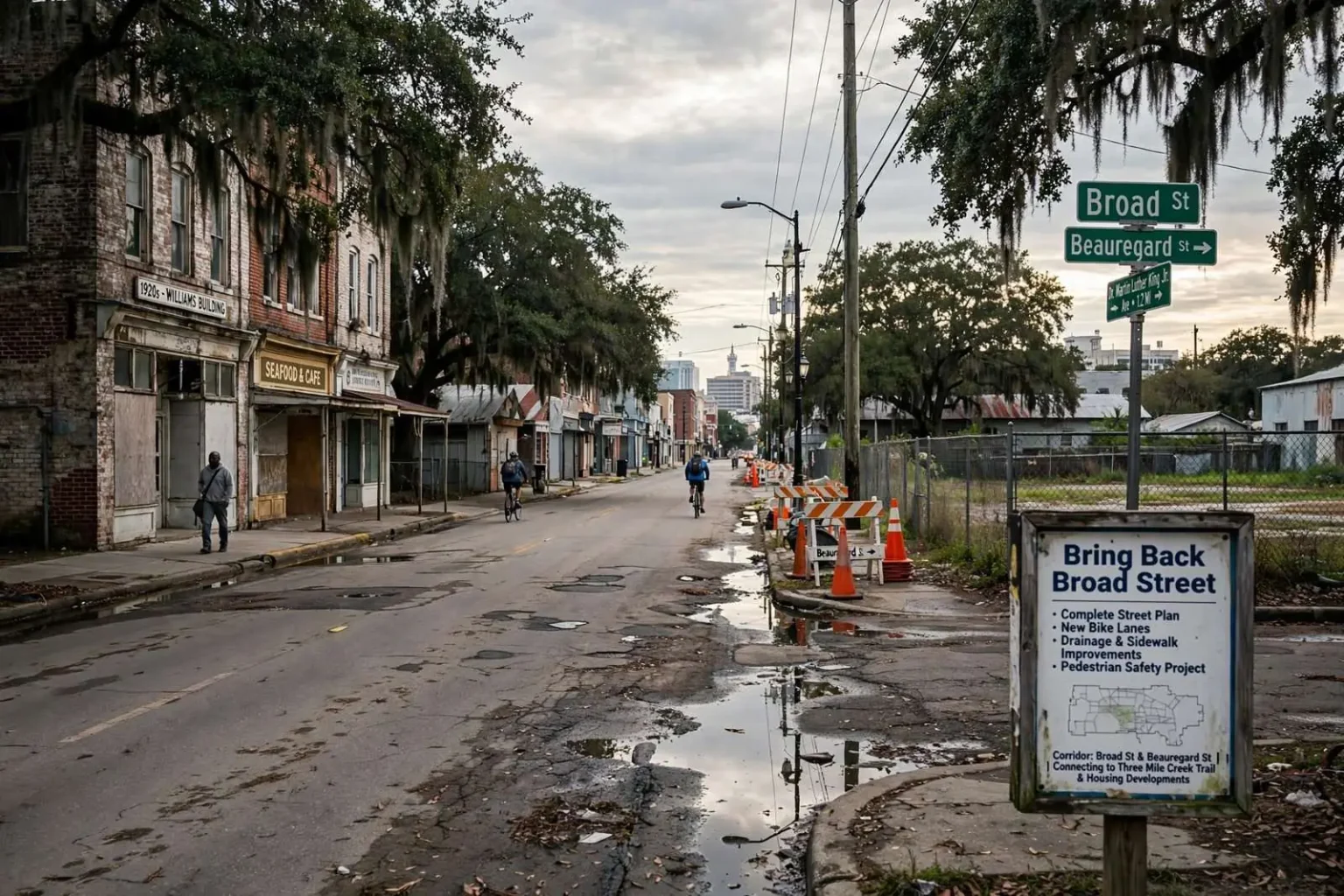
Mobile officials are renewing a push to redevelop the Broad Street corridor that circles much of downtown, applying once again for a competitive federal transportation grant to help pay for the long-delayed project. The Mobile City Council gave unanimous approval for the Stimpson administration to seek roughly $13.6 million through the U.S. Department of Transportation’s Transportation Investment Generating Economic Recovery program, commonly known as TIGER.
If awarded, the city would be responsible for a local match of about $3.3 million. That sharing formula is standard for the program, which requires applicants to put their own money behind the projects they request and rewards proposals that can document local commitment through budgeted funds, bonding capacity or other committed sources.
This marks the second consecutive year the city has applied for TIGER funding to support the “Bring Back Broad Street” initiative, an effort that traces back more than a decade and envisions turning the thoroughfare into a “complete street” designed for pedestrians, cyclists, transit riders and drivers alike. The complete-street approach treats a road as more than a channel for cars, rebuilding it so that people walking to work, waiting for a bus or riding a bicycle can move along the same corridor safely and comfortably.
The plan calls for rebuilding stormwater drainage, roads and sidewalks along Beauregard and Broad streets, while adding bike lanes, medians, street lighting and landscaping to a stretch of the city that officials say has lagged in economic investment. Those elements work together in the design: new drainage addresses flooding that has long plagued the low-lying corridor, while lighting, medians and landscaping are intended to slow traffic, improve safety and change the corridor’s character enough to attract private reinvestment along its edges.
A corridor with a long history
Broad Street runs through some of Mobile’s most historic neighborhoods, forming a spine between downtown and the communities to the north that grew up around the city’s shipbuilding and industrial waterfront. Over the decades the corridor absorbed heavy through-traffic and drainage problems, and like many urban arteries of its era it came to be defined more by passing vehicles than by the businesses and residents along it. The redevelopment strategy adopted in 2006 — built on planning work that began in 2002, with an initial construction phase completed in 2007 — was written specifically to reverse that pattern, and the current grant application is the latest attempt to fund its full scope.
City planners believe tying the Broad Street project to other federal investments already flowing into the area could strengthen this year’s application. Those include U.S. Housing and Urban Development funding for the Roger Williams Homes and Thomas James Place developments, along with a U.S. Interior Department grant supporting a planned walking trail along Three Mile Creek.
The logic is straightforward: federal reviewers weighing competing applications look for projects that build on investments their own agencies and other departments have already made, stretching each dollar further. A rebuilt Broad Street would physically connect two redeveloping public housing sites with a creekside trail system, turning three separate federal investments into a single, mutually reinforcing corridor of improvement.
Leveraging the Choice Neighborhood designation
Community planning officials noted that Mobile’s federal standing may have improved after HUD awarded the Mobile Housing Board a Choice Neighborhood Planning grant earlier this year, a designation that could make the broader corridor of investment more attractive to federal transportation reviewers. Choice Neighborhoods is HUD’s signature program for transforming distressed public housing while lifting the surrounding neighborhood, and planning grants of that kind are often viewed within the federal government as a signal that a community has organized its redevelopment priorities and is ready to execute.
Under the current proposal, a portion of the roadway project would extend down Dr. Martin Luther King Jr. Avenue, linking the corridor to both housing developments and the planned Three Mile Creek trail. That extension matters for residents as much as for grant reviewers: King Avenue is the commercial and civic heart of the neighborhoods north of downtown, and connecting it directly to the redeveloped corridor determines whether the benefits of the project reach the people who live nearest to it.
The Three Mile Creek trail adds a recreational and environmental dimension to the package. The creek winds through the corridor’s northern reaches, and a walking trail along its banks has been pitched for years as both a neighborhood amenity and a way to reclaim a waterway that has suffered from decades of runoff and neglect. Linking that trail to rebuilt streets means residents could walk or ride from their front doors to the creek without navigating dangerous roads.
City officials said this year’s application includes additional statistical data requested by federal reviewers after last year’s unsuccessful bid. Competition for TIGER dollars is intense, with the Department of Transportation receiving requests that far exceed the money available in each funding round, and applications routinely sharpen between attempts. The added data — the kind of demographic, economic and safety documentation reviewers use to score projects — addresses feedback from the previous cycle directly.
Officials expressed confidence that the project aligns closely with the grant program’s public policy goals. TIGER was created to fund projects that deliver multiple benefits at once — economic development, safety, environmental improvement and access to opportunity — and few proposals in this year’s national pool can claim the same convergence of housing redevelopment, trail construction and street rebuilding in one connected geography.
The application deadline is June 5, and the city will compete against similar roadway proposals from municipalities across the country. If the bid succeeds, the $13.6 million grant would represent the largest single infusion of funding the Bring Back Broad Street effort has secured, and the city’s $3.3 million match would set the stage for construction on a corridor that officials have promised for more than a decade to bring back.
What the corridor rebuild would mean
For the neighborhoods along the route, the practical changes would be felt first in everyday movement. New sidewalks and bike lanes would give residents of the Roger Williams Homes and Thomas James Place areas a direct, safe path toward downtown jobs and services that today requires walking along streets built almost exclusively for cars. Transit riders would gain better-lit stops and crossings, an improvement that matters most in the early morning and evening hours when bus commuters travel in the dark.
The stormwater component may prove just as consequential as the surface improvements. Beauregard and Broad sit in a part of the city where aging drainage has repeatedly left streets ponded after heavy rain, a chronic problem in a coastal city that absorbs intense Gulf storms. Rebuilding the drainage network at the same time as the roadway avoids the costly pattern of tearing up a new street to fix the pipes beneath it, and it brings the corridor closer to modern standards for handling storm runoff.
Economic development is the longer-term prize. Corridors that receive complete-street rebuilds frequently see storefront vacancies begin to fill as the public investment signals that the area is stabilized, and city officials have long argued that Broad Street’s proximity to downtown, the medical district and the waterfront makes it a natural candidate for that kind of turnaround. Medians, lighting and landscaping are not cosmetic additions in that calculation; they are the features that change how drivers perceive a street and whether businesses choose to locate along it.
The multi-year arc of the effort illustrates how slowly such projects move without a large funding source. Planning began in 2002, the city adopted the strategy in 2006, and a first construction phase wrapped in 2007 — but the full vision has waited ever since for financing on the scale the TIGER application now seeks. A federal award of $13.6 million, matched by $3.3 million locally, would effectively complete a project that has been in the city’s plans through three mayoral administrations’ worth of capital wish lists.
If the grant comes through, construction would still follow a design and bidding phase before shovels hit the ground, but the award would resolve the question that has stalled the project since its first phase — where the money will come from. City officials have said the corridor work would be sequenced to keep segments of Broad and Beauregard open to traffic while construction proceeds, minimizing disruption to the businesses and residents along the route during the rebuild.
For now, the city’s submission joins a national field on June 5. Federal reviewers will score it alongside applications from cities large and small, weighing benefit per dollar, project readiness and alignment with departmental priorities. Mobile officials believe the corridor’s combination of existing planning work, committed local match and adjacent federal investments gives it a strong case — and that this year’s sharpened application answers the questions that kept the project from crossing the line last time.