Consultant Testifies He Returned ‘Blood Money’ Payment in Hastie Corruption Trial
A public relations consultant testified he returned a $10,000 payment tied to Mobile County License Commissioner Kim Hastie's corruption trial.
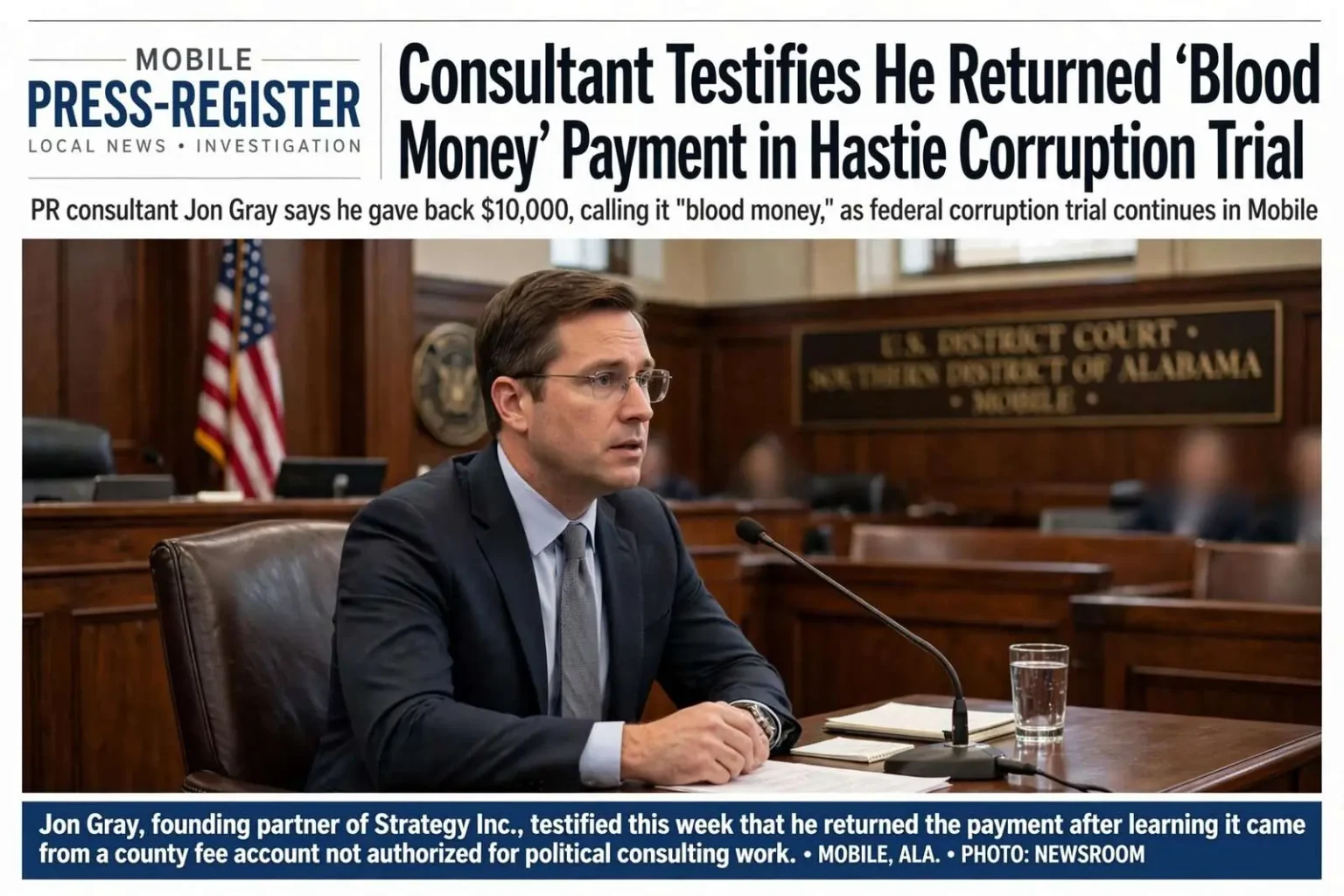
A public relations consultant testified this week that he handed back a $10,000 payment tied to work he did for Mobile County License Commissioner Kim Hastie because he considered it “blood money,” part of testimony in the federal corruption trial unfolding in Mobile. The moment provided jurors with one of the more vivid characterizations yet of the money at the center of a case that has pulled back the curtain on the business of county government along the Gulf Coast.
Jon Gray, founding partner of the public relations firm Strategy Inc., told jurors in U.S. District Court that Hastie hired his firm in January 2014 to help coordinate legislation that would let voters decide on a constitutional amendment merging Mobile County’s license and revenue offices statewide. “I didn’t want that blood on my hands,” Gray testified, explaining that he returned the money after learning it may have come from an account not authorized for that purpose.
At the time, Hastie was running unopposed to become Mobile County Revenue Commissioner, a role that would have combined with her existing license commissioner duties. Gray said the merger was central to her campaign message. “This was going to be her accomplishment, to combine the offices and save money,” he told the court.
The proposed measure, which would have paid Hastie a $95,000 salary to oversee both offices, ultimately stalled after the Alabama Legislature never brought it to a vote. Constitutional amendments in Alabama must clear both legislative chambers before reaching the ballot, and the consolidation plan — whatever support it enjoyed locally — never made it that far.
The trial, taking place in Mobile’s federal courthouse, has become one of the region’s closely watched public corruption proceedings, focusing attention on how county officials fund political ambitions and where the line falls between routine consulting and the misuse of public money. Prosecutors have walked jurors through invoices, accounts and payments connected to the license commissioner’s office, while the defense has worked to show that the spending in question was authorized, or at least honestly believed to be.
Gray’s firm was among several private vendors whose dealings with the license office surfaced during the investigation. His testimony linked the political and financial threads of the case: the merger campaign that gave the spending its purpose, and the fund that prosecutors say should never have paid for it.
How the money came back
Gray testified that his firm returned the payment after an FBI special agent told him the funds had come from an account not authorized for that kind of expenditure, a claim a Mobile County attorney also affirmed.
Prosecutors say the money originated from a fund generated by a $1.25 fee added to driver’s license transactions, money intended to cover technology upgrades in the license office. Hastie’s defense has argued the fund had broader allowable uses.
That dispute over the fund’s permissible scope has emerged as one of the central battlegrounds of the trial. The fee, collected on transactions at license offices across the county, was designed to modernize systems and equipment in an office that handles tens of thousands of driver’s license and tag transactions each year. Prosecutors contend that using it for political consulting drained money tagged for technology; the defense has maintained that the account was not so narrowly restricted, and that drawing on it for the consolidation effort — a project its architects pitched as a money-saver for taxpayers — was within its purpose.
Despite returning the payment, Gray said he did not believe Hastie ever intended to break the law.
Despite returning the payment, Gray said he did not believe Hastie ever intended to break the law — an assessment that cuts against the prosecution’s most aggressive framing and underscores how even the prosecution’s own witnesses have stopped short of describing deliberate criminal intent.
Cross-examination and a county feud
Under cross-examination, he acknowledged it was unlikely the Mobile County Commission would have hired his firm directly, citing what he described as an “ongoing feud” between Hastie and County Commissioner Jerry Carl, against whom Gray had previously run a political campaign.
The acknowledgment mattered because the defense has sought to show that Hastie turned to outside contractors precisely because the normal channels of county government were closed to her. If the commission would never have funded a public relations effort for the merger, the argument goes, the license commissioner’s office was the only available route — an explanation aimed at intent rather than innocence, portraying questionable judgment in place of criminal design.
The personal dynamics Gray described trace back years. Mobile County’s commission and its independently elected constitutional officers — the license commissioner, revenue commissioner, sheriff, probate judge and others — operate as separate fiefdoms under Alabama law, each controlling its own revenue streams and staff. Cooperation between the camps is optional, and rivalry is common. The rift between Hastie and Carl, per Gray’s testimony, added a political layer to a case that prosecutors have presented as a straightforward accounting of public money spent on political ends.
Gray’s own history with Carl gave the defense’s questioning an additional edge: the witness on the stand had run a campaign against the commissioner whose office’s approval would have been needed for the spending. Defense attorneys used that history to suggest Gray’s recollections and motivations deserved scrutiny, while prosecutors pointed out that the underlying fact — the money went back — was never in dispute.
A codefendant’s acquittal bid
Elsewhere in the trial, attorneys for Deputy License Commissioner Ramona Yeager, who faces nine fraud-related charges in connection with the case, asked the court to acquit her, arguing she was not promoted into her role until after the consulting contracts were arranged.
Prosecutors countered that Yeager helped conceal altered invoices from the county commission, calling that concealment central to the case against her. The presiding judge said she would consider the request.
The timing argument frames the dispute over Yeager’s culpability: her lawyers contend she cannot be held responsible for arrangements made before she held the deputy’s title, while the government’s theory rests on conduct after the fact — paperwork that reached the commission in a form that did not match what had actually been done. Altered invoices, prosecutors told the court, were the mechanism by which consulting costs moved through the system without drawing the scrutiny that a county commission review would have provided.
Judged-directed acquittal requests are a standard feature of federal trials, raised after the government rests its case and again at the close of all the evidence. They are rarely granted, but the argument signals how Yeager’s defense intends to attack the indictment count by count, separating her conduct from the decisions she says belonged to others in the office.
The charges against Yeager form part of a broader case that has already ensnared multiple people connected to the license office, and her fate alongside Hastie’s will likely shape how county departments across Alabama document — and defend — their use of dedicated fee accounts going forward.
Political support for the merger itself
State Rep. Margie Wilcox, a longtime supporter of Hastie’s, also testified during the proceedings, telling jurors she viewed the proposed office merger as a sound way to save taxpayer money, underscoring the political backing Hastie’s consolidation plan had before the case became a matter for federal court.
State Rep. Margie Wilcox, a longtime supporter of Hastie’s, also testified during the proceedings, telling jurors she viewed the proposed office merger as a sound way to save taxpayer money, underscoring the political backing Hastie’s consolidation plan had before the case became a matter for federal court.
Wilcox’s testimony served as a reminder that the consolidation idea itself was never controversial in the way the payments behind it became. Merging the license and revenue offices was pitched as a streamlining measure — one office, one salary, one set of administrative costs, in place of two separately elected posts performing overlapping collection work for the same taxpayers. Versions of that consolidation debate have recurred across Alabama county government for years, wherever separately elected fee offices sit blocks apart collecting revenue for the same residents.
Why the case matters beyond one office
For Mobile County residents, the trial has offered an unusually detailed look at the machinery of county fee offices — the constitutional offices that handle driver’s licenses, tags and property tax collection, and that operate with a degree of independence unusual even among Alabama’s 67 counties. Each fee office controls accounts funded by the transaction fees its customers pay, and each answers to the voters rather than to the county commission, a structure prosecutors say created both the opportunity and the temptation at the heart of this case.
The $1.25 transaction fee at the center of the funding dispute is the kind of add-on most customers never notice, folded into the total printed on a license renewal receipt. Aggregated across the volume of transactions a large county office processes, however, such fees generate substantial sums — enough, prosecutors allege, to look like a convenient source of money for purposes the fee was never approved to serve. Defense counterarguments about the fund’s “broader allowable uses” will leave jurors to decide whether the account was a technology fund or simply a discretionary pool.
The case also shines light on the role of political consultants in local campaigns. Hastie’s unopposed run to become revenue commissioner — a race with no opponent and therefore no campaign pressure in the usual sense — still required messaging, coordination and legislative advocacy, all of which cost money. Gray’s testimony traced how that work was funded and, eventually, how at least one vendor decided the money behind it was tainted enough to return.
Whatever the jury decides, the trial has already produced consequences beyond the courtroom. The merger legislation never advanced, the revenue commissioner’s office remains separate, and the vendors and officials who moved through the license office’s accounts have watched their dealings dissected in public testimony. For county officials across the state watching the case, the lesson is likely to outlast the verdict: dedicated fee accounts attract scrutiny, and the paperwork that moves money out of them will be read line by line.
The trial continues in Mobile’s U.S. District Court, where prosecutors are expected to call additional witnesses as they work through the counts against Hastie and Yeager, and where the defense has indicated it will present its own account of how the license office managed its money and why it believed it was entitled to.