Baldwin County Eyes Presidential Primary Ballot for School Tax Renewals
After Baldwin County voters rejected school tax renewals in March, officials are weighing placing them on the 2016 presidential primary ballot.
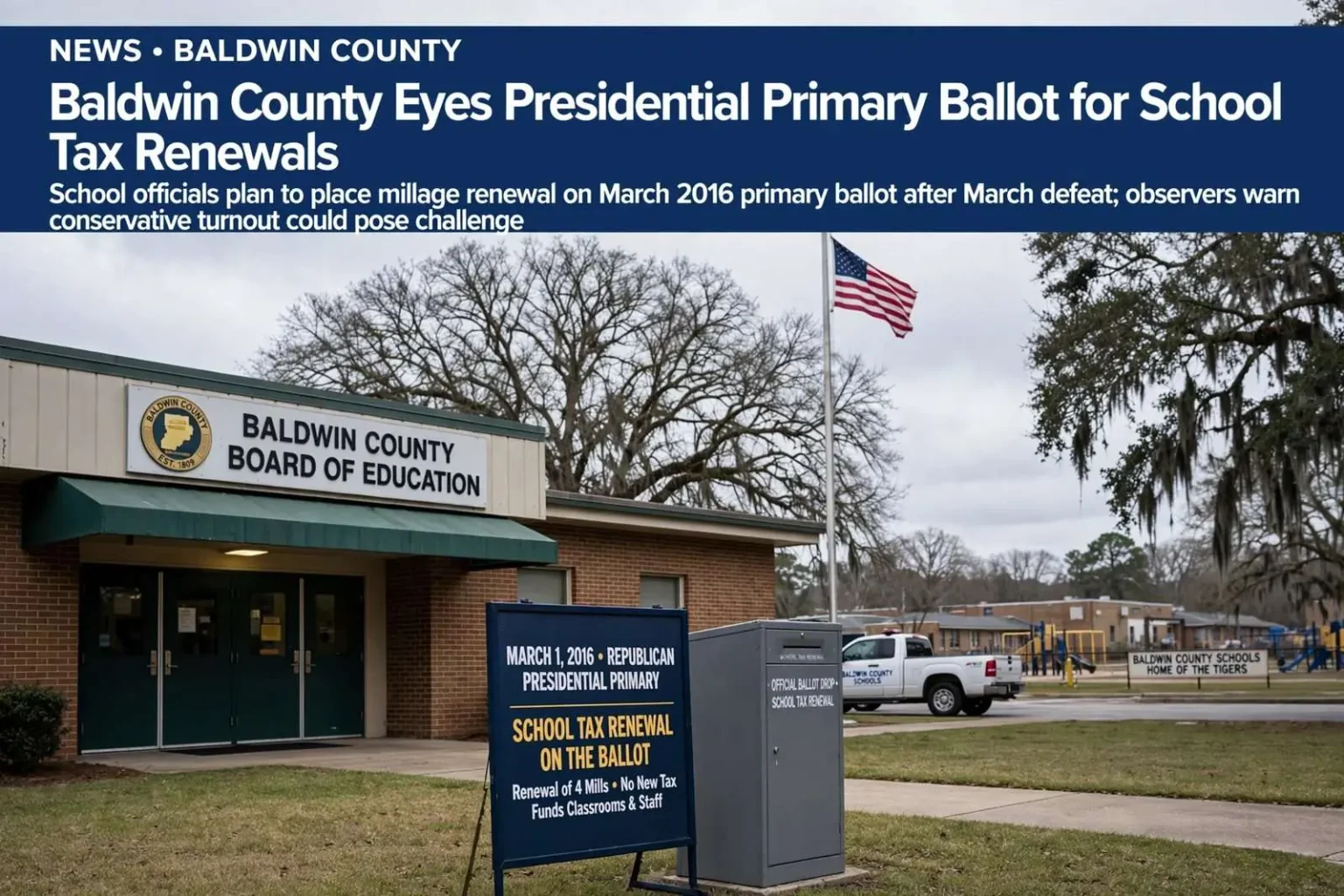
BALDWIN COUNTY, Ala. — Baldwin County school officials are eyeing next year’s Republican presidential primary as their next chance to win back millage renewals that county voters soundly rejected earlier this year, even as political observers warn that a heavily conservative primary electorate could work against them. The decision sets up a second referendum fight in less than a year over the property taxes that fund one of the fastest-growing school systems in Alabama, and it forces supporters to choose between a low-turnover ballot that favors loyal voters and a high-stakes election that could draw an unpredictable crowd.
Voters shot down the Baldwin County School Board’s property tax renewals in a March 31 special election, defeating the measures in all but one precinct across the county. The breadth of the defeat was the part that stung most for school officials: losing a tax vote in a handful of precincts might be written off as turnout or messaging, but losing nearly everywhere in the county suggested a deeper current of resistance that no single campaign could paper over.
At least 4 of those mills could now be headed back to voters on the March 2016 primary ballot, as the school system in Alabama’s fastest-growing county tries to avoid losing more than $7 million in annual revenue. For a district adding students nearly every year, that money funds the day-to-day cost of keeping classrooms open, and school leaders argue that losing it would force cuts that fall directly on children who had nothing to do with the election that produced it.
Understanding What Is at Stake
A mill is a unit of property taxation equal to one dollar per thousand dollars of assessed value, and Alabama school systems depend on locally voted millage for a meaningful share of their operating budgets. Because the state’s property tax framework keeps overall rates low by national standards, the local mills that communities vote onto themselves are often the difference between a bare-bones school budget and one that can afford current staffing levels. That is why a renewal fight in Baldwin County draws attention well beyond the county line — districts across the state watch to see how voters treat school tax questions.
The renewals in question are not new taxes in the strictest sense. They extend levies that property owners are already paying, so a successful vote keeps funding flat rather than raising it. School officials have argued that distinction should make the ask easier, but the March result showed that many voters treat any school tax question as a chance to push back, regardless of whether their bill would actually go up.
Baldwin County’s growth is the backdrop for the whole debate. New subdivisions continue to spread across the county from the Eastern Shore toward the beaches, feeding students into districts faster than many of their facilities were designed to handle. Fast growth cuts both ways in a tax argument: it creates genuine pressure on classrooms and school buildings, and it also brings in new residents who have no history with the county’s earlier school tax votes and no memory of the campaigns that produced them.
A Different Ballot, A Different Electorate
Political strategist and Baldwin County resident Jonathan Gray warned that a presidential primary, which historically draws hardline conservative and anti-tax voters to the polls, might not be the friendliest environment for a renewal campaign. He predicted that anti-tax sentiment, often reinforced from the pulpit in the lead-up to Republican primaries, will again dominate local political conversation in the months before the vote. In Gray’s view, the very voters most likely to show up for a presidential primary are the ones most likely to vote against a tax measure of any kind.
At the same time, supporters of the renewals may benefit from other high-profile local races drawing attention away from the tax question. The Baldwin County District Attorney’s race has already turned contentious, with retired judge Robert Wilters challenging incumbent Hallie Dixon over her leadership record. A competitive countywide race at the top of the local ballot can pull voters to the polls who might otherwise skip an election, and supporters hope some of those voters will be less animated by the tax issue than the base that turned out in March.
School board member David Cox said that combined with a crowded presidential primary field, voter attention could genuinely be split across many competing storylines this cycle. His point cuts both ways for renewal supporters: a distracted electorate may not organize against the taxes, but it also may not listen to the campaign to save them. Cox and other board members have acknowledged that they cannot count on the tax question being the only thing on anyone’s mind.
The Political Science of Turnout
Sam Fisher, an associate political science professor at the University of South Alabama, cautioned that a presidential primary could cut the opposite way too, potentially drawing more conservative voters to the polls specifically because of the national race, which could hurt the renewal’s chances. In primary elections, the electorate is not a random sample of the county — it is the most engaged slice of one party, and in Baldwin County that slice skews sharply conservative on fiscal questions.
School system spokesman Terry Wilhite pushed back on that concern, noting that Baldwin County voters have historically approved school sales tax renewals even during past presidential election cycles. His argument is that the county’s record on school funding questions is not as hostile as one bad special election suggests, and that voters have repeatedly chosen to keep school taxes on the books when the question was renewal rather than new money.
Unlike the March special election, which included proposals for 8 new mills tied to a $350 million building expansion plan, the 2016 ballot questions are expected to be renewals only, without new tax increases. The earlier proposals were defeated by wider margins than the renewal questions, which political observers noted were much closer contests. That distinction is the heart of the board’s new strategy: strip the package down to the least controversial piece and make the case that continuation is different from expansion.
Timing matters in Alabama school tax elections for a practical reason: the state requires local systems to secure a minimum level of local millage to receive their full share of state funding, and lapses in voted millage can ripple through a budget in ways that are hard to reverse. A failed renewal does not just remove money for one year. It creates uncertainty in staffing contracts, building maintenance schedules and debt planning that administrators must resolve before they know what revenue they can count on.
The experience of other fast-growing Alabama systems suggests why both sides treat this vote as consequential. Districts that lose local millage typically respond with some combination of larger class sizes, deferred maintenance and reduced programs, and none of those options plays well in communities that moved to Baldwin County expecting strong schools. Renewal supporters plan to make that connection explicit on the campaign trail, while opponents counter that the system can absorb the loss by trimming spending rather than raising or extending taxes.
Rebuilding Trust Before the Vote
School board members and local tea party leaders agree that public trust, not just ballot timing, will determine whether the renewals succeed. That rare point of agreement matters, because the March defeat was widely read as a rebuke of process as much as policy — voters who felt shut out of earlier planning decisions took their frustration out on the ballot questions, whatever their merits.
Board members Cecil Christenberry and Angie Swiger both pointed to plans for more transparency measures, including live-streamed board meetings and off-site sessions held around the county, similar to practices used by the Mobile City Council. The idea is to take the board out of its central meeting room and into the communities whose schools it governs, and to let residents watch decisions being made in real time rather than reading about them afterward.
A newly forming community task force, made up of at least 20 members nominated by area mayors, is expected to begin meeting later this month to gather public input ahead of the vote. Organizers describe the group as a way to route resident concerns directly into the school system’s decision-making before the campaign begins, so that the renewal ask in 2016 reflects input the public actually gave rather than a plan presented as finished.
Not everyone is convinced the process will be seen as fair. Lou Campomenosi, head of the Common Sense Campaign tea party organization in Baldwin County, questioned whether a task force selected partly by mayors who publicly backed the defeated March tax proposals can be viewed as truly nonpartisan. His criticism captures the skepticism renewal supporters must overcome: after a defeat this broad, every step the school system takes will be examined for signs that it is listening or simply re-running the same campaign with new branding.
Task force organizers say the goal is a broad, nonpartisan group focused on rebuilding public confidence in the school system’s spending and decision-making ahead of the March 2016 vote. Between now and then, the board must win two arguments at once — that the money is genuinely needed, and that the way it is spent has changed enough to earn a second chance. The crowded primary ballot, the contested district attorney’s race and the county’s own history of approving school tax renewals all give the outcome real uncertainty, and both sides will be spending the next year making their case.