Small Fire at Mobile Elementary School Causes Minor Damage, No Injuries
A small fire in a restroom at a Mobile elementary school caused about $3,000 in damage Wednesday, but no injuries were reported, officials said.
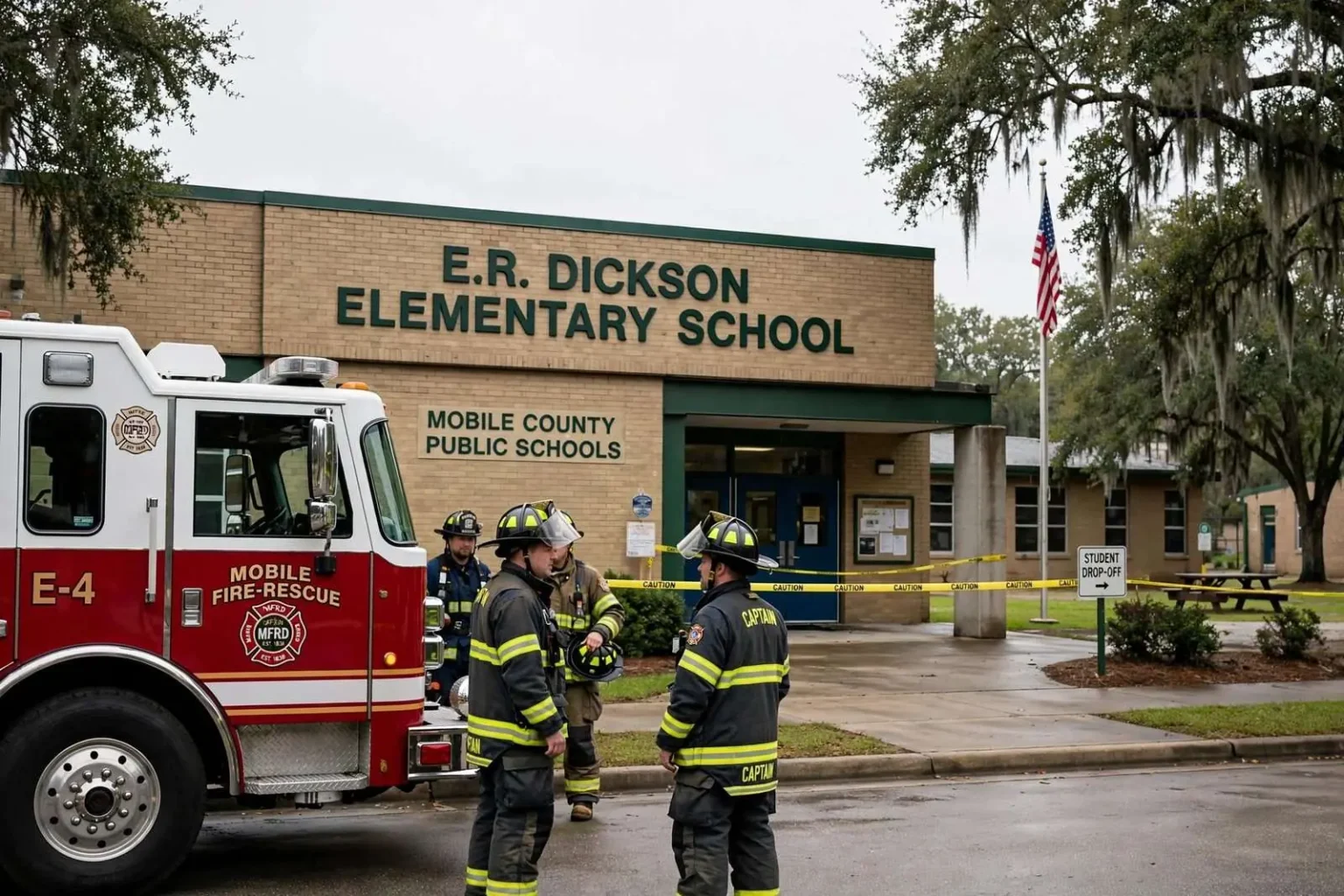
A small fire inside a bathroom at E.R. Dickson Elementary School in Mobile caused an estimated $3,000 in damage on a recent weekday morning, according to the Mobile Fire-Rescue Department, though no one was hurt and officials do not expect charges to be filed.
Crews were dispatched to the school around mid-morning after reports of smoke, but by the time firefighters arrived, a school employee had already extinguished the flames.
The rapid response from staff on the scene made the difference between a minor incident and a major one. A fire in an occupied school building, even a small one, sets a clock running — smoke moves through hallways faster than flames, and the difference between minutes and seconds determines whether an evacuation ends with students on the playground or in a parking lot down the street. At E.R. Dickson, the employee’s quick action meant the fire never got that head start.
Fire investigators determined the blaze started when a child was playing with fire inside a restroom and ignited a paper towel dispenser mounted on the wall. The fire was put out within minutes, according to the Mobile Fire-Rescue Department, limiting the damage to the fixture and surrounding area rather than spreading further into the building.
The estimated $3,000 in damage covered the dispenser, its mounting and the surrounding wall and finish surfaces — the cost of repairing a small corner of a large building. In school maintenance terms, that is a manageable repair, but one that still pulls custodial staff and contractors away from routine work and leaves a restroom out of service while it is completed.
A department spokesman said the quick response from school staff kept the incident from becoming more serious, and that no students or employees were injured as a result of the fire or the smoke it produced.
Why No Charges Will Be Filed
Because of the circumstances involved and the age of the child responsible, authorities said they did not anticipate filing any charges in connection with the incident.
The decision reflects the reality of elementary-age children and fire. Fire services across the country draw a sharp distinction between juvenile fire-setting done out of curiosity and arson committed with intent, and the response to the former is intervention and education rather than prosecution. A child too young to grasp what fire does is, in the system’s view, a child in need of teaching — not a defendant.
Alabama law sets the age of criminal responsibility well above the elementary years, which means a fire set by a young child at school simply cannot be charged as a crime no matter the outcome. That legal reality leaves the response to parents, school discipline and fire educators — the people positioned, in practice, to change the behavior. Prosecutors in Mobile County reserve juvenile arson cases for adolescents old enough to understand the danger and act with intent, and even those cases are handled through the juvenile system’s rehabilitative framework rather than adult court.
None of that minimizes the underlying risk. Children who play with fire once, uncorrected, statistically tend to do it again, and the next setting may not be a restroom with a quick-acting staff member nearby. That is why fire departments treat every juvenile incident, however small, as a teaching moment worth the follow-up visit — and why schools treat them as a prompt for the whole student body to hear the message again.
Fire departments typically follow up on such incidents with juvenile fire-setter intervention programs, which bring the child and parents together with fire educators to explain the consequences of fire, correct the misconception that playing with it is harmless, and screen for behavior that might warrant deeper attention. Mobile Fire-Rescue has long participated in public fire education, and elementary schools are among its most frequent venues for the message that matches and lighters are tools for adults, not toys.
Schools generally pair the official response with their own follow-up — a conversation with the student’s parents, a review of restroom supervision, and age-appropriate reminders to the student body about fire safety, handled without singling anyone out publicly.
A Common Pattern in School Fires
Small fires involving paper products or restroom fixtures are among the more common minor fire incidents reported at schools, and fire officials routinely note that wall-mounted paper dispensers and trash receptacles can ignite quickly if exposed to an open flame, even briefly. Because such fixtures are typically made of thin plastic or paper-based materials, fires involving them tend to spread fast in a small area but are also relatively easy to extinguish once identified, particularly when supervised adults are nearby.
Restrooms present a particular challenge for school administrators. They are the one semi-private space in a building full of children — unsupervised in the moment, visited throughout the day, and attractive to the kind of experimental behavior that students would not attempt in a classroom under a teacher’s eye. Fire officials and school safety specialists note that restroom fires account for a disproportionate share of intentionally set school fires nationally, which is why districts pair restroom design choices — durable fixtures, good visibility from hallways — with supervision routines.
The materials involved in this fire are typical of the genre. A wall-mounted paper towel dispenser holds a concentrated stack of paper, fed from a roll and packed into a plastic housing, and a small open flame can turn it into a burning column within a minute. The saving grace is the same as the vulnerability: the fire burns through its fuel quickly and, contained to a fixture on a tile or block wall, rarely reaches the structural elements of a modern school building. Smoke and water — from the extinguisher or hose that puts it out — usually do more damage than the flames themselves.
Mid-morning timing also worked in the school’s favor. The building was fully occupied, meaning any smoke or alarm reached dozens of adult eyes and ears within moments, and the hallways were not yet crowded with the lunch or dismissal traffic that complicates both detection and evacuation. A fire that starts when a building is full of alert adults is a fire that gets reported — and fought — almost immediately.
Incidents like this one typically prompt schools to review basic fire-prevention protocols with students and staff, including reminders about the dangers of open flames and unauthorized lighters or matches on campus.
The review usually extends to the adults as well: confirming that every staff member knows the evacuation plan for their wing, that fire extinguishers are charged and accessible, and that the person who acted quickly this time — the employee who had the fire out before trucks arrived — represents the kind of readiness the district wants everywhere.
Mobile County’s School Safety Framework
Mobile County Public Schools, like most districts, maintains fire safety plans and conducts regular drills at each of its campuses, in line with state requirements for school fire drills throughout the year. The state’s fire code treats schools as high-priority occupancies, with requirements covering alarms, extinguishers, sprinklers where mandated, and inspection schedules that bring fire officials onto campuses routinely rather than only when something goes wrong.
Drills are the visible part of that framework, and students at elementary schools like E.R. Dickson practice them from the first weeks of kindergarten — lining up, walking out, assembling at a designated spot while teachers account for every child by name. The repetition is deliberate: in a real incident, no one has time to read a plan, so the plan has to already be in everyone’s legs.
The district’s size makes the framework a considerable logistical undertaking. Mobile County Public Schools is Alabama’s largest school system, operating dozens of campuses across the county from downtown Mobile to the county’s western and northern reaches, each with its own buildings, age profiles and quirks. Fire safety at that scale means standardized plans, regular inspections and a maintenance operation that can respond to an incident like the E.R. Dickson fire — a burned dispenser and a scarred wall — and have it repaired and forgotten within days.
What Happens Next at E.R. Dickson
For the school community on Girby Road, the episode ends as the best kind of fire story: one with a $3,000 repair bill, a restroom back in service, and everyone — students, staff, firefighters — walking away uninjured.
The lessons it leaves behind are the durable ones. Staff readiness worked: an employee acted before the fire grew. The alarm and dispatch system worked: crews were rolling within moments of the smoke report. And the intervention that follows — the conversation with a young student about what fire actually does — may be the most consequential part of all, because the goal in a case like this is not punishment. It is making sure the next report of smoke at an elementary school in Mobile never has to come at all.