Salvation Army Angel Tree Distribution Brings Christmas Relief to Mobile Families
About 900 Mobile-area families picked up Christmas gifts at The Salvation Army's Angel Tree distribution near Dauphin Street, aided by dozens of volunteers.
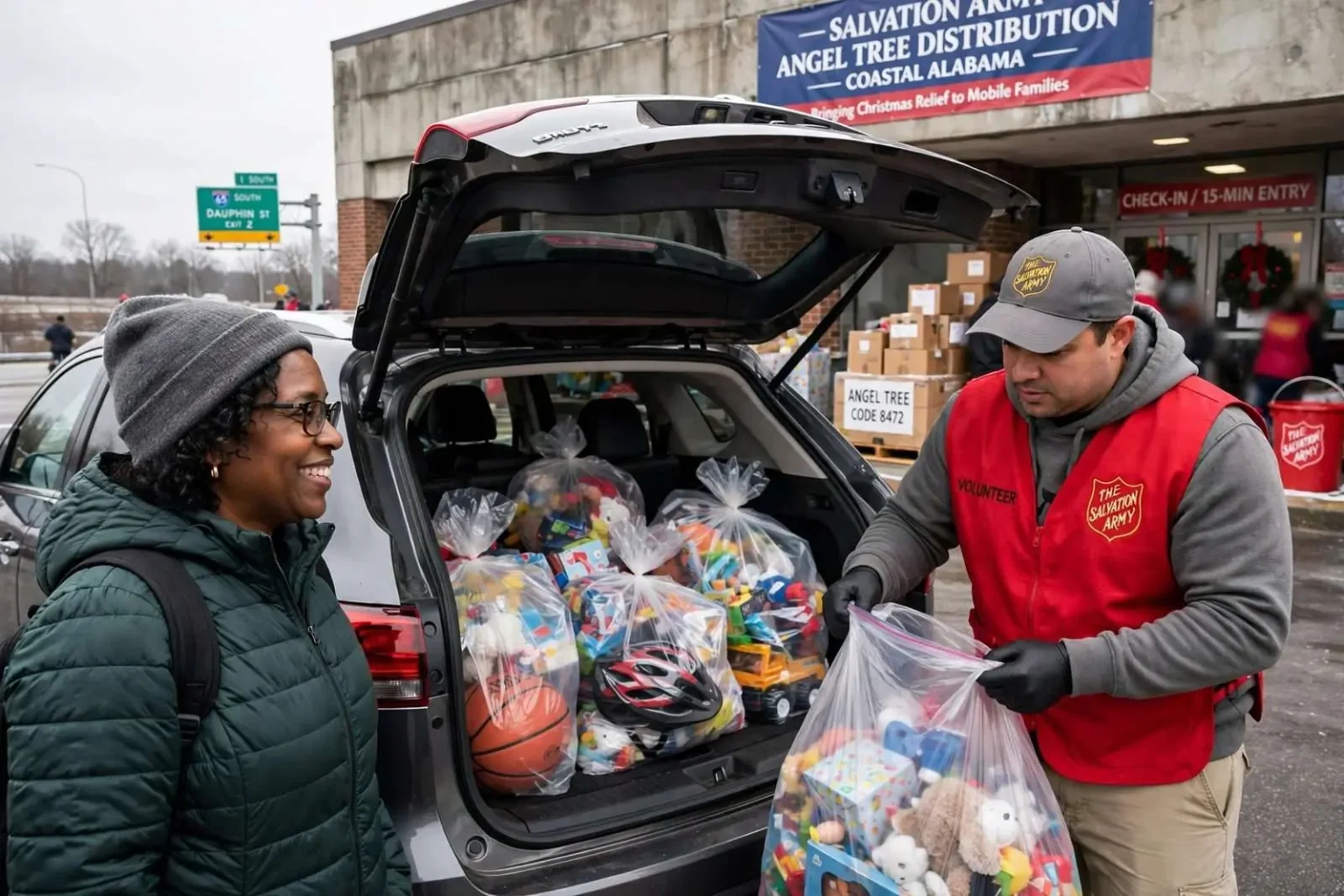
Geraldine Lindsey couldn’t hide her smile as she followed a Salvation Army volunteer loading bags of toys for her two daughters into her SUV outside a former West Telemarketing building just off Dauphin Street near Interstate 65. “I thank God for this,” she said. “On Christmas morning, they’re going to be so excited. I just want to see them smile.”
Lindsey was one of roughly 900 people who came through The Salvation Army’s Angel Tree distribution in Mobile, picking up bags of toys along with bicycles and basketball goals for children whose families had registered for help back in September. The vacant building, transformed for a few days each December into a warehouse of wrapped hopes, hummed with the steady traffic of parents, grandparents and guardians carrying out Christmas for households across the city.
Inside the building, staff and volunteers had built a system designed to move families through efficiently, with a line forming outside in 15-minute intervals. The staggered entry kept the lobby from crowding and gave each family a predictable window, an unglamorous piece of logistics that made the difference between an orderly giveaway and a crush of hundreds of people in a vacant building.
How the Angel Tree Works
When families registered months earlier, they were asked to list a “need” and a “want” for each child, according to Maj. Mark Brown, area commander for The Salvation Army of Coastal Alabama. Those requests, ranging from shoes and a basketball to a blanket and a train set, were written on paper angels and hung on Angel Trees around the region, including one at Bel Air Mall, others at area Walmart Vision Centers, and one at the Tanger Outlet Center in Foley.
The need-and-want structure is what separates the Angel Tree from a generic toy drive. A donor who picks an angel knows the specific child on the other end — a girl who needs winter shoes and wants a bicycle, a boy who needs a blanket and wants a train set — and can shop for a real child rather than an abstraction. Shoppers at the mall, the vision centers and the Foley outlets pull angels from the trees each December, and the ones they choose come back to the distribution center as bags bearing code numbers.
The Salvation Army had already distributed toys earlier in the week in Foley and Bayou La Batre before Wednesday’s Mobile distribution, staging the same operation in South Baldwin County and the fishing communities of south Mobile County before the largest event. The multi-site schedule reflects the reach of the Coastal Alabama command, which serves a region that stretches from the state line to the beaches and includes communities where a trip to Mobile is an hour each way.
The Volunteers Who Make It Run
About 40 volunteers worked from 9 a.m. to roughly 5 p.m. matching code numbers to cardboard boxes, each representing a family that had signed up for help. Some families had just one bag for a single child; one box held nine bags for a larger household, Brown said. The sorting floor ran on simple arithmetic — angels in, bags out, every code number matched — performed at a pace that kept the 15-minute lines outside moving.
Every bag, packaged in large clear plastic, contained the child’s stated need and want along with a few extra items either purchased directly by the donor who “adopted” that child’s angel or added through a separate community toy drive. Families were expected to take the bags home to wrap for Christmas morning, a detail that matters more than it sounds: the presents under the tree on Christmas Day are wrapped by the parents, not the charity, preserving the moment every parent wants to give a child.
Longtime volunteer Sophia Newby, who has helped with the Angel Tree program for 16 years, said the effort depends on teamwork. “This is my way of giving back,” she said. “It’s a team thing. It always goes smoothly when you have a team. We want to make each child as happy as can be.”
Brown echoed that sentiment, crediting the volunteers directly for making the large-scale distribution possible. “We could not manage it without these absolutely wonderful volunteers,” he said.
The volunteer corps at a distribution like Mobile’s is a cross-section of the community — retirees who return every December, church groups, employees given a day off to serve, and in this case volunteers from the U.S. Coast Guard, whose presence at a Salvation Army event reflects the long partnership between the service and the Gulf Coast communities where its aviation and sector facilities are based. The parking lot outside the distribution center stayed busy throughout the day, with Salvation Army staff and Coast Guard volunteers helping carry bags of gifts to family vehicles.
Why Donors Keep Coming Back
Brown said he has been moved over the years by families who make adopting an Angel Tree child a yearly tradition, sometimes choosing children the same age as their own kids, and occasionally choosing an angel quietly in memory of a child they lost.
“It’s almost as meaningful, or even more meaningful, for the people who give than for those who receive,” he said. The observation runs against the usual assumption about charity — that the flow of benefit runs one way — but anyone who has watched a family select an angel off a mall tree year after year recognizes what he describes. For many donors, the angel on the tree is the part of December that feels most like Christmas.
The tradition also solves the program’s central problem: scale. Roughly 900 adults came through a single day of distribution in Mobile alone, with earlier rounds in Foley and Bayou La Batre, and no charity can shop for that many children with staff alone. The angel system distributes the work across thousands of individual shoppers, each carrying a small piece of the operation, while the community toy drive backfills the bags where an adopted angel’s donor fell through.
The Reach Across Mobile
Among those in line was Ashley Bendolph, who brought her six-week-old baby along with her mother to pick up gifts for her three older children, one more example of the program’s reach across Mobile-area households this holiday season. Three generations of one family made the trip together — the kind of detail that plays out hundreds of times at a distribution site and rarely makes it into the numbers.
The families the program serves are identified months in advance, with registration opening in September and continuing until the available angels are claimed. That early deadline reflects the logistical reality of the operation: paper angels have to be printed, hung and adopted, and donors need shopping weeks before the bags must be matched, boxed and staged. A family that waits until December to seek help has generally missed the window, which is why the Salvation Army’s other December programs — the kettle stands outside grocery stores, the community toy drive that supplements the angel bags — exist to catch the overflow.
For the children on the receiving end, the program’s design keeps the focus on Christmas morning. The bicycles and basketball goals loaded into SUVs outside the former telemarketing building, the train sets and shoes inside the clear plastic bags, all of it arrives under the tree wrapped by a parent who picked it up like any other present. Lindsey’s hope — to see her daughters smile on Christmas morning — is, in the end, what the whole apparatus of angels, volunteers and code numbers is built to deliver.
The distribution closed out another season for the Coastal Alabama command, but its calendar never really resets. Registration for the next Christmas begins before school starts, kettle season begins before Thanksgiving, and the volunteers who matched code numbers this week will be asked back next December. Sixteen years in, Newby’s arithmetic still holds: it always goes smoothly when you have a team.
A Building Transformed for a Week
The choice of venue says something about the scale of the operation. A former telemarketing building off Dauphin Street near Interstate 65 offers what a storefront or church fellowship hall cannot: open floor space for rows of numbered cardboard boxes, loading access for truckloads of toys, and parking for the SUVs and pickup trucks that stream through all day. Every December, the building trades its empty offices for sorting tables and shrink-wrapped bicycles, then empties again after the last family drives away.
The location also puts the distribution within reach of the neighborhoods where need is concentrated, a short drive from the Dauphin Street corridor and visible from the interstate that carries commuters across the city. Families came from across Mobile County, and the day’s steady rhythm — lines forming on the quarter hour, bags leaving by the armload — continued from the 9 a.m. opening until the afternoon wound down around 5 p.m.
The Salvation Army’s Christmas work in Mobile sits within a much larger year-round operation. The same command that stages the Angel Tree runs shelters, feeding programs and social services across Coastal Alabama through the rest of the year, and the December push — kettles, angels, toy drives — funds and symbolizes the mission the organization pursues in every season. Christmas is the organization’s visible moment, when the red kettles and paper trees are on every corner, but the volunteers who return each December are largely the same community members who support the work in July.
That is the quiet lesson of a distribution day: the smiles Lindsey carried out the door in clear plastic bags were assembled by a chain of hundreds of strangers — the registrars who took down a need and a want in September, the shoppers who pulled angels off trees at Bel Air Mall and in Foley, the donors who bought the extra gifts, the volunteers who matched numbers for eight hours, the Coast Guardsmen hauling boxes across a parking lot. By the time a parent backs out of the lot, the charity of an entire region has passed through a vacant building on Dauphin Street — and on Christmas morning, two little girls in Mobile will never know how many hands it took.