
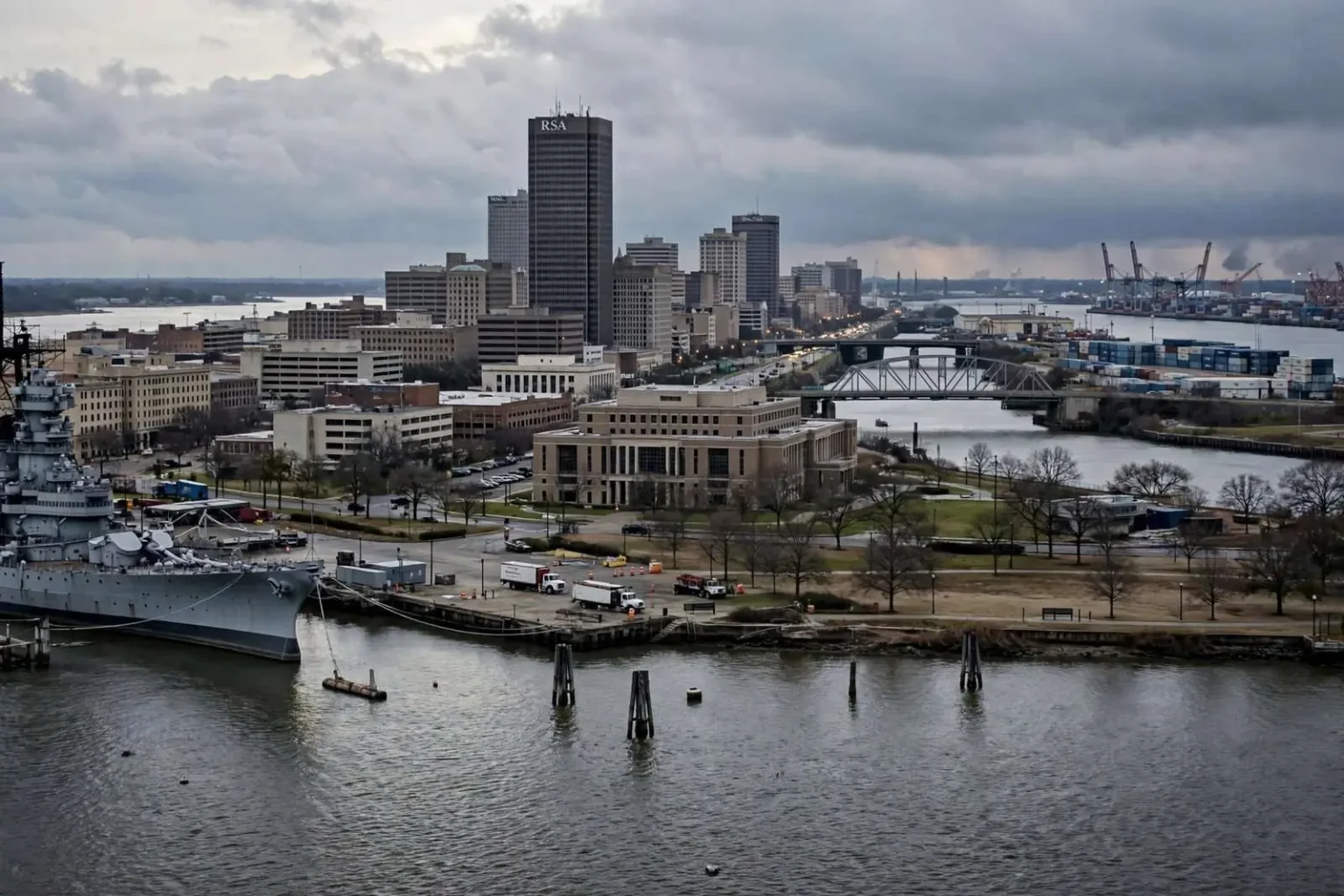
With Mobile’s municipal elections set for Aug. 25, 2009, and fewer than nine months to go, the field was nearly empty. Only one candidate had announced: Mobile police detective Ron Wallace, who would oppose longtime City Councilman Clinton Johnson in District 3. Challengers in the other six council districts, and any opponent for first-term Mayor Sam Jones, were expected to surface shortly after the holidays. In the meantime, a cross-section of the city’s civic, business and legal community was asked a simple question: what will the issues be — and what should they be?
The answers, gathered in the closing weeks of 2008, amounted to an unusually candid inventory of what Mobile worried about. Mobile operates under a mayor-council form of government in which the mayor runs citywide and seven council members represent individual districts, all chosen in the same nonpartisan election every four years. That structure means a single campaign season can reset both the city’s executive leadership and the entire council at once, which is why the quiet months before qualifying opens matter as much as the race itself. What follows is a summary of the concerns that surfaced again and again in those conversations.
Annexation, again
No subject came up more often. The Jones administration had pursued annexation aggressively, and opinion divided sharply over whether it represented growth or a revenue grab. Matthew S. Metcalfe of Airland Corporation put the case for it bluntly: “Either we grow or die (like Birmingham)… Growth is growth.”
Bill Tunnell, executive director of USS Alabama Battleship Memorial Park, predicted annexation and city employee raises would lead the field. Others were hostile. One retired respondent called the annexation program a consequence of reckless spending, arguing the city was trying to adjust its income to meet its expenses rather than the reverse. A retired restaurant critic was blunter still: he called it “an overt grab of tax revenues as well as an overt grab to expand a power base.”
The intensity of those reactions reflected a long and unsettled history. Mobile had spent decades expanding its boundaries westward and southward into unincorporated Mobile County, absorbing neighborhoods and commercial corridors whose residents suddenly found themselves city taxpayers. Each annexation added population and sales tax base to the city, but it also added miles of streets, drainage and public safety obligations, and county residents in the affected areas often resisted being pulled into city jurisdiction. Critics argued that the city was chasing tax revenue from growing commercial areas while pushing their infrastructure costs into the future; supporters countered that a city that stands still while its suburbs grow gradually loses its employment centers, its convention business and its standing in the region.
The stakes were easy to state. Birmingham’s long decline as Alabama’s largest city — hollowed out by suburban flight and boundary lines frozen decades ago — has been the cautionary tale cited in Gulf Coast growth debates for a generation. Mobile’s proximity to fast-growing Baldwin County, and the steady migration of shoppers and employers across Mobile Bay, gave the argument urgency. Whether annexation was growth policy or fiscal patchwork promised to be the first question any mayoral candidate would face.
Crime, police and the pension
Public safety ran a close second. Community leader John Gavin listed rising crime first among his concerns and tied it directly to the strain on the police and fire departments, which he said were losing personnel in record numbers to better-paying jobs elsewhere. He also flagged the quiet consolidation of gangs and called for reviving the code enforcement unit of the Dow years.
Attorney Karlos Finley pointed specifically to violence in the R.V. Taylor and Birdsville housing communities and to the morale and attrition problems at the Mobile Police Department. Bess Rich, the former District 6 councilwoman, cited officer and paramedic staffing, response times and morale alongside robberies, murders and other violent crime.
The staffing concerns were not abstract. Gulf Coast police departments had spent years losing trained officers to municipal agencies in Florida and elsewhere that paid substantially more, and every departure took years of accumulated experience with it. Replacing an officer is slow work — months of academy training followed by months of field supervision — so a run of resignations shows up in response times and neighborhood patrol coverage long before it shows up in a budget document. Fire and EMS staffing followed the same math, with paramedics in particular drawn to higher-paying hospital and private ambulance work.
Behind the crime debate sat a fiscal question that had rarely made it onto a campaign platform. A lawyer writing anonymously urged voters to ask about the unfunded liability of the police and firefighters’ pension fund, noting that it is treated as off-the-books debt and rarely mentioned when the city’s per-capita debt is discussed. County Commissioner Steve Nodine put shoring up pension contributions at the top of his own 10-point list.
Public safety pensions were under strain nationwide at the time, and Mobile was no exception. Retirement benefits for police and firefighters are typically more generous than general-employee plans because of the physical demands of the work, and when investment returns fall short or payroll grows without matching contributions, the gap between promised benefits and set-aside money widens quietly. For candidates, the topic carried a built-in tension: acknowledging a large unfunded liability meant either raising taxes or trimming benefits — both unpopular with the very public safety employees a candidate needed on their side. That few candidates volunteered to discuss it was itself a story.
Gavin’s call to revive code enforcement pointed at a related neighborhood concern. Blighted houses, overgrown lots and derelict commercial buildings depress property values and, residents argued, create the conditions in which crime takes root. A functioning code enforcement operation — inspectors, citations, demolition orders — was seen in many neighborhoods as the city’s most visible promise kept or broken.
The bridge, the port and the tanker
George Crozier, director of the Dauphin Island Sea Lab, answered in two words, twice: THE BRIDGE — the proposed new I-10 crossing of the Mobile River — along with a plea for more commitment to subsidized mass transit.
Business executive Elliot Maisel warned of a lockdown on Interstate 10 once the container facility opened and called for a long-term bus and light rail program coordinated across Mobile, Baldwin and Washington counties and with Mississippi. “Mobile is a small city now as opposed to a big town,” he said.
The traffic worries had a concrete source. The George Wallace Tunnel under the Mobile River, opened in 1973, was built for a fraction of the volume that Mobile’s growing port and the region’s growth were expected to push through it. Freight and commuter traffic funneled into a bottleneck that backed up daily, and the state’s long-studied plan for a new I-10 crossing — a large bridge rising over the river and the working waterfront south of downtown — had been debated for years over questions of height, cost, placement and the impact on historic neighborhoods. The pending opening of the container terminal at the Alabama State Port Authority’s Choctaw Point facility promised to add trucks to that congestion, which is why business leaders framed the issue as economic survival rather than convenience.
Regional transit was the other half of the argument. Mobile’s public bus system had long run on a lean budget, and none of the three coastal counties had the kind of coordinated, funded regional transit network that peer Southern cities had begun building. Maisel’s call for cooperation across Mobile, Baldwin and Washington counties and with neighboring Mississippi acknowledged a reality on the ground: thousands of workers crossed the bay every day, and the bridges and tunnels that connected them were the same ones carrying freight.
Finley and Nodine both put the aerial refueling tanker contract near the top of their lists, with Nodine describing an “all-out assault” to secure a program that would make Mobile an international aerospace hub. The competition to build the Air Force’s next-generation refueling tanker had become a defining economic fight for the city. EADS North America had proposed assembling the aircraft at the former Brookley Air Force Base property adjacent to Mobile’s downtown airport, and the promise of thousands of assembly jobs, an aerospace supplier chain and a new industrial identity for the city hung on the Pentagon’s decision. Local officials had already broken ground on assembly-site work in hopes of locking the project in, and every candidate was expected to have a position on it.
Finley also asked what the city intended to do with the Theodore Industrial Canal now that it had been annexed. The canal, dredged to serve industrial sites in the Theodore area south of the city, posed the same question annexation always poses: new territory brings not just revenue but maintenance obligations — in this case waterway depth, spoil disposal and industrial safety — that the city would now own outright.
Money, and what it buys
Page Stalcup, a CPA with Wilkins Miller, predicted pocketbook issues would dominate and that the candidate who best soothed economic fears would hold the greatest appeal. Bob Brazier, general manager of the Arthur R. Outlaw Convention Center, expected cost-cutting to be the theme.
The timing made that prediction easy to understand. The closing weeks of 2008 were the deepest stretch of the national financial crisis, and Alabama’s city budgets — built heavily on sales tax collections — feel recessions quickly. Every dollar of the city’s spending on police, fire, parks and streets traces back to revenue that contracts when consumers pull back, so the promise to “cut costs” and the promise to “keep neighborhoods safe” were headed for a direct collision in the 2009 campaign.
Gavin and roofing contractor Jerry Lathan both took aim at the Mobile Civic Center, which Lathan called “a virtual ghost town.” The downtown arena, exhibition halls and theater complex had opened in the 1960s and, despite renovations, struggled in recent years to book the concerts and events that newer facilities in the region attracted. Debates over whether to reinvest, rebrand or eventually replace it had been simmering for years, and its empty calendar made it a ready-made symbol in any argument about how the city spent its money.
Lathan also asked why Mobile’s airport boarded roughly 700,000 passengers a year while Pensacola boarded 1.8 million and Gulfport 1.2 million, and why the city’s subsidy of the transit system had grown from a projected half-million-dollar deficit to more than $3 million.
Both questions cut at the same vulnerability: Mobile was losing travelers and tax dollars to airports across state lines that had attracted low-fare carriers, and the city’s own transit system had become a growing claim on the general fund. For fiscal conservatives in the civic survey, the two together made the case that the city needed to re-examine not just how much it spent but what it was buying with the money.
Attorney Pete Burns wanted a different conversation altogether: competing visions for the city’s future, including fuel efficiency, mass transit, citywide wireless internet, and how Mobile might avoid being choked off by bedroom municipalities.
His list captured a strain of thinking common in mid-sized Southern cities at the time — that growth in the next decade would reward places that invested in connectivity, energy efficiency and urban quality of life, and that a city content to sprawl outward while suburbs incorporated around it would wake up one day with its commercial core surrounded by jurisdictions claiming its shoppers.
One downtown respondent summed up the likely dynamic in a sentence: “I think it will be a referendum on Mayor Jones.” Jones had won the 2005 mayor’s race to succeed the long-serving Mike Dow, becoming the city’s first African-American mayor, and had governed through an annexation push, a national recession and the tanker fight. With no declared challenger as 2008 ended, every issue in the survey was, in effect, a preview of the case that a challenger would eventually build — and a checklist of what the incumbent would have to defend.