Mobile County Approves $5 Million for New Trucks, Patrol Cars and Ambulances
The Mobile County Commission approved $5 million in capital equipment purchases covering road department trucks, sheriff's vehicles and EMS ambulances.
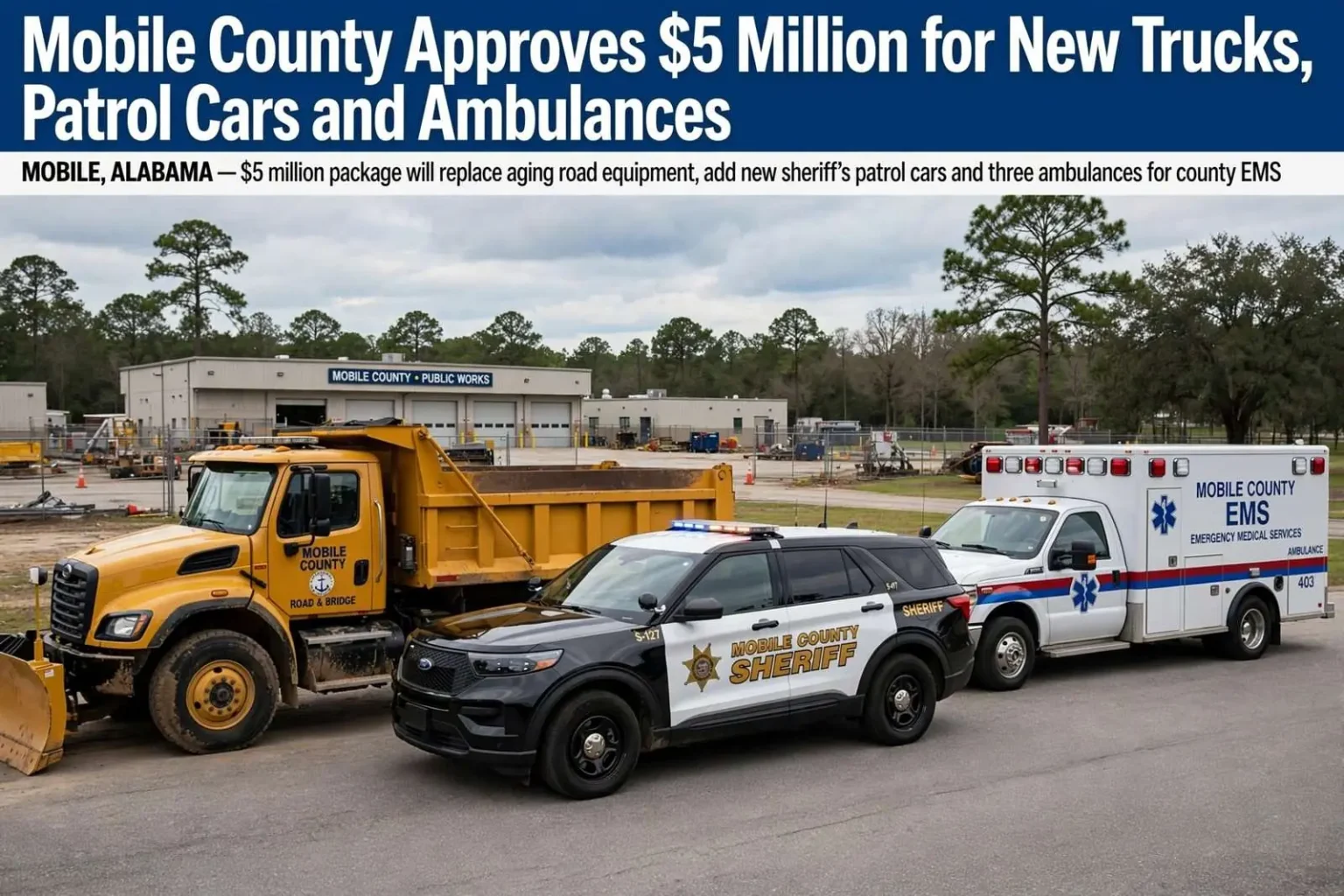
MOBILE, Alabama – The Mobile County Commission approved roughly $5 million in capital equipment purchases during a recent meeting, funding replacements for aging road department vehicles, new sheriff’s patrol cars and additional ambulances for the county’s emergency medical services. The package touches nearly every corner of county government — from the dump trucks that grade rural roads to the ambulances that answer calls across Alabama’s second-most-populous county — and it arrived in a single vote that commissioners framed as routine maintenance of the county’s service capacity rather than an expansion of it.
Capital purchases of this kind sit at the heart of county government’s daily work. Unlike cities, counties deliver a long list of services directly: they build and maintain roads outside municipal limits, operate major law enforcement and emergency medical operations, run animal control and manage the infrastructure of elections. Each of those functions rides on fleets of vehicles and heavy equipment that wear out on predictable schedules, and deferring replacement for too long costs more in repairs and downtime than the original purchase would have. The $5 million package was presented in exactly those terms.
The Biggest Share: Roads and Bridges
The single largest portion of the spending, about $3.5 million, will go to the county’s road and bridge department to replace a number of dump trucks and to purchase a grader, an excavator and mowers used for maintaining county roadways and rights-of-way. County officials said much of the existing heavy equipment fleet has reached the point where replacement is more cost-effective than continued repair, a familiar threshold for public works departments running machines through years of daily duty on rural roads.
The county’s road network is vast by any measure. Mobile County covers more than 1,200 square miles, and outside the cities of Mobile, Prichard, Saraland and the other municipalities, the county commission’s road and bridge crews are responsible for grading, resurfacing, drainage and right-of-way maintenance across thousands of properties. Dump trucks and graders are the backbone of that work, hauling material and reshaping shoulders after storms, while mowers keep rights-of-way clear for visibility and drainage through a growing season that runs most of the year in south Alabama’s climate.
A grader and an excavator add capabilities that fleet age had eroded. Graders maintain the unpaved roads that cradle much of the county’s rural development, and excavators handle the ditch and drainage work that determines whether a rural road survives the region’s heavy rains and hurricane seasons. County officials have repeatedly linked storm recovery speed to equipment availability — crews can only work as fast as their machines allow — and the replacement purchases were cast as insurance against the next season of severe weather.
Patrol Cars and Ambulances
The Mobile County Sheriff’s Office will receive $765,000 of the approved funding for patrol vehicles and other law enforcement equipment, helping the department keep pace with the wear and mileage that patrol cars accumulate over years of service. A county patrol unit can run through a passenger car’s useful life in a fraction of the normal time, with deputies covering sprawling rural districts and interstate corridors around the clock, and the sheriff’s office maintains a replacement cycle to keep front-line units reliable.
Emergency medical services will receive $405,000 to purchase three new ambulances along with related medical equipment, an investment county officials described as necessary to maintain reliable emergency response capacity across the county. Ambulance fleets age harder than almost any other public vehicle — engines idle at emergency scenes, suspensions absorb thousands of transports, and onboard medical equipment demands both power and space — and a county the size of Mobile cannot afford to have units out of service when call volume peaks. The three new units slot into a coverage map that stretches from the city’s neighborhoods to the rural communities along the Mississippi line and the shores of Mobile Bay.
The Rest of the Package
Additional purchases approved as part of the package include new trucks for Mobile County Animal Control and equipment upgrades for the county’s voting machine warehouse, according to the county’s director of public affairs and community services. Both line items serve functions the public rarely sees until something goes wrong. Animal control handles everything from stray calls to animal cruelty investigations across the county’s unincorporated areas, and its field trucks take a beating; the voting machine warehouse, meanwhile, houses the equipment that every election in the county depends on, where climate control and security upgrades are the difference between machines that certify and machines that fail.
The election warehouse investment carries its own weight on the calendar. Mobile County runs some of the largest vote totals in Alabama, and the equipment stored and staged there — voting machines, ballot supplies, tabulation gear — must be maintained, tested and moved to precincts on a fixed schedule. Upgrades to the facility’s equipment are the kind of spending that never draws a headline but prevents the kind of Election Day failure that does.
A Busy Day for Capital Spending
The commission approved the capital purchases the same day it signed off on a master plan for a new soccer and aquatic center complex, making it a significant meeting for county capital spending overall. The pairing of the two actions illustrated the two lanes of county investment running side by side: the equipment package maintains services the county already delivers, while the recreation complex plan points toward facilities the county intends to build. Commissioners have pushed in recent years to expand youth sports infrastructure, arguing that tournament-grade facilities draw visiting teams and their spending while giving local families alternatives to traveling out of county for leagues and competitions.
County officials noted that despite the sizable equipment investment, Mobile County’s overall debt payments are projected to decrease by about $2 million in the 2015 fiscal year compared to 2014, a reduction they attributed to the county’s broader debt management strategy even as it continues funding necessary equipment replacement. The county has worked for years to retire older obligations and refinance debt at favorable terms, and officials have pointed to the declining debt service as evidence that the commission can fund fleet replacement without borrowing its way into higher annual costs.
The equipment purchases will roll out as dealers deliver the vehicles and heavy machines over the coming months. Road and bridge crews will see the first benefit, with the new dump trucks, grader and mowers rotating into service as older units are retired or relegated to backup duty; the sheriff’s patrol vehicles and the three ambulances will follow the same path, replacing high-mileage units one for one.
For county residents, the practical effect is continuity of service rather than anything visibly new. The same crews will still grade the same miles of rural road, the same deputies will answer calls from Citronelle to Grand Bay, and the same medics will run the same emergency routes — but on machines that are newer, cheaper to maintain and less likely to fail at the worst moment. County government’s most important purchases, as this meeting demonstrated, are usually the least glamorous ones: trucks, graders, patrol cars and ambulances, replaced on time so the county’s promises to its residents keep their schedule.
How the Commission Pays for It
County capital purchases of this size are typically funded through a mix of current-year revenue and scheduled equipment funds rather than new borrowing, which is why officials could pair the $5 million outlay with a projected drop in annual debt service. The commission’s general fund draws on property tax and sales tax collections from across the county, and a healthy revenue year allows fleet replacement to be cash-funded — avoiding the interest costs that pile on when equipment is financed over its whole working life. Officials have described that discipline as the quiet engine behind the county’s improved fiscal standing in recent years.
The three-member commission, with each member representing a geographic district, approves such packages in public meetings where the line items are laid out for scrutiny. That structure gives each commissioner a direct stake in how equipment is distributed across the county, since the condition of a district’s roads and the response times of its sheriff’s and EMS units are among the most visible measures of the commission’s performance. Fleet requests are assembled by department heads, weighed against usage records and repair histories, and consolidated into a package that spreads replacements across districts and functions.
The repair-versus-replace calculation that drove the road department purchases is one public works directors revisit constantly. An aging dump truck or grader can consume tens of thousands of dollars a year in parts and shop time, and every day it spends in the bay rather than on a road is a day of service the county paid for and did not receive. Replacing a unit at the point where repair costs begin to climb steeply preserves reliability while stretching each purchase dollar as far as it will go.
Together, the equipment package, the recreation complex plan and the declining debt service sketch out a county government trying to manage growth without mortgaging it. Mobile County’s population and tax base have grown steadily, and the demands on its roads, deputies and medics grow with them. The $5 million approved at this meeting does not expand what the county does — it keeps the county able to do what it already promised, which in local government is often the harder and more important task.