Mobile County Jail Officer Resigns Amid Marijuana Distribution Charges
A 21-year-old Mobile County Metro Jail corrections officer resigned after he was charged with multiple counts of distributing marijuana, officials say.
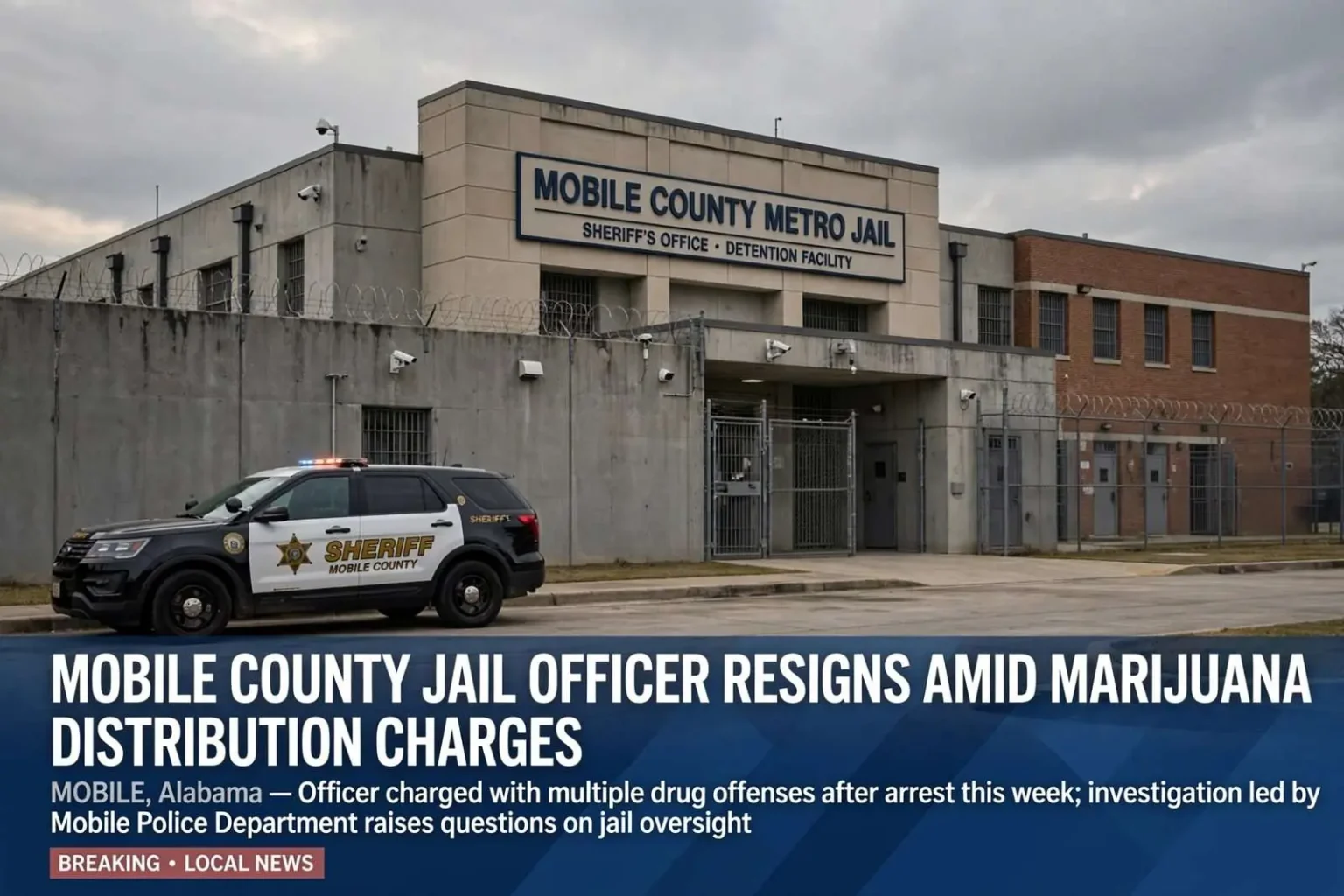
MOBILE, Alabama – A Mobile County Metro Jail corrections officer resigned this week after being arrested and charged with multiple drug offenses, according to the Mobile County Sheriff’s Office. The arrest and rapid resignation have raised familiar questions about personnel screening and oversight at the county’s main detention facility.
The officer, 21-year-old David John Black, submitted his resignation Tuesday morning shortly after being taken into custody. He faces four counts of distributing marijuana, along with single counts of first-degree marijuana possession and possession of drug paraphernalia. The distribution counts are the most serious of the group, and each is filed as a separate felony charge under Alabama law, meaning the case could ultimately be resolved through a single trial covering all six counts or handled through plea negotiations.
A sheriff’s office spokeswoman said it was not immediately clear whether the charges were connected to Black’s role at the jail. That distinction matters both legally and institutionally: offenses alleged to have occurred away from the facility are handled as ordinary criminal cases, while any allegation that an officer smuggled or sold drugs inside a jail would typically trigger additional security reviews and potentially federal involvement.
How the Case Came Together
The Mobile Police Department led the investigation that resulted in the arrest, and additional details about the case were not released. The arrangement follows standard practice for allegations against employees of a county law enforcement agency, which are usually referred to an outside department to avoid any appearance of a conflict of interest. Mobile police investigators assembled the case independently before charges were presented, and the Sheriff’s Office has said it is cooperating fully with the prosecuting authorities.
Records show Black joined the Mobile County Metro Jail as a cadet in June 2014 before being promoted to corrections officer this past January. His resignation took effect the same day he was booked, ending an employment history of just over a year and a half at the time of his arrest. Jail administrators confirmed that his separation from the agency was processed through the normal personnel channels rather than a termination action.
Inside the Metro Jail
The Mobile County Metro Jail, operated by the Mobile County Sheriff’s Office, houses inmates awaiting trial as well as those serving shorter sentences. The facility is one of the largest detention centers in southwest Alabama, holding hundreds of inmates on any given day and serving as the intake point for everyone arrested by municipal, county and state agencies across Mobile County.
Corrections officers in Mobile County undergo state-mandated training before being certified to work inside the facility. That training covers inmate supervision, use-of-force rules, suicide prevention, contraband interdiction and the legal standards governing the treatment of people in custody. Officers must also pass background screening and maintain their certification through continuing education, and deputies and jailers alike operate under the same ethical standards that apply to law enforcement officers across the state.
Contraband is a constant concern in any jail, and marijuana possession or distribution charges against a jail employee strike at the heart of that mission. Agencies nationwide have invested in mail scanning, body scanners and tightened visitation rules in recent years to keep drugs out of detention facilities, because drugs behind bars are linked to assaults, overdoses and extortion among the inmate population.
The Legal Stakes
Distribution of marijuana is a felony offense in Alabama, and a conviction on multiple counts can carry significant prison time depending on the quantity involved and a defendant’s criminal history. Under Alabama’s sentencing framework, judges weigh the specifics of each count, and prosecutors typically charge each alleged distribution act separately, which can compound the potential exposure. First-degree marijuana possession, the other felony count Black faces, applies under state law when the amount involved crosses statutory thresholds or aggravating factors are present.
Court records had not yet listed a scheduled arraignment date at the time of Black’s booking. He will be entitled to an initial appearance and the appointment of counsel if he cannot afford an attorney, and the Mobile County District Attorney’s Office will determine how the counts are ultimately prosecuted.
Oversight and Outside Investigations
Cases involving jail or law enforcement personnel are typically investigated by an outside agency, as occurred here, to avoid conflicts of interest and preserve public confidence in the outcome. The practice has become standard across Alabama and the country, particularly after high-profile cases showed how easily internal investigations can be questioned. In this instance, Mobile police built the case from the ground up, and the Sheriff’s Office learned of the charges as the arrest was carried out.
The Mobile County Sheriff’s Office has not indicated whether further internal review of the matter is planned. Such reviews, when they happen, examine how the employee was hired, whether any policies were violated beyond the criminal conduct itself, and whether additional training or screening changes are warranted. Any findings could inform how the agency documents personnel issues going forward.
The Mobile County Sheriff’s Office has periodically faced scrutiny over staffing and personnel conduct at the county-run facility, though officials have not suggested any connection between this case and prior incidents. Jail operations across the country have struggled in recent years with recruitment and retention, forcing agencies to hire younger, less experienced officers and to move them onto the floor quickly after certification – pressures that experts say make robust supervision all the more important.
Neither the sheriff’s office nor the district attorney’s office has commented on what penalty will be sought if there is a conviction, and both have stressed that the charges remain allegations at this stage. Black, like any defendant, is presumed innocent until proven guilty in court.
What Happens Next
The case now moves through the standard track for felony prosecutions in Mobile County. After an initial appearance, the charges will be presented to a grand jury or resolved through preliminary proceedings, and prosecutors will evaluate the evidence police gathered before deciding on trial strategy. Court dockets in the county typically move over a period of months, and defense attorneys in multi-count drug cases often negotiate dispositions that consolidate the counts.
Because Black is no longer employed at the jail, the case will proceed like any other criminal matter, with no administrative suspension or internal disciplinary process running alongside it. Any future employment in law enforcement or corrections, however, would be affected by the outcome, since state certification records and background checks follow officers from agency to agency.
For the Sheriff’s Office, the episode is a reminder of the stakes involved in jail staffing. The agency has emphasized in the past that the vast majority of its officers serve without incident, and that the facility’s daily operations – feeding, medical care, court transport and inmate supervision – depend on hundreds of employees who follow the rules under difficult conditions. The arrest of a single officer, officials acknowledge, can erode public trust that took years to build, which is why agencies tend to move quickly and publicly when an employee is charged.
Residents with questions about the case can follow filings in Mobile County District Court, where the charges will be docketed. Officials said additional information may become public as the case progresses through the court system.
A Higher Standard Behind the Walls
Corrections work is often described as the invisible side of law enforcement, but it carries some of the strictest conduct requirements of any public safety job. Officers control movement, meals, medication and communication for people who cannot leave, and even the appearance that an officer might bend the rules can destabilize an entire housing unit. That is why agencies bar officers from accepting gifts from inmates or their families, restrict personal cell phone use on the floor and require documentation of nearly every interaction inside the facility.
In Alabama, jail employees who commit crimes can also lose their state certification, effectively ending any career in corrections or law enforcement regardless of how the criminal case is resolved. The Alabama Peace Officers’ Standards and Training Commission maintains the records that follow certified officers across jurisdictions, and a felony conviction is among the most serious disqualifying events.
The case also arrives as sheriffs’ offices across the state compete for a shrinking pool of qualified detention applicants. Agencies have responded with signing bonuses, expanded recruiting events and partnerships with area colleges, while also emphasizing career ladders that let jailers move into deputy roles over time. Officials say the challenge is to recruit quickly without lowering the screening standards that keep facilities safe.
Community watchdogs in Mobile County have called for transparency as the case moves forward, including disclosure of whether the alleged distribution activities touched the jail in any way. The Sheriff’s Office has said it will share what it appropriately can once investigators and prosecutors clear the release of further details.