Federal Lawsuit Challenges Mobile Police Shooting That Killed Local Man
A federal civil rights lawsuit alleges Mobile police used excessive force in a 2013 shooting death of a man with a history of mental illness.
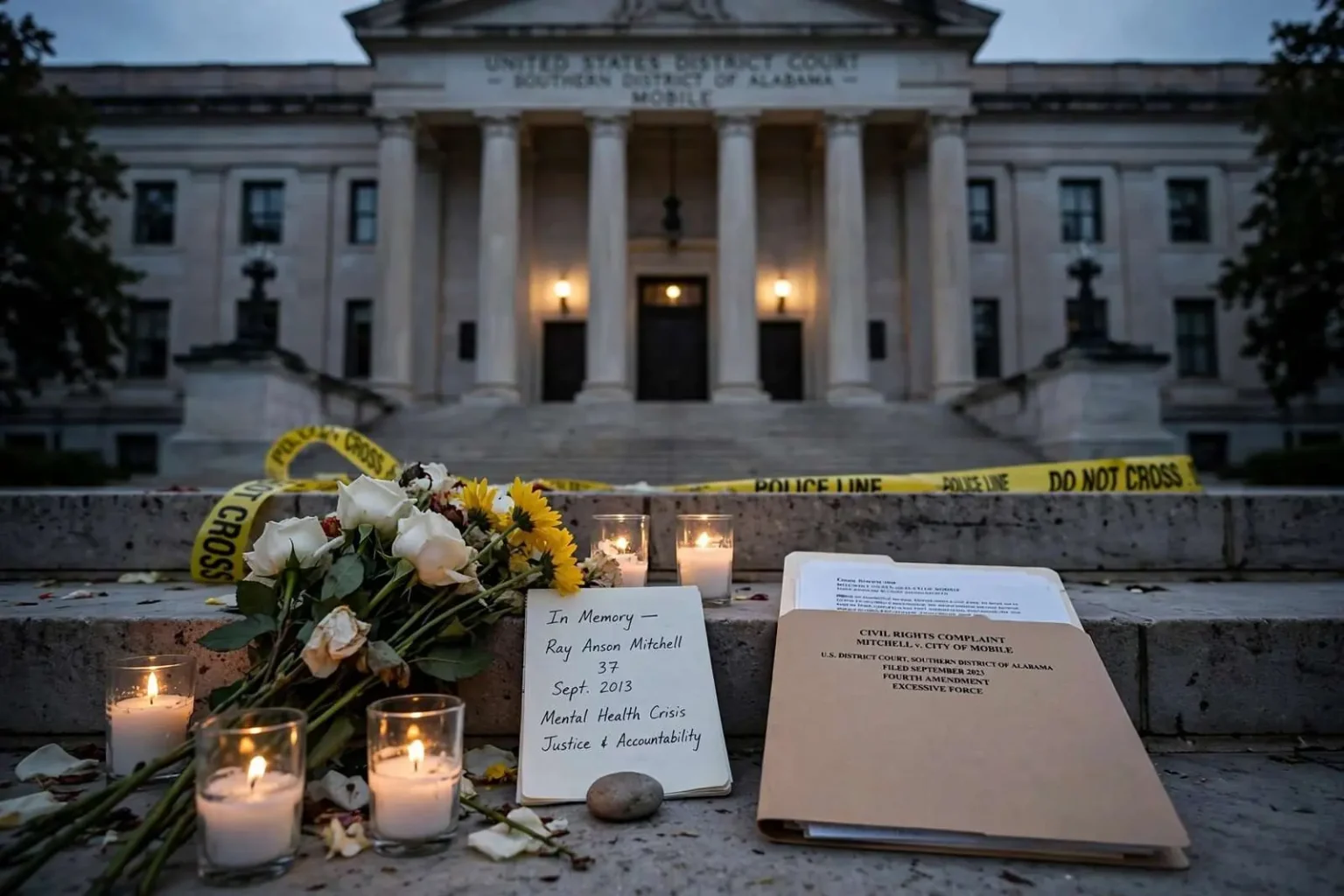
A civil rights lawsuit filed in federal court is challenging the Mobile Police Department’s fatal shooting of a 37-year-old man two years ago, arguing that officers used unnecessary deadly force against someone who posed no real threat. The lawsuit, filed last month in the U.S. District Court in Mobile, names three police officers and the City of Mobile as defendants and seeks damages along with attorney fees. It stems from the September 2013 shooting death of Ray Anson Mitchell, who was killed in the backyard of his aunt’s home after a confrontation with officers.
The complaint puts the city’s response to a mental health crisis at the center of the case. According to the lawsuit, Mitchell had a history of mental illness that was managed with prescription medication and, despite occasional odd or peculiar behavior, had no history of violence and was capable of living independently. His family’s account, as described in the filing, portrays a man whose episodes were known to relatives and who had previously been handled without force when police were called. The lawsuit asks a federal jury to decide whether that history should have changed how officers approached him the night he was shot.
Mitchell had previously spent time at the home of his aunt, a police dispatcher, visiting a cousin who had since moved out, a fact the lawsuit says Mitchell struggled to accept. The suit describes an earlier encounter in May 2013 in which Mitchell left the property without incident after his aunt called police. Family members cited that earlier call in arguing that Mitchell’s behavior, while distressing to relatives, was familiar to the department and had been resolved peacefully before.
The Night of the Shooting
Four months later, he returned, sat in the backyard and began going through his backpack. His aunt again called police, telling dispatchers Mitchell was not a threat but was mentally ill and needed to leave. Officers arrived and told the aunt she would need to sign a trespassing complaint against her nephew, according to the lawsuit. The filing describes the aunt as reluctant, saying she wanted help getting Mitchell off the property without criminalizing him, but was told the complaint was the mechanism available.
When officers then entered the backyard looking for Mitchell, he ran, and a foot chase ensued that ended in the fatal shooting. Police have said Mitchell was shot after wresting a Taser from an officer and firing it at police during the chase; he was pronounced dead at the scene. The department’s account frames the seizure of the Taser as the pivotal moment — a weapon taken from an officer and turned on him — while the lawsuit contends the physical circumstances of the chase and the shooting do not support the conclusion that Mitchell posed a deadly threat.
The lawsuit disputes the department’s account, alleging Mitchell did not pose any threat or harm to officers and that his only conduct was an attempt to get away from them. It further alleges that the department’s internal investigation into the shooting was purely ceremonial rather than a genuine review of officers’ conduct. Plaintiffs in cases of this kind typically point to the speed and consistency of internal exoneration as evidence that the review process cannot be trusted, and the complaint follows that pattern, arguing the city failed to hold anyone accountable for a shooting that should have been avoided.
Suing the City and Its Officers
Filing against both individual officers and the municipality is the standard architecture of a police shooting lawsuit in federal court. The claims against the officers generally allege excessive force under the Fourth Amendment, while the claim against the City of Mobile alleges that a policy, custom or practice — in this case, the complaint argues, the department’s handling of encounters with people in mental health crisis — caused the constitutional violation. Damage awards and settlements in such cases are paid by the city, and attorney fees can be recovered under the federal civil rights statute if the plaintiffs prevail.
The case will turn in part on qualified immunity, the doctrine that shields government officers from damages liability unless they violated a clearly established constitutional right. Courts weigh the force used against the circumstances officers faced at the moment of the shooting, and the record — dispatch tapes, witness statements, the autopsy, the officers’ statements — will be assembled through discovery over the coming months. The aunt’s calls to dispatch, in which she described her nephew as mentally ill but not a threat, are likely to figure prominently in the plaintiffs’ argument that the officers knew the nature of the situation they were walking into.
The lawsuit’s emphasis on the trespassing complaint also raises a question that mental health advocates have pressed nationally: whether police should be the default response to a family member in crisis, and whether officers are equipped to de-escalate rather than force a confrontation. The complaint describes a sequence in which a family seeking help was offered a criminal process, the subject of the call attempted to leave, and the pursuit that followed ended in his death. Plaintiffs argue each step offered an off-ramp that was not taken.
The case is among several in recent years that have drawn scrutiny to how Mobile police respond to encounters involving residents with mental illness, and it remains pending in federal court. Nationally, a significant share of fatal police encounters involve people in mental health crisis, and a number of cities have responded with crisis intervention training, co-responder models pairing officers with clinicians, or dedicated crisis teams. The lawsuit asks Mobile to account for where its own practices fell short in September 2013.
What Comes Next in Court
Once the city answers the complaint, the case will move through motions, discovery and, absent a settlement, trial. Defendants in police shooting cases frequently seek dismissal on qualified immunity grounds before discovery is complete, and the court’s ruling on that question often shapes whether the case settles or proceeds to a jury. The three officers named as defendants will be represented by the city’s legal department, as municipal employees acting within the scope of their duties, while the City of Mobile answers separately for the policy claim.
For Mitchell’s family, the lawsuit represents the only avenue remaining after the criminal and internal processes concluded without charges. Families in similar cases across Alabama have turned to federal court for the same reason: the civil docket is where the use of force itself gets examined on the merits, with public testimony and documentary evidence. The aunt who made both calls to police — first in May, then on the night of the shooting — is positioned to be a central witness, and her account of what she told dispatchers is already part of the public record through the complaint.
The September 2013 shooting remains a reference point in Mobile’s ongoing conversation about policing and mental health. Whatever the jury or the parties ultimately decide, the case asks the question that cities across the country continue to struggle with: when a family calls for help with a loved one in crisis, and that loved one runs, what should happen next. The U.S. District Court in Mobile will now take up that question with the full record in front of it.
The complaint also walks through the family’s history with Mitchell’s illness in detail, describing the prescription regimen that kept his condition stable and the family members who monitored his care. According to the filing, his odd or peculiar behavior — the phrase the lawsuit uses — never crossed into violence at any point in his life, and he had held together the routines of independent living. That portrait is central to the plaintiffs’ theory: that the officers who entered the backyard were dealing with a frightened man trying to leave, not a suspect presenting a deadly threat.
The department’s account of the Taser — that Mitchell wrested it from an officer and fired it at police — will be tested against physical evidence. Tasers fire barbed darts connected by wires, and the deployment record, the distance involved in the chase, and the autopsy findings will all bear on whether the device could have incapacitated an officer at the range described. Plaintiffs’ experts in similar cases have argued that a fleeing subject firing a recovered Taser does not present the same danger as a firearm, while defendants point out that the device momentarily disables its target and could have left an officer vulnerable. That dispute over what the Taser meant, moment by moment, is likely to be the technical heart of the case.
The internal investigation that followed the shooting is criticized in the complaint as a formality. Civil rights suits against police departments routinely target the review process as well as the shooting itself, arguing that a department cannot discipline what its own investigators refuse to find. The lawsuit’s claim against the city rests partly on that allegation — that Mobile’s failure to scrutinize deadly force cases seriously allowed the practices that led to Mitchell’s death to persist.
Whatever the outcome, the case will add to the public record on how Mobile handled one of the most difficult categories of police work: the call about a family member in crisis, on a dark night, in a residential backyard. The complaint tells one version of that night; the officers’ accounts, once filed, will tell another. The federal court will have to decide which version a jury gets to hear — and, ultimately, whether the force used was lawful.