Mobile Man Charged With Murder in 2012 Cold Case Shooting
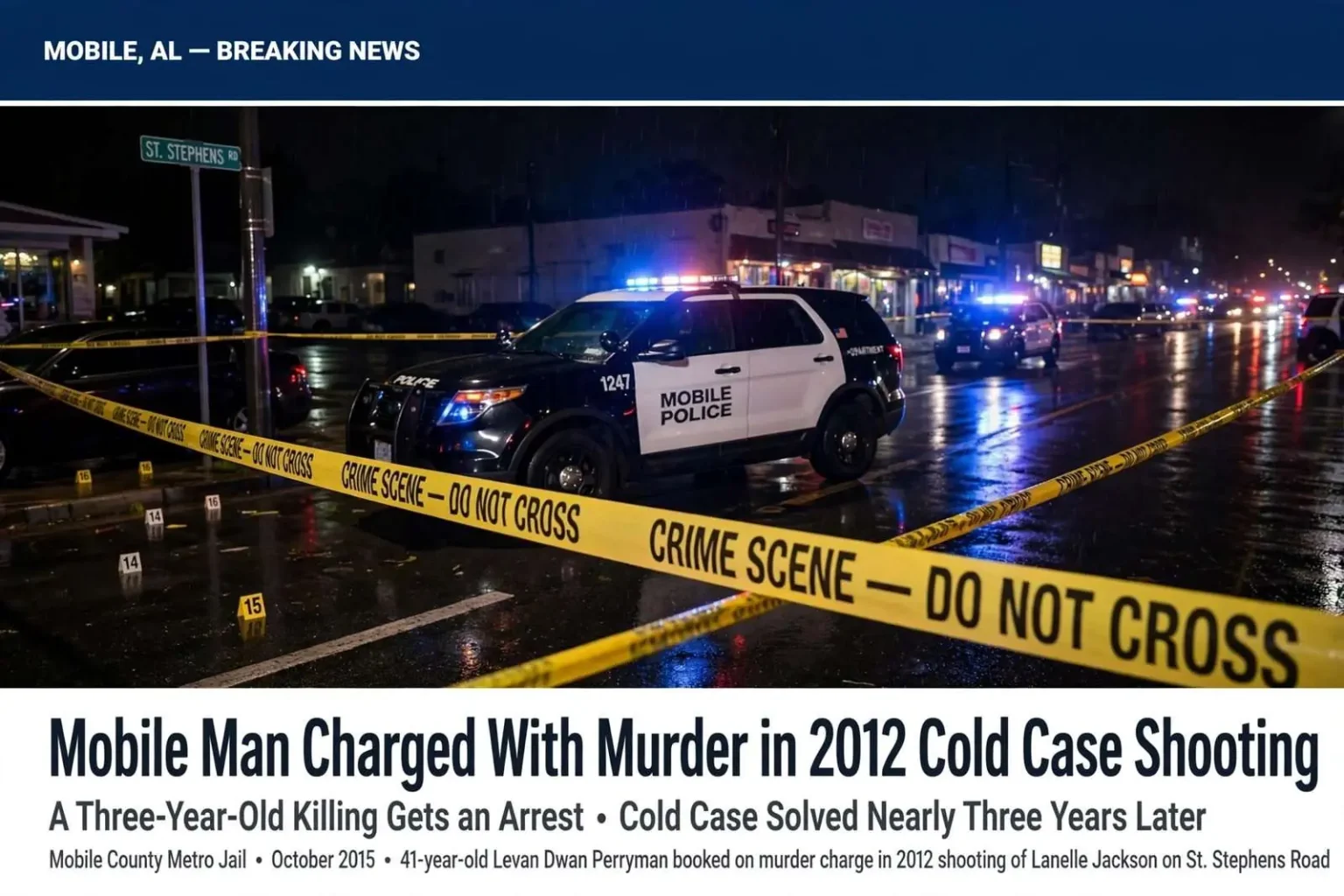
Mobile police have charged Levan Dwan Perryman with murder in the October 2012 fatal shooting of Lanelle Jackson on St. Stephens Road, records show.
A Three-Year-Old Killing Gets an Arrest
A Mobile man already jailed on unrelated charges now faces a murder count after investigators linked him to a fatal shooting from nearly three years ago, according to police and court records. Mobile County Metro Jail records show 41-year-old Levan Dwan Perryman, who has also gone by the name Tony Dwan Williams, was booked on one count of murder this week. Detectives identified him as a suspect in the October 2012 killing of 38-year-old Lanelle Jackson, closing a gap of nearly three years between the crime and the charge.
Officers found Jackson fatally shot inside his vehicle on St. Stephens Road early on the morning of Oct. 28, 2012, according to a Mobile police spokesman. The case sat unsolved while detectives continued to work the file, and investigators have not publicly detailed how they connected Perryman to the killing nearly three years later. What is clear from the arrest is that the case never left the homicide unit’s active stack, and that developments in a defendant’s custody status can bring long-dormant charges back to life.
How the Original Case Unfolded
The shooting occurred in the pre-dawn hours along St. Stephens Road, a busy corridor that runs through portions of Mobile’s north side. Jackson was discovered inside his vehicle, and his death immediately became one of the city’s homicide investigations for that year. Like many such cases, it went quiet publicly even as detectives pursued leads, waited on forensic results and gauged whether witnesses would cooperate.
Cold-case work in Mobile follows a familiar pattern: evidence is preserved, tips are logged, and cases are periodically revisited as new information surfaces. Homicide investigations that stretch on for years are not uncommon in the city, where detectives periodically reopen unsolved cases as new evidence, forensic testing or witness cooperation becomes available. Advances in testing methods and shifts in the willingness of people to come forward can turn a stalled file into a prosecutable case, and police have not said what specifically led them to file charges against Perryman at this time.
A Jail Cell, a Standoff and a Shot Fired
Perryman has not been a free man since well before the murder charge was filed. He had already been behind bars since a November 2013 arrest unrelated to the homicide case. That arrest came after police, investigating him as a suspect in an armed robbery, cornered him at a home on Gaston Street. Detectives said Perryman fired a shot at an officer during the encounter, though the officer was not hit. He was taken into custody following an hours-long standoff with the department’s tactical response unit, an episode that shut down activity around the neighborhood while negotiators and tactical officers worked the scene.
The court path since that arrest has been winding. Court records show the robbery charge from the 2013 incident was later dropped for lack of probable cause, but a separate charge of attempted first-degree assault stemming from the shot fired at the officer was sent to a grand jury in early 2014. The distinction matters: the charge tied to the standoff survived, meaning Perryman remained in custody and in the court system while detectives continued examining the 2012 killing.
That custody status is what made the new charge administratively possible without a fresh arrest on the street. Instead of locating a suspect who had been at large for nearly three years, investigators brought the case to a man already in the Mobile County Metro Jail, where booking documents and jail records create a clear paper trail from charge to court.
The Most Serious Count in Alabama Law
The addition of a murder charge means Perryman now faces the most serious count available under Alabama law in connection with Jackson’s death. A murder conviction in Alabama carries the state’s most severe penalties, and cases of this grade are handled with the full weight of the district attorney’s office. It was not immediately clear when he might be arraigned on the new charge or whether a trial date had been set in either matter.
What Cold-Case Arrests Mean for Mobile
For the neighborhoods along St. Stephens Road and across Mobile, an arrest nearly three years after a killing sends a signal that unsolved cases remain open files rather than forgotten ones. Families of homicide victims frequently describe the wait for an arrest as its own ordeal, and detectives who work cold cases emphasize that charges can come at any hour once the evidence supports them. The timing of this arrest, against a defendant already in custody, illustrates how the criminal justice system can absorb a new charge without waiting for a suspect to be found.
The case also highlights the role of the Mobile County Metro Jail’s booking records, which become public documentation of how serious charges move through the system. Booking sheets, court dockets and grand jury actions give residents a way to follow a case from arrest to arraignment, even when investigators decline to discuss the evidence that produced the charge.
What Comes Next in Court
Perryman’s legal path now runs on two tracks. The attempted first-degree assault charge from the 2013 Gaston Street standoff, which went to a grand jury in early 2014, remains part of the court record, and the new murder count from the 2012 shooting will proceed on its own schedule. Arraignment dates, bond considerations and trial settings will unfold in Mobile County’s court system, and prosecutors will be required to present evidence supporting the murder charge as the case moves forward.
Defense considerations are predictable in cold cases that resurface: the reliability of witness recollections years old, the chain of custody of physical evidence, and the forensic methods used to link a defendant to a decades-old scene — in this case, one nearly three years old. None of those questions has been answered publicly, and police have released no new details about what broke the case open.
For now, the arrest answers the question that families of unsolved-homicide victims ask most often: whether anyone is still working the case. In Jackson’s death, the answer arrived nearly three years later, in the form of a murder charge booked against a man who had been in jail the whole time. Whether it ends in a conviction will be decided in the months ahead in a Mobile County courtroom.
Inside the 2013 Gaston Street Standoff
The November 2013 arrest that has kept Perryman in custody began as an armed-robbery investigation but escalated into one of the more dangerous encounters a suspect can create with police. When detectives cornered him at a home on Gaston Street, authorities said Perryman fired a shot at an officer — a round that missed — before the scene hardened into an hours-long standoff. Mobile’s tactical response unit took over the perimeter, and the episode ended only after officers took him into custody without further injury.
Standoffs of that length draw personnel from across a police department and often from neighboring agencies, and they test both negotiation strategy and neighborhood patience. Residents of blocks like Gaston Street typically spend those hours unable to reach their homes while officers hold a perimeter. The fact that no officer was struck and the arrest ended in custody rather than gunfire is the detail that investigators and prosecutors point to when explaining how a robbery case that was ultimately dropped for lack of probable cause still produced a surviving assault charge.
The grand jury’s early-2014 decision to send the attempted first-degree assault charge forward reflected the seriousness of firing at an officer, regardless of how the underlying robbery allegation fared. In Alabama, firing a weapon at a law enforcement officer is treated as an attack on the officer’s life, and prosecutors treat it as such even when the shot misses and no one is hurt.
Resources Behind a Cold-Case Arrest
Arrests in cases as old as the 2012 Jackson shooting rarely happen by accident. They typically follow a renewed review of the file, re-contact with witnesses, new forensic testing, or a combination of all three. Mobile’s homicide investigators balance a docket of fresh cases against a backlog of older ones, and charges filed years later represent a decision that the evidence has finally crossed the threshold needed for an arrest warrant.
The alignment of factors in this case — a suspect already in custody, a surviving assault charge that guaranteed his availability, and a detective’s determination that the evidence now supported a murder count — is a common pattern in cold-case work. Prosecutors generally prefer to charge when a defendant is already before the court, because it simplifies transport, arraignment and pretrial supervision while the case is prepared.
Police have not disclosed whether the break in the case came from a witness, forensic testing or evidence already in hand from 2012. That silence is standard practice: disclosing the basis for an arrest can compromise witness safety and the prosecution itself. What the department has confirmed is the essential fact for the public record — a 2012 killing has a charged suspect, and the case will now be tested in open court.