Mobile Teen Arrested on Murder Charge After Ridge Street Shooting Death
Mobile police arrest 18-year-old on a murder charge hours after naming him a person of interest in a fatal Ridge Street shooting.
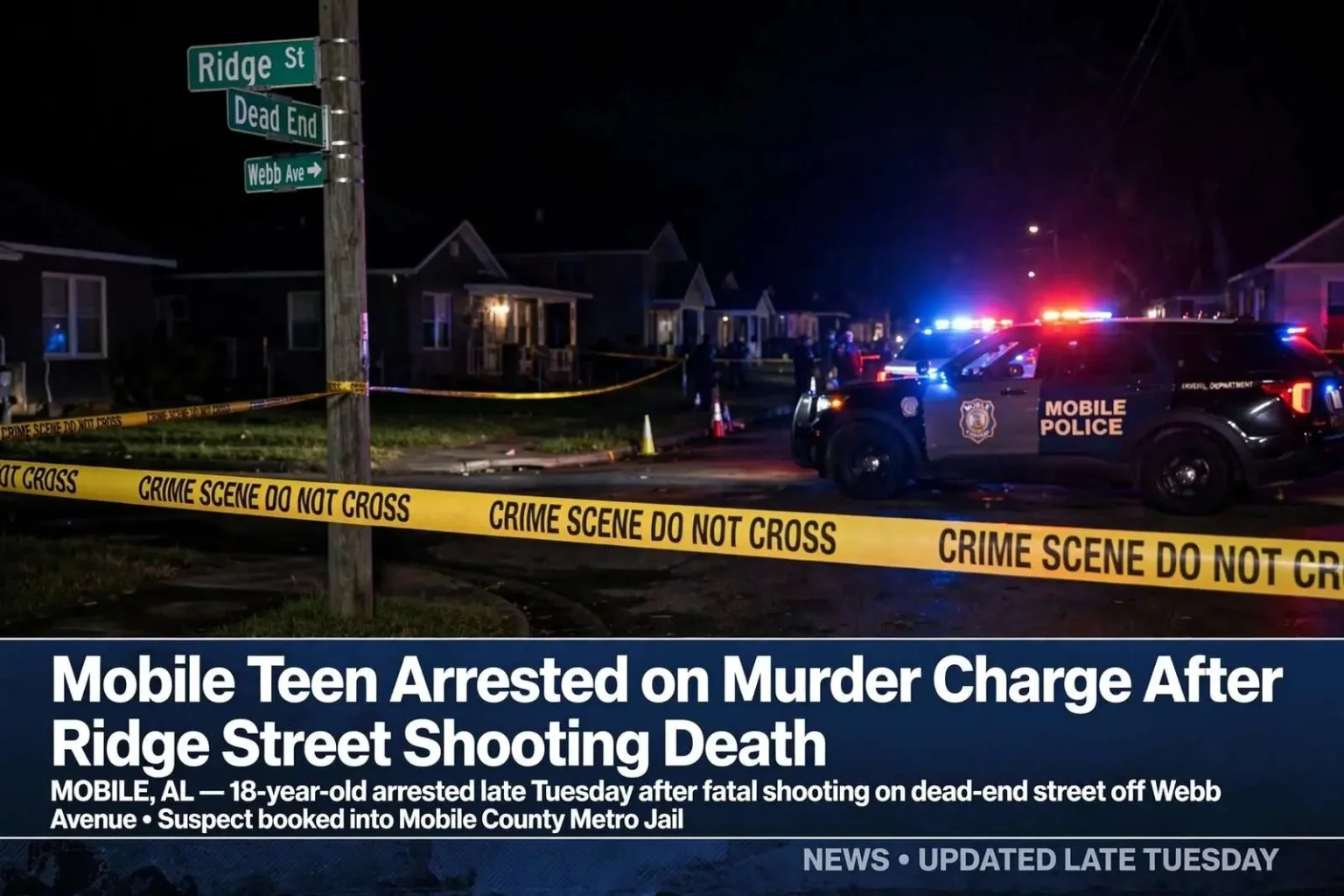
MOBILE, Ala. — Mobile police arrested an 18-year-old man on a murder charge late one Tuesday night, just hours after investigators publicly named him a person of interest in a fatal shooting that had shaken a quiet dead-end street off Webb Avenue. The arrest capped a fast-moving sequence that began with a body found at the scene, moved through days of detective work, and ended with the suspect in a jail cell before midnight.
Darrius Lamar Chestnut was booked into Mobile County Metro Jail shortly after 11 p.m. on one count of murder in connection with the death of 19-year-old Dave Levon Martez Populus. The booking came hours after police had circulated Chestnut’s name and asked for the public’s help finding him, a gap of several hours in which investigators say public tips and detective work converged to locate the 18-year-old.
According to jail records, Chestnut had no prior arrests on file in Mobile County before that night. The absence of any prior record stood out in a case otherwise marked by the speed of the identification and arrest, and it left investigators’ public appeals focused entirely on locating him rather than on any known history.
The case began days earlier, when officers responded to a report of a shooting on a dead-end stretch near Webb Avenue. Emergency medical technicians arrived to find Populus already dead at the scene, and investigators quickly opened a homicide investigation. The location — a dead-end street that sees little through traffic — meant investigators could work from a narrow field of possibilities about who had reason to be there and why.
Detectives spent the following days piecing together what led to the shooting and identifying who might have been involved. Homicide work in cases like this typically proceeds through canvassing for witnesses, collecting shell casings and surveillance video, tracing the victim’s recent movements and associations, and cross-referencing the accounts that emerge. In this case, that work produced a name within days.
By Tuesday, investigators had zeroed in on Chestnut and released his name publicly as a person of interest, asking for the public’s help locating him. The announcement was notable for its directness — naming an adult suspect whose record showed nothing — and it signaled that detectives had developed substantial information tying him to the Ridge Street scene.
Hours later, he was in custody.
Neighbors along Webb Avenue told reporters at the time that neither Chestnut nor Populus appeared to live in the immediate area, leaving some residents uncertain why the two men had crossed paths on that particular street. The dead-end block, residents said, is the kind of place where unfamiliar faces draw notice, and the presence of two outsiders — one of whom ended up dead — left the neighborhood unsettled in the days that followed.
At the time of his arrest, jail records listed Chestnut’s home address on Seneca Street, in a neighborhood between South Ann and Ross streets. The Seneca Street area sits in a different part of the city from the shooting scene, underscoring the question that neighbors and investigators alike were left with: what brought two young men from elsewhere to a quiet dead-end street in the moments before gunfire.
What happens next in the case
Mobile police have not publicly detailed a motive for the shooting, and it remains unclear what brought Populus and Chestnut together on Ridge Street in the moments before the gunfire. Detectives have said only that the investigation is continuing, which means interviews are ongoing and additional arrests or charges have not been ruled out.
Cases like this typically move next to a preliminary hearing, where prosecutors lay out probable cause before a judge, followed by presentation to a Mobile County grand jury. The preliminary hearing is the first public test of the state’s evidence, and the grand jury process that follows determines whether the case proceeds to trial in Mobile County Circuit Court. Between those stages, defense attorneys will receive the state’s evidence through discovery, and bond arguments are likely given the nature of the charge.
The Mobile County Metro Jail, where Chestnut is being held, is the county’s main detention facility, and booking records there — including charges, bond amounts, and court dates — are public. Any court appearances in the case would take place in Mobile’s municipal and county court system, which handles the full pipeline from initial appearance through trial for felony matters arising within the city limits.
Homicide investigations in Mobile are handled by the Mobile Police Department’s violent crimes unit, which continues to investigate shooting deaths across the city. The unit’s detectives carry some of the heaviest caseloads in the department, and their work in the Ridge Street case — from the initial scene response to a named suspect within days — reflected the compressed timeline that early witness cooperation and physical evidence can produce.
For the neighborhood off Webb Avenue, the arrest brings the first measure of closure in a case that began with emergency lights on a dead-end street and ended, days later, with an 18-year-old from Seneca Street charged with murder. The question of why it happened remains for the courts to answer.
The public identification of a person of interest is a step Mobile police use sparingly, and its mechanics matter to understanding how the Ridge Street case unfolded. Detectives typically exhaust direct means of contact first — attempting to locate a suspect at known addresses, through family members, or via warrants issued through the court system. Going public with a name signals both that investigators have concluded the person is actively involved and that conventional efforts to find him have not succeeded. It also enlists the public: tips to police, to Crime Stoppers, or simply to friends and family of the person named often produce the call that ends the search.
The hours between the public appeal and the 11 p.m. booking suggest that appeal worked as designed, though police have not detailed exactly how Chestnut was located. Once in custody, he would have been transported to the Metro Jail for booking — the process of recording identifying information, photographing and fingerprinting the arrestee, and entering the charge into the jail’s records. Booking shortly after 11 p.m. means the paperwork was completed overnight, with the case entering the court system the following day.
The geography of the case
The two locations at the center of the case sit in distinct corners of Mobile. The shooting scene off Webb Avenue is in the western part of the city, an area of residential streets where the dead-end block in question sees little traffic beyond the people who live there. Seneca Street, the address listed for Chestnut at booking, lies in a neighborhood between South Ann and Ross streets closer to the city’s central corridors. Populus’s own address has not been detailed publicly, but neighbors agreed that neither young man was from the block where the shooting occurred.
That mismatch — a crime scene with no local connection for either principal — is common in homicide work and is one of the first things detectives attempt to resolve. Phone records, social media activity, and witness accounts of the men’s movements in the hours before the shooting typically fill in the picture of how the meeting came about. Until police release more, the question of why Ridge Street became the location remains open.
Dead-end streets present particular challenges and advantages for investigators. The limited access points mean witnesses are usually residents who notice unfamiliar vehicles or visitors, and the small circle of people with ordinary reasons to be there makes unusual activity more memorable. On the other hand, such locations often lack commercial surveillance cameras that help investigators in busier areas, making resident cooperation disproportionately important.
A community’s questions
The ages of both young men — 18 and 19 — have marked the case for many in the community, as it has in the broader pattern of gun violence in Mobile, where young men are overrepresented among both victims and defendants in homicide cases. Community organizations and churches in the affected neighborhoods have long pushed for intervention programs aimed at exactly this age group, and each new case renews those calls.
For Populus’s family, the arrest is the first step in a legal process that will stretch over months. Families of victims in Mobile County cases typically follow the case through the district attorney’s office, which handles communication about hearings, plea discussions, and trial dates. The preliminary hearing, when scheduled, will be the first public airing of the evidence supporting the murder charge.
For Chestnut, the charge carries the weight of Alabama law on homicide, and the absence of any prior record in Mobile County will become part of the picture his defense presents — at bond hearings and, if the case reaches that stage, at trial. The presumption of innocence applies to him as to any defendant, and the evidence that emerges in court may answer questions the initial police statements left open, including the question of motive and the circumstances that brought the two young men to the same dead-end street on a weeknight.
Detectives are asking anyone with information about the case to contact the Mobile Police Department or to leave an anonymous tip through the city’s Crime Stoppers line, which pays rewards for information leading to arrests. In cases like this one, investigators say, even small details — a car seen on the block, a conversation overheard — can be the piece that completes the picture.