Two Board Members Resign From Centre for the Living Arts Amid Director Search Dispute
Carol Hunter and Ann Bedsole resign from the Centre for the Living Arts board amid a dispute over the search for a new executive director.
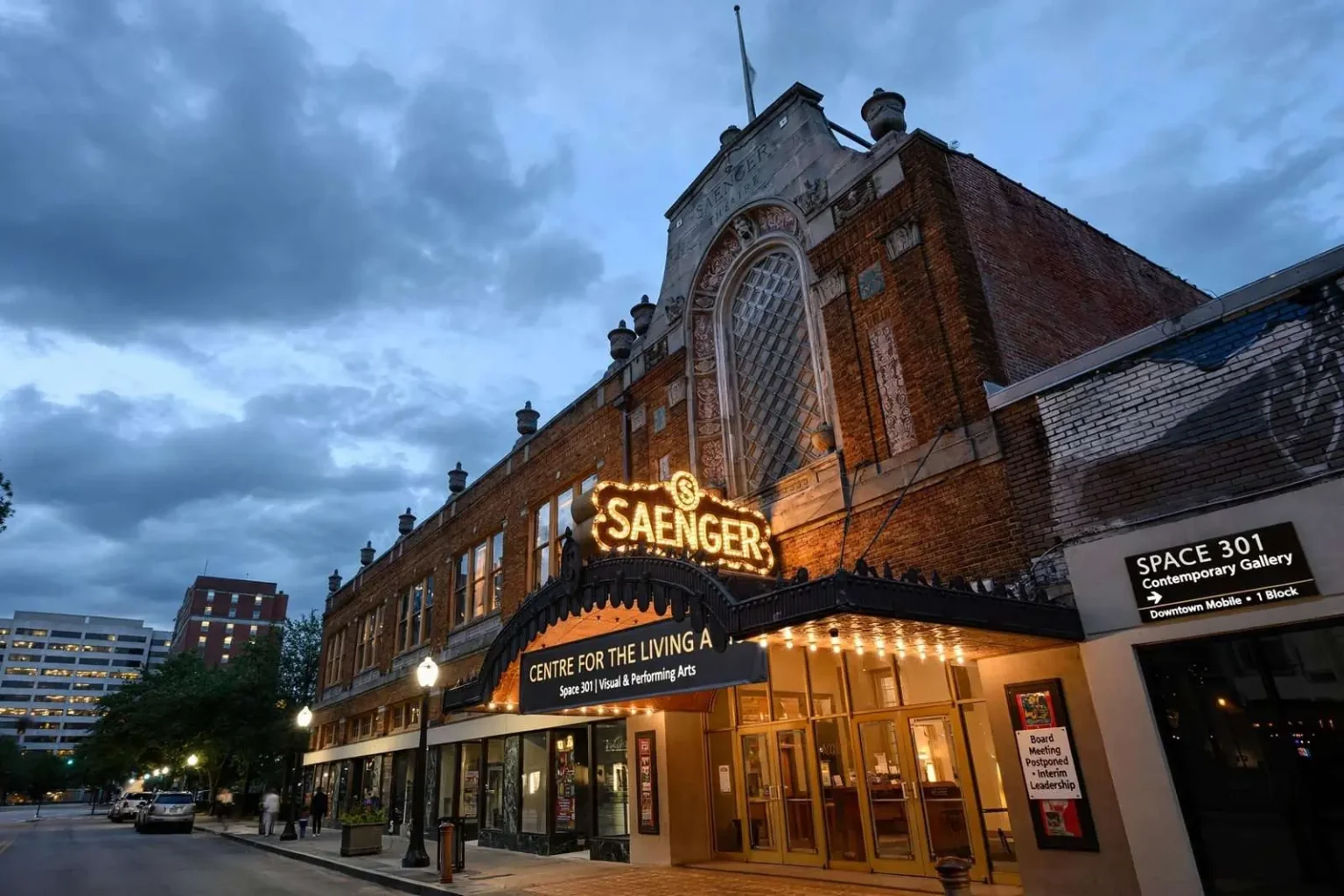
Two prominent members of the board of directors for the Centre for the Living Arts, the downtown Mobile nonprofit that operates the historic Saenger Theatre and Space 301, have resigned following disagreements over the organization’s search for a new executive director. Board chair Carol Hunter, who also leads the Downtown Mobile Alliance, and longtime board member Ann Bedsole, a former Republican state senator and past Mobilian of the Year, both stepped down from the board.
The departures remove two of the most experienced and well-connected voices from the organization at a delicate moment, just as the Centre works to replace a longtime chief executive and steady its finances. Hunter’s resignation in particular leaves the board without its presiding officer, and both departures come from figures whose names carry weight with Mobile’s philanthropic and business communities — the very constituency a nonprofit arts organization depends on for support.
A Dispute Over Fiscal Direction
Bedsole, who chairs the distribution committee for the Smith Trust — a major financial supporter of the Centre for the Living Arts — said she resigned rather than risk the organization’s funding relationship with the Bedsole Foundation over a disagreement about the search committee’s approach. “If I persist in what I want us to do, we are going to lose Bedsole Foundation funding, and I don’t see that the organization can afford to do that right now,” Bedsole said. “I don’t want to stand in the way of keeping them from getting money they need because I don’t agree with the fiscal philosophy of the search committee.”
Her statement frames the dispute as fundamentally about money and priorities rather than personalities. In nonprofit governance, the search for a chief executive is often where an organization’s financial philosophy becomes concrete: the salary offered, the fundraising expectations placed on the hire, and the balance between artistic programming and revenue-generating operations all get decided by the people who choose the leader. A disagreement over that approach, among board members who also sit on the foundations that fund the organization, puts institutional support directly in play.
Bedsole’s dual role — board member at the Centre and leader of the distribution committee that steers Smith Trust grants — made the conflict especially pointed. Foundations frequently require visibility into the financial direction of organizations they support, and her decision to step aside rather than press her position represents an attempt to insulate the Centre’s funding from a governance fight, even at the cost of her own seat at the table.
The Organization at the Center
The Centre for the Living Arts is a 501(c)(3) nonprofit established in 1999 to promote contemporary visual and performing arts in downtown Mobile. In addition to operating the Saenger Theatre and Space 301, the organization works to create opportunities for learning, practice and public engagement with the visual and performing arts across the Mobile area.
The Saenger Theatre anchors the organization’s public profile. The historic downtown movie palace, with its grand auditorium and ornate detailing, hosts concerts, film screenings, comedy shows, and touring performances, serving as one of downtown Mobile’s primary entertainment venues. Space 301, the Centre’s contemporary gallery, gives visual artists — many of them local — a professional exhibition space in the heart of the city’s arts district, and the two venues together make the Centre one of the most visible arts institutions on the central Gulf Coast.
Latest in a Series of Leadership Changes
The resignations follow a string of personnel changes at the organization this year. In July, longtime president and CEO Carlos Parkman, who had led the Centre for nearly a decade, retired. Wendy Riggs, a senior consultant with Arts Consulting Group, was named interim executive director shortly after.
Riggs called the board resignations “unfortunate” but said she believes the Centre for the Living Arts board is moving in the right direction as it works to find permanent leadership. “You have to make people understand that the arts really are about quality of life,” Riggs has said of her approach to nonprofit arts management, “not so much about disposable income.”
Her framing speaks to the challenge every nonprofit arts organization faces when a founding-era leader departs. Institutions like the Centre rely on a mix of ticket revenue, foundation grants, corporate sponsorships, and individual giving, and transitions at the top tend to unsettle all of them at once. Donors watch how the search is conducted; staff and artists watch for signals about programming priorities; and the community that fills the Saenger’s seats waits to see whether the institution’s direction will hold.
The use of an interim executive from a national search firm signals that the board chose continuity while it works through its differences. Interim leaders with consulting backgrounds are typically brought in to stabilize operations, review finances, and prepare the organization for a permanent hire — a mandate that becomes harder to fulfill when the board itself is reshaping in public. Riggs’s suggestion that the board is “moving in the right direction” is an acknowledgment that the path has not been smooth.
The Stakes for Downtown Mobile
The Centre’s leadership question matters beyond its own boardroom because of what the organization represents in downtown Mobile’s economy. The Saenger Theatre draws audiences into the city center on nights and weekends, feeding restaurants, bars, and parking operations, and it anchors a performing-arts corridor alongside the city’s other historic venues. Space 301 contributes to the gallery scene that supports Mobile’s monthly art walks and gives the city’s visual artists a professional platform.
Civic leaders have invested heavily in downtown revitalization over the past two decades, and arts institutions are consistently cited as part of that formula: they attract residents and visitors after business hours, support small businesses, and give a city a cultural identity that helps recruit employers and workers. A stable, well-led Centre for the Living Arts is part of that infrastructure, which is why the involvement of figures like Hunter — whose day job leads the Downtown Mobile Alliance — and Bedsole, one of Mobile’s most prominent civic figures, reflected how closely the organization’s fortunes are tied to the district’s.
The loss of both voices at once, amid a funding dispute, illustrates a governance risk common to mid-sized nonprofits: boards drawn from the same small circle of civic leadership can find their personal relationships to funders colliding with their oversight duties. When a disagreement touches the money, the options narrow — someone yields, or someone leaves. In this case, two people left.
What Comes Next
The Centre has not yet named a timeline for naming a permanent successor to Parkman or for filling the two vacated board seats. Both tasks will shape the organization’s direction for years: the executive search determines who runs the Saenger and Space 301 day to day, and the board vacancies determine who oversees that hire and the finances that follow it.
Board reconstitution after resignations of this kind typically begins with the remaining directors selecting officers and deciding whether to expand or restructure the search committee whose approach sparked the dispute. Foundations watching the situation — including the Bedsole Foundation and the Smith Trust, whose distribution committee Bedsole chairs — will be looking for signs that the fiscal questions raised during the search have been resolved rather than deferred. Whether the organization can keep those funding relationships intact while rebuilding its governance is the central test of the coming months.
The performing and visual arts schedule, meanwhile, continues. The Saenger’s calendar of concerts and events and Space 301’s exhibitions proceed under interim leadership, which buys the board time but also underscores the stakes: every month without a permanent executive extends the period in which long-term programming decisions, budget planning, and donor cultivation sit with a transitional team.
A Familiar Challenge for Gulf Coast Arts Institutions
The Centre’s turmoil arrives at a time when arts nonprofits across the Gulf Coast are navigating the same pressures: recovery of audiences after years of disruption, rising costs for productions and facility maintenance on historic buildings, and donors increasingly focused on financial sustainability. Historic theaters like the Saenger carry particular obligations, since the buildings themselves require ongoing investment that programming revenue alone rarely covers.
Against that backdrop, Bedsole’s warning that the organization “can’t afford” to lose foundation funding reads as more than rhetoric. Mid-sized arts organizations live close to the margin, and the loss of a major funder — or the hesitation of funders uncertain about an organization’s direction — can force cuts to programming and staff within a single budget cycle. Her decision to step aside to protect that funding, while disagreeing with the search committee’s philosophy, captures the bind that boards face when governance disputes and fundraising realities intersect.
For Mobile’s arts community, the hope among supporters is that the Centre emerges from the transition with both its leadership and its funding secured. The organization’s two decades of operation have made it a fixture of the city’s cultural life, and the questions raised by the resignations — about fiscal philosophy, board composition, and the cost of the next chief executive — are the same questions that, once answered, could position the Centre for a stable decade ahead. Until a permanent director is named and the board seats are filled, though, downtown Mobile’s flagship arts organization remains a work in transition.