Mobile Finance Chief Touts Budget Surplus as Councilman Defends Prior Year’s Numbers
Mobile's finance director reported a budget surplus for 2014 as a councilman pushed back on claims about the prior year's deficit.
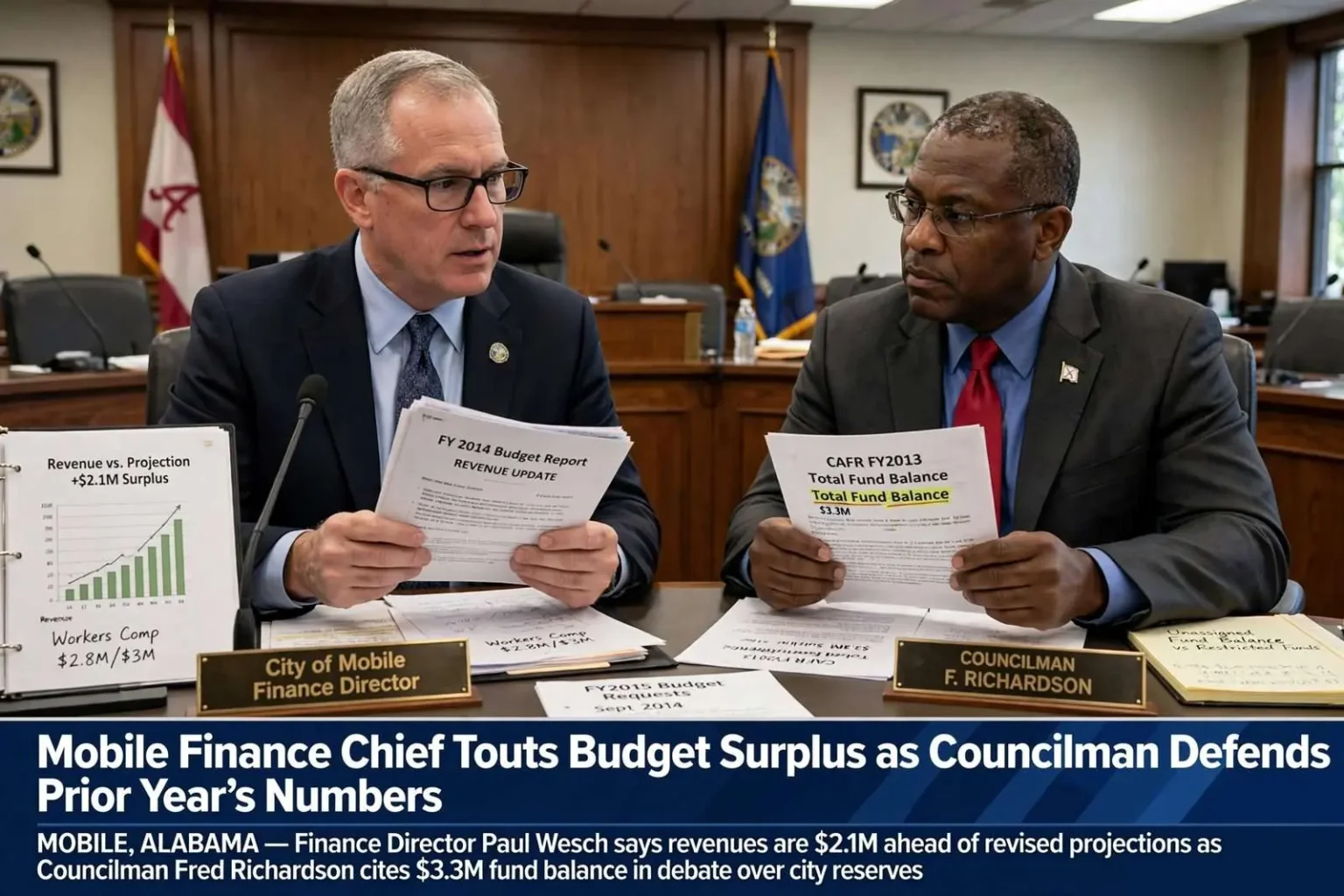
MOBILE, Alabama — With Mobile’s fiscal year winding toward its September close, Finance Director Paul Wesch told the City Council that the city is running ahead of revised revenue projections, even as a lingering dispute over the previous year’s budget figures resurfaced at a council meeting and a later Finance Committee session. The back-to-back discussions offered a snapshot of Mobile’s budget politics in mid-decade: genuine good news on the revenue line, old grievances about who inherited what, and a fundamental argument over which accounting numbers tell the truth about the city’s finances.
Revenue Running Ahead of Projections
Wesch said city revenues have come in $2.1 million better than the revised budget approved in April, and roughly $8 million above the more conservative estimates originally set under the previous mayoral administration. The revised budget, adopted in the spring after the city had several months of actual collections in hand, was itself more optimistic than the original plan — and actual receipts were beating even that. The surplus, driven by a modest recovery in local economic activity, gave the council its first real breathing room in several budget cycles.
He cautioned, however, that the good news should be weighed against expenses still to come and unforeseen costs. Budget surpluses in September can evaporate quickly, Wesch warned, when the last quarterly bills arrive, overtime totals are tallied and end-of-year obligations come due. As one example, he pointed to workman’s compensation spending, which had already reached $2.8 million against a full-year budget of $3 million with more than three months still remaining in the fiscal year, which runs from October through September. Workers’ compensation has long been one of the most volatile lines in Mobile’s budget, tied to injury claims across police, fire and public works departments that are difficult to predict.
The timing of the report mattered as much as the numbers. Department heads were finishing their operational budget requests for fiscal year 2015 that same week, ahead of a preliminary spending plan expected before the council the following month. A surplus at year’s end directly shapes the next year’s starting position: money carried forward reduces the gap the city must close between projected revenues and projected expenses, and every dollar of cushion lessens the temptation to raise fees or cut services when the new budget is assembled.
A Councilman Defends the Past Administration
The discussion took a turn when Councilman Fred Richardson raised objections to how the prior year’s finances had been characterized. Richardson had shared a page from the city’s Comprehensive Annual Financial Report on social media, pointing to a $3.3 million total fund balance at the close of the 2013 fiscal year as evidence the city was not, in his view, left in a deficit by the previous administration. For Richardson, the audited financial statement was the authoritative record — a document prepared under accounting standards and reviewed by independent auditors, not a political talking point — and he argued that claims of a handoff deficit did not survive contact with it.
A Dispute Over Which Numbers Matter
Wesch countered that the total fund balance figure Richardson cited blends together restricted money, including grant funds that legally cannot be used for general city operations, with the unrestricted money that actually pays day-to-day bills. A city can show a positive total fund balance on paper while the portion it is free to spend on police, fire, trash collection and street repairs is far smaller — or negative. He said the unassigned fund balance, the pot that funds general operations, started fiscal year 2013 at a level far below what the city’s financial policies called for, leaving the incoming budget with almost no cushion against unexpected costs.
The disagreement was not really about arithmetic — both sides were reading the same audited statements — but about which line tells the story. Municipal finance experts generally side with the distinction Wesch drew: the Government Finance Officers Association urges cities to maintain healthy unassigned fund balances precisely because restricted dollars, grants and dedications cannot backfill a shortfall in general operations. But for an elected official defending a record, the total fund balance figure is the one that appears in the summary pages, and the more technical distinction is easy to dismiss as spin.
The exchange between the finance director and the councilman replayed a debate that has run through Mobile budget discussions for years: how much of the city’s condition is the inheritance of one administration versus the management of the next. Budgets are cumulative documents — reserve levels, deferred maintenance, debt loads and staffing decisions carry over — and each administration’s critics and defenders can find numbers somewhere in a comprehensive annual financial report to support their case.
Why Fund Balances Matter to Residents
For ordinary residents, the technical argument has real consequences. A city’s unassigned fund balance is what pays the bills during a revenue downturn — the reserve that keeps the lights on when sales tax collections sag in a recession or an unexpected disaster drives up costs. Cities that run lean reserves face harsher choices when trouble arrives: mid-year layoffs, service cuts, or one-time fixes like selling property that only postpone the reckoning. That is why bond rating agencies scrutinize reserve levels when Mobile or any city borrows money, and why a stronger reserve translates directly into lower interest rates on future debt.
The fund balance question was especially pointed for Mobile in this period. The city, like every Alabama municipality, operates under constitutional limits on property tax rates that leave it heavily dependent on sales taxes and shared state revenues — revenue sources that swing sharply with the economy. A thin reserve in a sales-tax-dependent city is a structural vulnerability, which is why finance officials treat rebuilding the unassigned balance as a first-order priority rather than bookkeeping trivia.
The Road to the Fiscal 2015 Budget
With the current year closing out ahead of projections, attention in the council chambers turned immediately to fiscal 2015. Department heads submitting their requests were working against the usual reality of municipal budgeting: personnel costs, which consume the majority of most Alabama city budgets, continue to rise with health insurance and retirement contributions, while revenue growth in a recovering economy is gradual and uneven. The preliminary spending plan expected before the council the following month would be the first public look at how the administration intended to balance those pressures — and whether the year’s surplus would be directed to reserves, capital projects, or restoring services trimmed in leaner years.
The Finance Committee sessions where Wesch delivered his updates are where most of the council’s real budget work happens. Before any budget reaches a formal public hearing and a vote, committee members question department heads line by line, probe revenue assumptions and flag priorities for the administration. The tone of those sessions — cooperative or contentious — usually signals how smoothly the final budget vote will go.
What Residents Should Watch
For Mobilians trying to follow the numbers, the useful takeaway from the dispute is to know which figures measure what. The total fund balance in the city’s Comprehensive Annual Financial Report answers the question of everything the city holds, restricted or not. The unassigned fund balance answers the question residents actually care about: how much freedom the city has to respond when times get hard. Both numbers matter, but they answer different questions — and budget debates become far clearer once the distinction is understood.
As the fiscal year closed, the city could take some genuine comfort from revenue running $2.1 million ahead of its revised plan and roughly $8 million above the original conservative estimates — a sign of economic life returning to the city’s sales tax base. But the same meeting that delivered the good news also contained the caution: workers’ compensation had nearly exhausted its annual budget with a quarter of the year left, expenses were still accruing, and the reserve that protects the city from the next downturn remained a work in progress. The surplus, Wesch made clear, was a reason for measured relief — not celebration.
The episode also highlighted the role the city’s financial reports play in public debate. The Comprehensive Annual Financial Report, published after independent audit each year, is the one document where every faction in a budget dispute can be checked against the same pages. When council members and finance officials trade figures on social media and in committee, the eventual resolution usually comes down to agreeing on definitions — and on the recognition that an audited statement can be accurate even when a single line item, taken alone, tells only part of the story.
In the end, the budget season ahead would show whether the surplus could be put to durable use. Finance officials long ago learned the difference between a good month and a good year, and Mobile’s recovery — like its reserve — would be measured across both.