
MUSEmusic Series at Mobile Museum of Art Opens with Amphibian Lark
Mobile Museum of Art launches its MUSEmusic Series with Amphibian Lark on July 17, featuring Lydia LeVert and Silver Apples' Simeon Coxe.
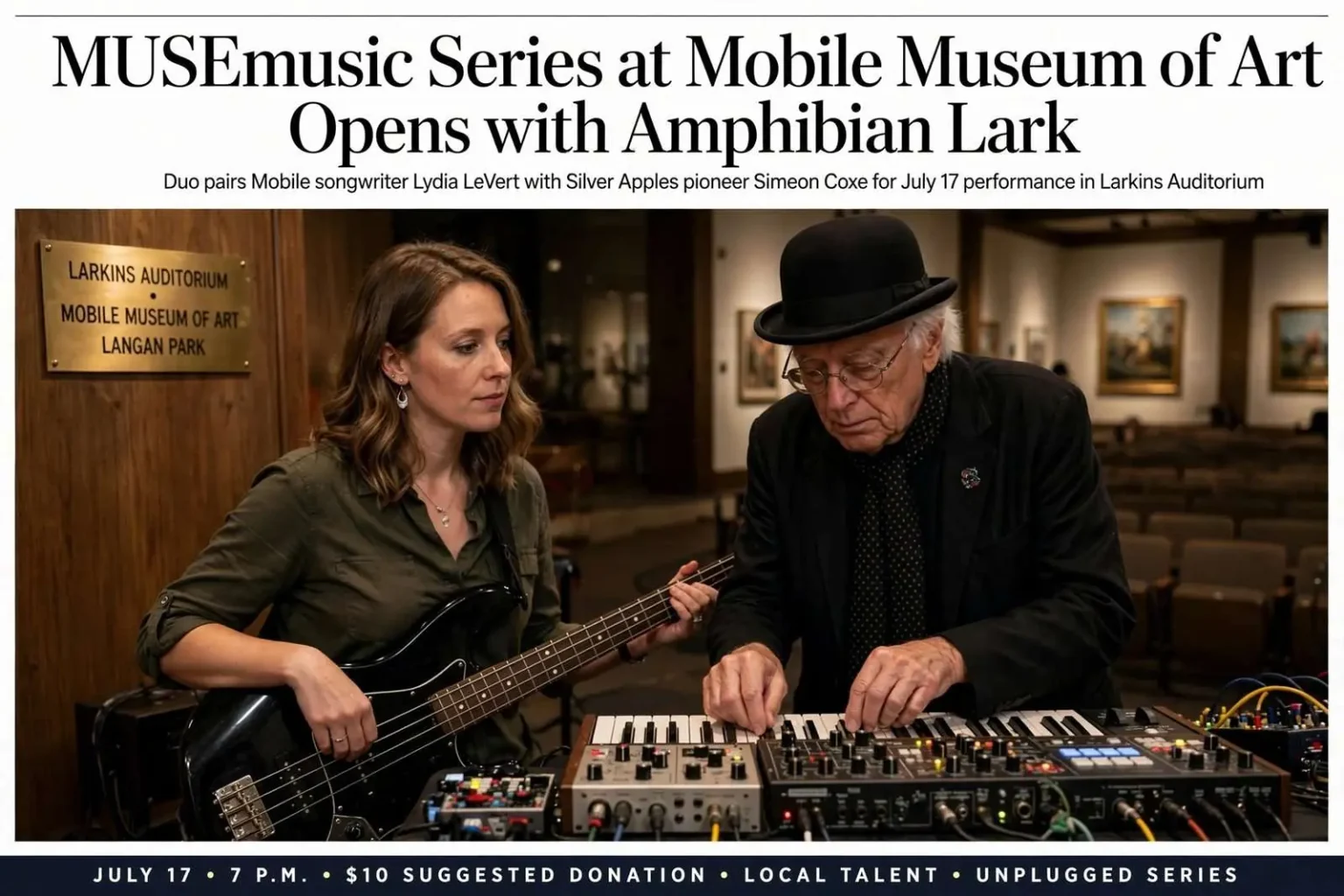
The Mobile Museum of Art launches its MUSEmusic Series with a performance by Amphibian Lark on July 17 at 7 p.m. in Larkins Auditorium, opening the series with one of the Gulf Coast’s more unusual musical duos. The program celebrates homegrown talent, presenting local emerging and established performers in an unplugged setting, and the debut edition sets the tone by pairing the museum’s galleries with a night of original music.
Amphibian Lark is the duo of Lydia LeVert and Simeon Coxe, a partnership that links the Mobile scene to a genuine landmark of electronic music history. LeVert writes the material and sings, playing bass and vocals, while Coxe handles the electronics, building the pair’s sound around synthetic textures that reviewers have described as electro-cabaret with an edge. The description fits: the duo’s songs combine LeVert’s melodic writing and voice with electronic soundscapes that drift between the atmospheric and the theatrical, material that rewards close listening in a room as intimate as an auditorium inside a museum.
Coxe’s name carries weight far beyond the Gulf Coast. He is best known for his work in Silver Apples, the pioneering 1960s electronic rock group whose experiments with oscillators, rhythm machines, and early synthesizers helped lay the groundwork for virtually every electronic music movement that followed. That Silver Apples not only endured as an influence but continues to tour internationally is one of the more remarkable stories in American music, and it gives Amphibian Lark a connection to the deepest roots of the genre the duo works in.
From Silver Apples to the Gulf Coast
Silver Apples formed in New York in the late 1960s, releasing albums whose combination of electronic sound generators and rock rhythm was years ahead of its time. The band’s records became touchstones for generations of musicians in electronic, psychedelic, and experimental music, cited widely as the point where electronic instruments first took a leading role in a rock context. After decades of obscurity following an early label collapse, the group was rediscovered in the 1990s as electronic music’s profile rose, and the band returned to active touring, playing festivals and clubs around the world with the same vintage oscillators that defined its original sound.
For Coxe, decades on, the Amphibian Lark project continues that experimental thread in a new form, this time built around LeVert’s songs rather than a rhythm-and-oscillator format. The duo’s arrangement — songwriter plus electronicist — allows the material to move between intimate and expansive, and the museum setting suits music that asks listeners to sit and take it in. Amphibian Lark released its full-length debut album in December 2013, a body of work that introduced the partnership’s electro-cabaret sound to listeners and set the stage for live dates like the MUSEmusic appearance.
A series built on local talent
The MUSEmusic Series is designed to celebrate homegrown Gulf Coast talent, giving local performers a distinctive stage and giving the museum’s audience a different way to experience the institution. Mobile has a deep musical tradition, from the jazz and rhythm-and-blues heritage of the neighborhood clubs to church choirs, school bands, and the singer-songwriters working the local rooms today, and a series hosted by the city’s art museum creates a bridge between that living scene and the city’s cultural institutions.
The unplugged format is central to the series’ identity. Rather than a full-band, amplified show, MUSEmusic performances are staged for listening, letting audiences hear songwriting and performance up close. For a duo like Amphibian Lark, whose music blends voice, bass, and electronics, the setting is a natural fit, offering the detail and intimacy that the material rewards. Museum programs of this kind have become a popular way for arts organizations to reach younger audiences while giving established patrons a new reason to visit after hours.
The venue and the evening’s practical details
Larkins Auditorium, inside the Mobile Museum of Art in Langan Park, has long served as the museum’s lecture and performance space, hosting talks, films, and concerts in the heart of west Mobile’s largest public park. The museum’s grounds and galleries give attendees an occasion for a full evening, and the July 17 program begins at 7 p.m., timed for an after-dinner audience. Admission follows the series’ community-minded approach: a $10 donation is suggested at the door, with beer and wine available by donation, keeping the evening accessible while supporting the museum’s programming.
That format reflects the series’ purpose. Donations go toward the museum’s operations and the continued presentation of programs like MUSEmusic, and the by-donation drinks service adds a social element that turns the concert into a gathering. For locals, it is a chance to hear serious original music minutes from home without downtown traffic or ticketing fees; for the museum, it is an audience-building exercise that introduces new visitors to the collection and the park campus.
The musicians’ local roots
LeVert’s presence anchors the duo in Mobile. Her songwriting and singing drive Amphibian Lark’s material, and her bass work gives the songs their foundation beneath Coxe’s electronic treatments. Local audiences will recognize in the duo’s story a pattern familiar to Gulf Coast music: a hometown musician with a distinctive voice connecting with a collaborator whose experience runs deep enough to transform the material into something neither could make alone. The result is the kind of act that a series like MUSEmusic exists to showcase — original, locally rooted, and genuinely unusual.
The pairing also reflects Mobile’s long, surprising connections to the wider music world. The city has produced and attracted musicians across genres for generations, and the presence of a founding member of Silver Apples on a Mobile stage, playing songs written by a Mobile songwriter, is exactly the kind of crossroads moment that gives the local scene its texture. The July 17 show brings that story into the museum, where the audience can hear it in person.
Why museum concerts matter
Across the country, art museums have increasingly opened their spaces to live music, and the practice has proven mutually beneficial. Musicians gain a distinctive, attentive venue; museums gain audiences who might not otherwise visit; and communities gain cultural programming that neither the clubs nor the institutions could offer alone. The MUSEmusic Series follows that model with a specifically local focus, and its debut with Amphibian Lark — a duo bridging Mobile songwriting and electronic music history — makes the mission concrete from the first night.
For residents of Mobile and the surrounding Gulf Coast, the July 17 performance offers a rare combination: a hometown songwriter’s debut album brought to life with a pioneer of electronic rock, in an intimate auditorium, at a price anyone can afford. Doors open for the 7 p.m. show at the Mobile Museum of Art, where a $10 suggested donation supports the series that brings local talent to the museum stage.
The wider story of electronic music’s pioneers
Understanding Coxe’s place in music history helps explain why the MUSEmusic debut is a notable event for Mobile. When Silver Apples began performing in the late 1960s, the idea of electronic instruments at the center of a rock band was essentially unheard of. Synthesizers were laboratory-scale machines, drum machines did not exist commercially in usable form, and the duo improvised its own solutions, building sound generators and custom oscillators to create rhythms and textures that audiences had never heard live. The records the band released in that era later became collector’s items and touchstones, rediscovered by each new wave of electronic, indie, and psychedelic artists searching for the genre’s origins.
The band’s revival and continued international touring gave those pioneers a second career decades after their first, and audiences around the world have had the chance to see the original instruments and the original sound up close. That history now passes through the Gulf Coast by way of Amphibian Lark, whose live show pairs that experimental lineage with LeVert’s contemporary songwriting, making the duo a living link between the 1960s avant-garde and the Mobile music scene of today.
What audiences can expect at the show
An Amphibian Lark performance in an auditorium setting unfolds differently from a club show. With the audience seated and close, the duo’s dynamics come through clearly: the interplay of LeVert’s voice and bass against Coxe’s electronic treatments, the theatrical streak that reviewers catch in the electro-cabaret label, and the material from the duo’s December 2013 debut album that forms the backbone of the live set. Listeners unfamiliar with the band will hear something genuinely outside the local bar-band mainstream, and longtime followers of experimental music will recognize the historical thread running through it.
The MUSEmusic Series’ unplugged framing suits that material. Rather than competing with a bar crowd, the music occupies a listening room where subtlety survives, and the museum setting frames the performance as the cultural event it is. For the debut of a series intended to celebrate homegrown Gulf Coast talent, Amphibian Lark makes an ideal case: local at its core, worldly in its connections, and unlike anything else on the local calendar.
A summer night in Langan Park
The museum’s setting in Langan Park adds to the occasion. The park’s lakes and grounds in west Mobile have long been a destination for families and afternoon visitors, and the museum anchors the site with its collection and programs. An evening concert extends that role into the summer nights, when Mobile’s heat finally eases and the park fills with visitors. Attendees on July 17 can expect the museum’s usual hospitality, a 7 p.m. start, the suggested $10 donation at the door, and beer and wine available by donation — a modest ask for a program that keeps live, local, original music on the museum’s calendar.
As the MUSEmusic Series opens with Amphibian Lark, the debut sets a standard for the editions that follow: local performers, distinctive material, and a setting that treats the Gulf Coast’s musicians as the artists they are. For one summer night, the Mobile Museum of Art will hold the meeting point of Mobile songwriting and the birthplace of electronic rock, and the community is invited to be there for it.


