Mobile Residents Press Arc Logistics on Waterfront Chemical Storage Plans
More than 100 Mobile residents questioned Arc Logistics over plans to expand sulfuric acid storage at its waterfront terminal near downtown.
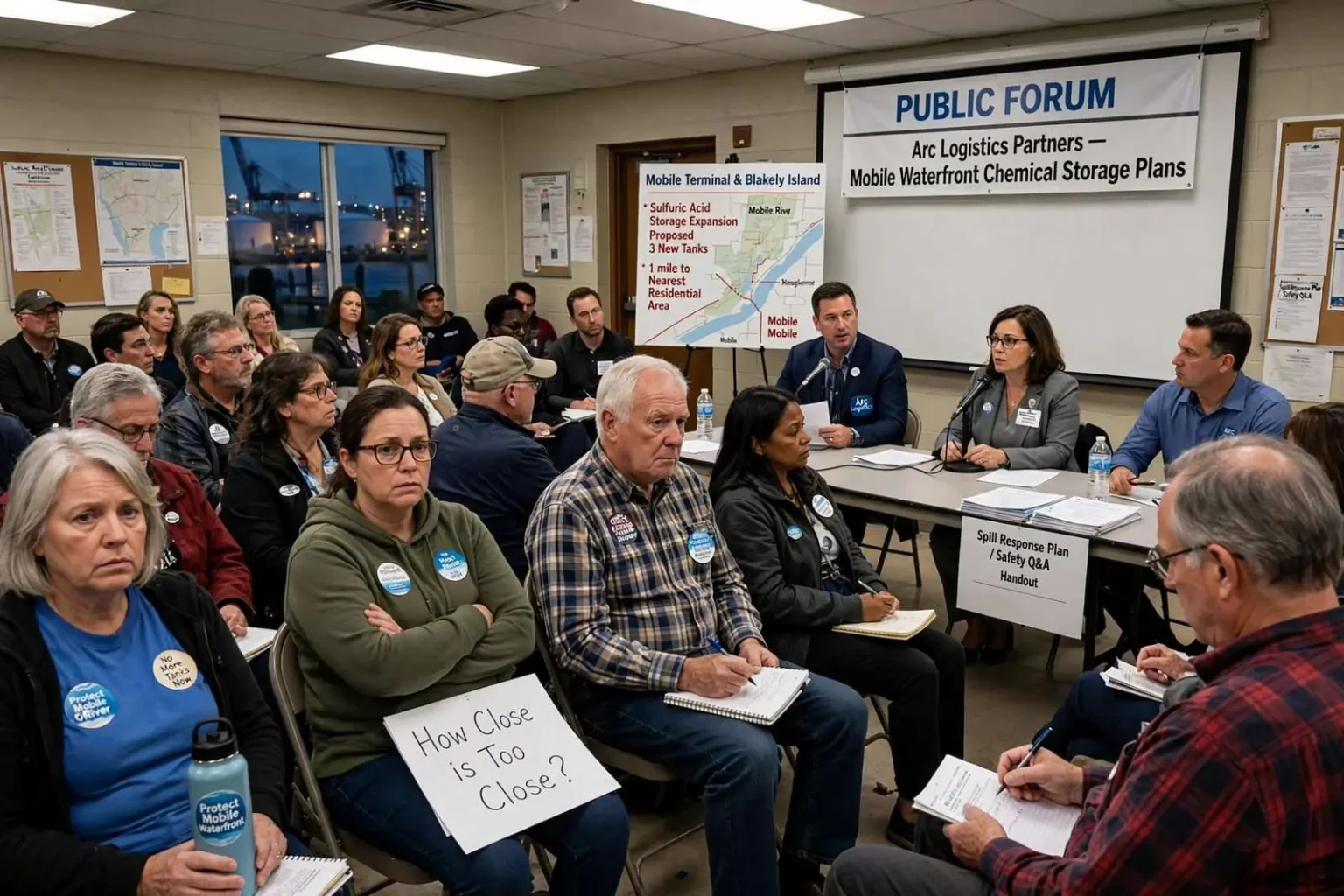
More than 100 residents turned out for a public forum this week to question representatives of Arc Logistics Partners about plans to store additional sulfuric acid at the company’s Mobile waterfront terminal, part of a broader debate over industrial development near the city’s downtown.
The meeting, held at a community center in Mobile, was organized after residents appealed a Planning Commission decision allowing the terminal operator to build three smaller storage tanks for asphalt on Blakely Island, rather than one larger tank. Arc Logistics separately received approval to expand its sulfuric acid storage capacity at its Mobile terminal. Both matters remain before the Mobile City Council, which has delayed votes on the appeals.
The turnout underscored how closely neighborhoods near the waterfront watch the river of industrial proposals that flows through them. Blakely Island and the surrounding terminals sit within view of downtown, across the water from districts where the city has invested heavily in revitalization, and every new tank or expansion reignites a question that has divided Mobile for generations: how close is too close when the port and the neighborhood share the same shoreline?
Sulfuric acid is among the most widely used industrial chemicals in the world — a workhorse of fertilizer manufacturing, metal processing and countless other applications — and the Port of Mobile has long handled it as part of the chemical trade that moves through its terminals. The question before the city is not whether such materials belong in the port economy, but where they should be stored, in what quantities, and at what distance from the people who live nearby.
A simmering zoning fight
The debate over how the city should regulate above-ground storage tanks near residential areas has simmered for years, prompting officials to appoint a citizen committee to study the issue and recommend zoning changes that the Planning Commission has since been evaluating. The committee’s work grew out of years of frustration from neighborhood associations that felt tank farms expanded one approval at a time, without a comprehensive map of where the city wanted such facilities and where it did not.
Zoning is the tool cities use to draw those lines, and Mobile’s effort is an attempt to replace piecemeal decisions with a coherent policy. Cities across the country that host heavy industry have struggled with the same task, balancing the jobs and tax value industrial operations bring against the safety buffers and quality-of-life standards their neighbors expect. The recommendations under review could determine setback distances, tank size limits and review requirements for years to come.
Until the council acts, decisions continue to arrive case by case, which is precisely what has kept the dispute alive. Each approval — one more tank here, one more chemical there — becomes a referendum on the larger question, and each referendum fills a community center with residents demanding answers.
Worst-case questions
Much of the discussion centered on worst-case scenarios. Residents asked company representatives how they would respond to a spill, what risks sulfuric acid would pose to children if it reached local waterways, and how far an evacuation zone might extend in the event of a leak at a facility located roughly a mile from the nearest residential area.
Those questions reflect the standard vocabulary of chemical safety planning. Facilities that store hazardous materials in significant quantities operate under federal risk management requirements, maintain spill response plans, and coordinate with local emergency agencies, and public meetings like this one give residents a chance to probe how those plans would actually work. The distance from the facility to the nearest homes — roughly a mile, by the company’s account — became a focal point of the exchange, with residents questioning whether that buffer is adequate for the materials involved.
Company officials also fielded questions about a long-rumored plan to bring crude oil to the terminal by rail, tied to a rail facility north of downtown. Arc Terminals’ vice president of regulatory affairs told the audience those plans were no longer active, drawing applause from the crowd.
He said interest in transporting crude by rail had cooled significantly in recent years amid falling oil prices and tighter rail safety regulations nationwide, even though the company had explored the idea when it acquired the Blakely Island site in 2013. That site was previously owned by a company that spilled oil into the Mobile River, a history residents have not forgotten and one that colors their view of every subsequent proposal for the property.
The crude-by-rail question has shadowed Mobile’s waterfront debates for a decade. At the height of the domestic oil boom, ports across the Gulf South were courted as terminals for unit trains of crude, and communities near the rail lines organized against the prospect of mile-long oil trains passing through their cities. The economics that fueled that era have faded, and Mobile’s experience followed the national arc — ambitious plans announced, then shelved as prices collapsed and regulators tightened the rules governing tank cars.
For the residents in the room, the company’s assurance was welcome but incomplete. Plans that are inactive can be revived, they noted, unless the city’s rules say otherwise — another argument, in their view, for adopting zoning standards that settle these questions in advance rather than leaving each proposal to be fought on its own.
The forum’s organizers framed the evening as a chance for direct answers rather than the procedural exchanges that dominate commission and council meetings. In practice, it functioned as a preview of the decision the City Council will eventually have to make on the pending appeals — and of the political weight the neighborhoods will bring to that vote.
Council members have delayed action on both matters while the zoning study continues, a choice that satisfies neither side entirely. The company wants certainty for its investments; the residents want a policy that constrains the next expansion, not just this one. The delay keeps both waiting on a document that could resolve years of argument in a single vote.
Whatever the council decides, the forum demonstrated the shape of the constituency watching. More than a hundred people gave up an evening to ask an executive about pH levels, evacuation distances and rail economics, and their questions were specific enough to demand specific answers. Mobile’s waterfront neighborhoods have become sophisticated participants in the regulatory process, and they have shown in case after case that they will appeal, organize and show up when a proposal troubles them.
City officials, for their part, face a balancing act that defines port cities everywhere. The working waterfront pays for a great deal of Mobile — the port is the economic engine of the region, and its terminals, tanks and warehouses exist because the city chose generations ago to build its fortunes on the water. The task the citizen committee took on is to decide, in black and white, which parts of the shoreline can absorb that activity and which parts deserve protection from it.
The pending votes on the asphalt tanks and the sulfuric acid expansion will be early tests of where that line falls. If the council adopts the committee’s recommendations, the era of one-tank-at-a-time decisions may give way to a fixed map that developers and residents alike can read in advance. Until then, every proposal will get the reception this one did — a full room, hard questions, and a community prepared to keep asking them.
Terminal operators and their neighbors measure the same facility very differently. To the company, a tank is capital equipment, permitted and engineered, holding a commodity that supports jobs down the supply chain. To the family a mile away, the same tank is a question mark — what is in it, what happens if it fails, and who decided it could be there. Public forums like this week’s exist to force those two descriptions into the same room.
Emergency management professionals say the most valuable outcome of such meetings is often the contact itself. Residents who know which facility is which, who to call with a concern, and what a response actually looks like are better prepared for any incident, and companies that face hard questions in public tend to sharpen their own planning. The exchanges can be uncomfortable, but they are how a port city maintains the trust its industrial economy runs on.
Mobile is hardly alone in this reckoning. Harbor cities from Houston to Charleston have spent the past decade rewriting the rules that govern the boundary between industry and neighborhood, driven by the same mix of waterfront revitalization, freight growth and resident activism now on display here. The cities that have navigated it most successfully, planners say, are the ones that put their standards in writing before the next application arrives — which is exactly the crossroads Mobile’s council now occupies.
For now, the matters sit on the council’s deferred calendar, and the neighborhoods that packed the community center this week are watching to see whether their worst-case questions become the city’s new rules.