Cyclist Run Off Road, Robbed of Bike at Gunpoint in Mobile
Mobile police say a cyclist was forced off Hamilton Boulevard by a truck and robbed of his bicycle at gunpoint before dawn on San Marino Drive.
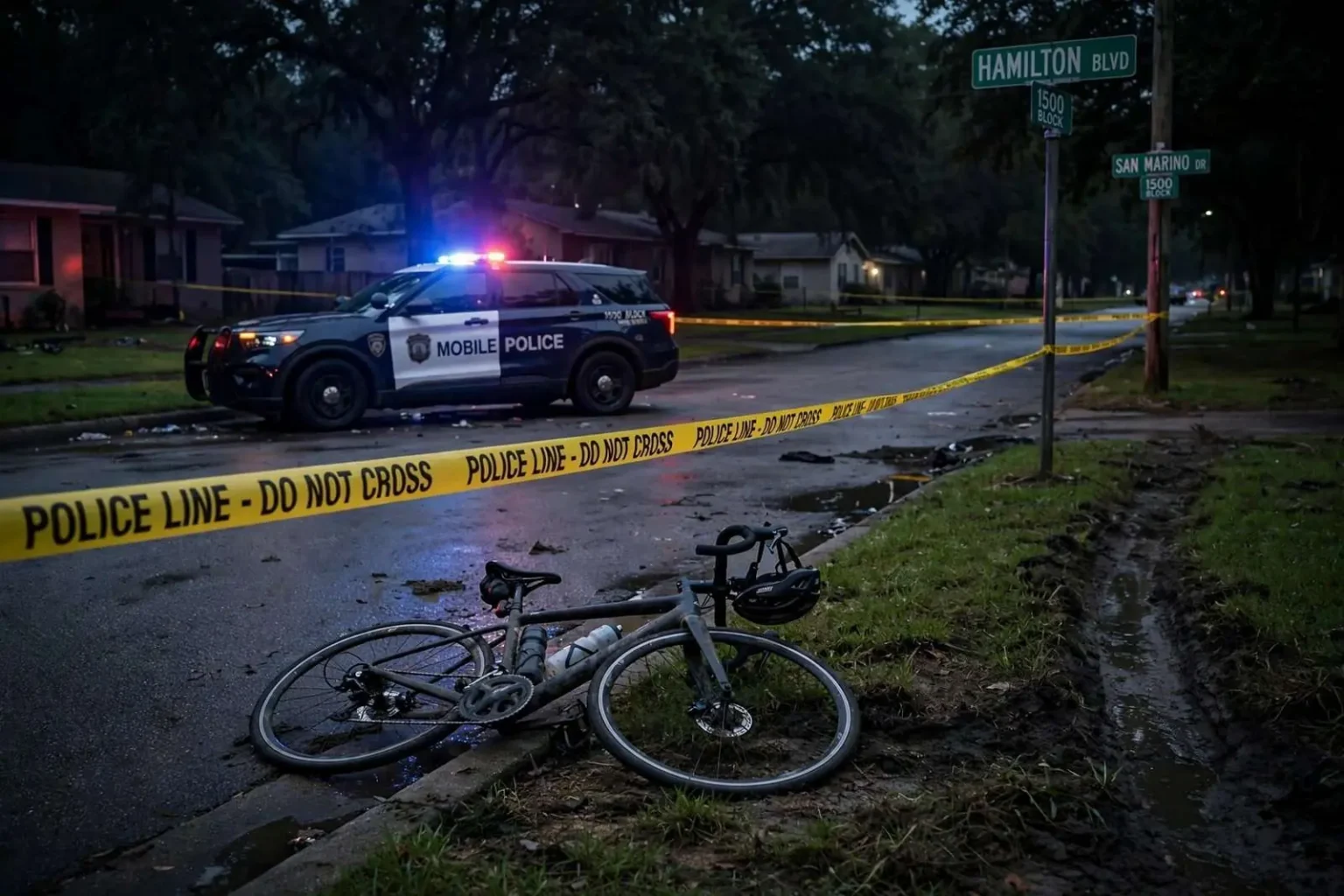
MOBILE, Ala. — A man riding his bicycle before dawn Monday lost his bike to an armed robbery after a truck forced him off the road, according to the Mobile Police Department. Officers were called to San Marino Drive shortly before 12:45 a.m. on May 22, 2023, on a report of a robbery, and investigators say the encounter that prompted the call began a short distance away on Hamilton Boulevard.
Police said the victim had been cycling on Hamilton Boulevard when the driver of a truck ran him off the road. Once the cyclist was stopped, a female passenger in the truck pulled out a gun and forced the man to load his own bicycle into the bed of the vehicle. The two suspects then drove away with the bike, leaving the victim at the scene.
The case remained under investigation as an armed robbery, one of the most serious classifications in Alabama’s criminal code, and police had released limited details about the suspects in the hours after the incident. The case stood out even among the city’s recent robbery reports: a pre-dawn hour, a quiet west Mobile street, and a victim targeted while simply riding a bicycle.
What Police Say Happened on Hamilton Boulevard
According to the account investigators assembled, the sequence unfolded in two places. The victim was riding along Hamilton Boulevard, a through street in west Mobile lined with neighborhoods, churches, and small commercial strips, when the truck driver deliberately ran him off the road — an act that itself transforms a traffic encounter into something far more dangerous, because a cyclist forced from the roadway at speed risks a fall that can cause serious injury before any robbery even begins.
After the truck stopped, police said, the female passenger produced a firearm and ordered the cyclist to lift his bicycle into the truck bed himself. That detail matters in robbery investigations: a victim forced to handle his own property at gunpoint has been deprived of it through force and the threat of deadly force, which is precisely the element that separates robbery from lesser offenses such as theft. The truck then left the area with the bicycle, and the man made his way to a point where the robbery could be reported, with officers ultimately responding to San Marino Drive shortly before 12:45 a.m.
Investigators did not release a detailed description of the truck, the two suspects, or the bicycle in their initial public statements, and no arrests had been announced in the immediate aftermath of the report. Police typically withhold some details in open robbery cases, both to protect the integrity of the investigation and to use verifiable specifics as a screening tool when tips begin arriving.
Armed Robbery Under Alabama Law
Under Alabama law, robbery in the first degree — the charge that typically follows an offense committed with a deadly weapon or causing serious physical injury — is a Class A felony, the most serious category in the state’s criminal code, punishable by up to life in prison. Even where the only property taken is a bicycle, the display or use of a gun during the taking places the offense in that top tier, because the law treats the threat of deadly violence, not the value of the property, as the core of the crime.
That framework explains why Mobile Police Department investigators handled the San Marino Drive report as they did. An armed robbery case involving two suspects and a vehicle gives detectives multiple threads to pull: the truck itself, which may have been captured by any camera along the route the suspects traveled; the bicycle, a distinctive piece of property that can surface later through resale listings or street contacts; and the two offenders, who can be identified if any witness saw the truck or its occupants before or after the holdup.
For the officers who worked the case, the timeline presented its challenges. A robbery reported shortly before 12:45 a.m. on a late-May night means the suspects and the truck were moving through west Mobile streets in darkness, when residential traffic is nearly nonexistent and potential witnesses are scarce. Detectives would have canvassed the Hamilton Boulevard corridor and the San Marino Drive area for security cameras, a method that has become central to Mobile police work in recent years as doorbell and surveillance cameras have spread through city neighborhoods.
The Streets Where It Happened
San Marino Drive and Hamilton Boulevard sit in the western portion of Mobile, an area of established subdivisions, apartment complexes, and arterial roads that funnel commuter traffic between West Mobile neighborhoods and the city’s core. Hamilton Boulevard in particular functions as a connector street, which makes it plausible territory for a cyclist at any hour, and its width and straight stretches can tempt drivers to move quickly even where pedestrians and riders are present. San Marino Drive, the address where officers took the robbery report, threads through residential blocks not far away.
West Mobile’s position in the city also shapes how cases there are worked. The area is covered by the Mobile Police Department’s precinct structure, with patrol officers handling the initial response — securing the scene, interviewing the victim, broadcasting suspect and vehicle descriptions — before the case moves to investigators who handle follow-up. Pre-dawn incidents add a further wrinkle, because the pool of people awake and alert on the streets at that hour is small, and the first hour of a robbery investigation often determines whether a solid suspect picture emerges.
Cyclists and Road Violence in the City
Incidents like this one highlight the vulnerable position of cyclists on urban and suburban streets. A rider has none of the enclosure that protects a motorist, so any vehicle that deliberately forces a cyclist off the road is not merely playing a traffic game — it is exposing the rider to potentially serious injury from the moment the maneuver begins. Bicycle advocates in Mobile have long pushed for better accommodations on arterial streets, citing the need for riders to reach jobs, schools, and shops safely, particularly in parts of the city where car ownership is not universal and cycling is a practical necessity rather than a hobby.
Police departments in cities across the country have also seen bicycles themselves become targets, because a decent bike can be worth hundreds or even thousands of dollars and can be transported away from a scene quickly in a truck bed. That combination — a valuable, portable piece of property attached to a person with no protection — is part of why investigators treat robberies of cyclists seriously, even when the stolen item is, on paper, simply a used bicycle.
How the Investigation Proceeds
In the days after the report, Mobile police continued to classify the case as an open armed robbery investigation. That work typically proceeds through several lanes at once: the camera canvas along the routes the truck likely traveled, interviews with anyone who saw the vehicle or its two occupants, checks on whether similar robberies or road-rage incidents were reported nearby, and monitoring of resale channels where a stolen bicycle might reappear. Robbery cases involving a distinctive vehicle often break when a tip connects a truck description to a person, which is why departments publicize the general outline of a case even while withholding sensitive details.
Robbery investigations in Mobile also rely on the public’s willingness to come forward, and detectives know that even fragments of information can be decisive. A neighbor who noticed an unfamiliar truck circling the block, a driver who passed the suspect vehicle on Hamilton Boulevard earlier in the evening, or someone who recognizes a detail about the bicycle’s make or decals may hold the single fact that connects the offenders to the case. That is why police ask potential witnesses to come forward even when they doubt that what they saw matters; in an investigation with few physical leads, small observations frequently become the thread the whole case hangs on.
Anyone with information about the robbery — the truck, its occupants, or the bicycle — can contact the Mobile Police Department directly, or leave an anonymous tip through Mobile County Crime Stoppers, which passes information to investigators without requiring a caller to identify themselves. Tips that lead to an arrest can qualify for a cash reward under the Crime Stoppers program, an arrangement that has become a routine part of how Gulf Coast police agencies close cases that begin, as this one did, with a victim, a dark street, and very little left behind to go on.
For the cyclist targeted before dawn that Monday morning, the loss was more than property: an armed holdup on a quiet road leaves victims wary of the very streets they have to travel. Mobile police have not announced any arrests in the case, and it remains under investigation as an armed robbery.