Mobile Council Extends Penny Sales Tax Through 2018 for Infrastructure
Mobile's City Council voted 6-1 to extend its penny sales tax increase through 2018, directing funds toward infrastructure and economic development.
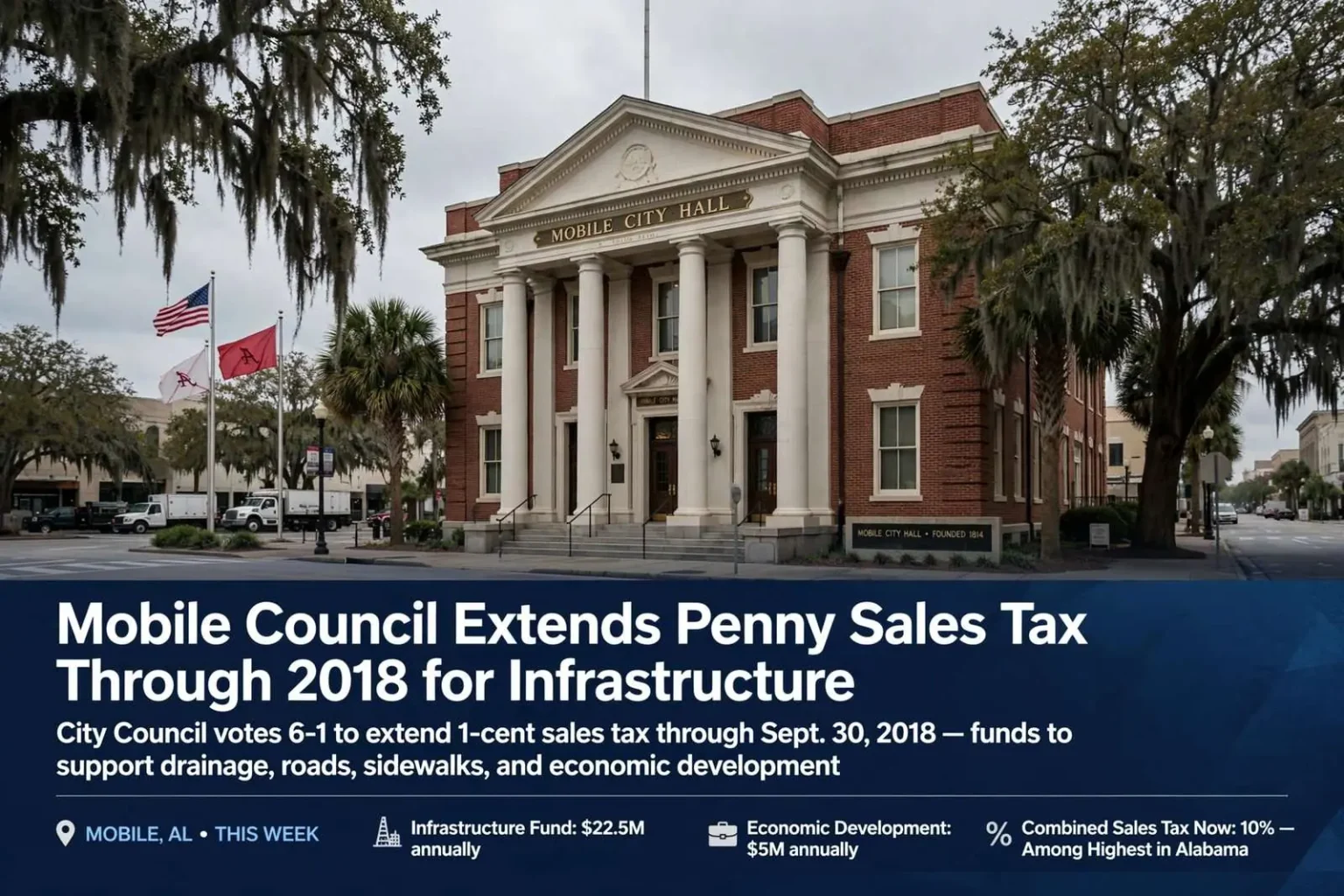
A one-percentage-point increase to Mobile’s share of the sales tax, first billed as a temporary fix for budget problems back in 2010, is sticking around for at least three more years.
The Mobile City Council voted 6-1 this week to extend the so-called penny sales tax through Sept. 30, 2018, marking the third time the increase has been renewed since it was first adopted. The extension keeps the city’s portion of the sales tax at 5 cents on the dollar, pushing the combined city, county and state sales tax rate in Mobile to 10 percent — among the highest combined rates in the country, on par with Birmingham and Montgomery.
Finance Committee Chairman Joel Daves argued the roughly $32 million generated annually by the tax has become essential not just for growth initiatives but for the city’s basic financial stability.
Under the extension, $22.5 million a year is earmarked for the city’s Capital Fund to cover infrastructure needs such as drainage improvements, sidewalks and road repairs, while another $5 million annually goes toward economic development incentives meant to attract new business investment to Mobile.
From Temporary Fix to Fixture
The penny tax arrived in 2010, when Mobile — like cities across Alabama — was wrestling with the budget damage of the recession and a decline in traditional revenue sources. It was sold then as a temporary measure, a one-cent bridge over a crisis. Five years later, it has been renewed three times, and Tuesday’s vote extends it well past the 2015 city elections and into the next mayor’s term.
Its evolution from emergency measure to structural revenue is a familiar story in municipal finance. Once a city builds payrolls, debt service and capital programs around a revenue stream, unwinding it means cutting something — and each renewal has made the penny less an exception and more a permanent part of what Mobile’s 5-cent city rate rests on.
At 10 percent combined, Mobile’s shoppers pay among the highest sales tax rates in the United States, level with Birmingham and Montgomery. That reality puts pressure on the city to show the money is doing visible work — the drainage projects, sidewalks and road repairs the Capital Fund exists to deliver, and the development incentives that put new businesses on formerly vacant ground.
A Split With the Mayor’s Office
The three-year extension marks a notable departure from what Mobile Mayor Sandy Stimpson’s administration had floated. The mayor’s office had pushed for only a short, two-month extension of the tax, running from July through September 2015, tied to a planned increase in the city’s capital improvement spending for the coming fiscal year.
The gap between a two-month bridge and a three-year commitment is not a technical detail — it is the difference between keeping the tax as a stopgap and locking it into the city’s long-term budget. The council’s 6-1 vote chose the latter, betting that the $32 million a year is worth more to Mobile than the promise of its eventual removal.
Stimpson was not present for Tuesday’s vote, attending meetings in Washington, D.C. with other regional mayors regarding federal transportation funding and a proposed Interstate 10 bridge project — a coincidence that underlined the stakes on both sides of the issue: the mayor was out chasing federal dollars for infrastructure even as the council was extending the local tax that pays for infrastructure at home.
Rich’s Dissent
Councilwoman Bess Rich cast the lone dissenting vote, saying she could have supported a shorter extension but objected to locking in a three-year commitment without more public discussion beforehand.
Rich has been the council’s most consistent skeptic of the penny tax since its adoption, and her objection this time focused on process as much as policy: a decision of this size — extending a tax the city once promised was temporary — deserved public hearings and a fuller airing before the council committed to 2018.
Other council members countered that the extension had been discussed publicly for weeks and had been covered by local media, arguing that the vote was the product of a long public debate rather than a rushed one. The exchange captured the recurring tension over the tax: whether its renewals have received the scrutiny a “temporary” measure deserves, or whether each extension has simply rolled forward on the momentum of the last.
Where the Money Goes
The arithmetic of the extension explains why the council held on. Of the roughly $32 million the penny generates each year, $22.5 million flows into the Capital Fund — the account that pays for the city’s physical plant: drainage systems that determine which neighborhoods flood in a Gulf Coast storm, sidewalks that connect them, and the road resurfacing that visibly ages without steady funding.
Mobile’s drainage needs have been a recurring theme of city politics for decades, with aging pipes and pumps struggling against heavy rain and development that keeps adding pavement to the landscape. Capital money is the only kind that fixes those systems, and the council’s decision to dedicate the largest share of the penny to that purpose reflects the complaint residents register most often.
The remaining $5 million a year directed to economic development incentives represents the city’s ammunition for recruiting. Whether the target is a manufacturer, a retailer or a downtown redevelopment project, incentives — tax abatements, infrastructure participation, grants — are the currency of modern site selection, and a city without a dedicated funding stream for them competes with one hand tied.
What 10 Percent Means for Mobile Shoppers
The combined rate — 10 cents on the dollar in Mobile — places the city’s consumers at the top of the national range. Sales tax is regressive by design: it takes a larger share of a low-income household’s budget than a wealthy one’s, which is why every renewal of the penny has drawn the same core objection from fiscal watchdogs and residents alike.
Defenders of the tax answer with the alternative: property taxes that would have to rise, services that would have to fall, or capital projects that would simply go undone. The 2010 crisis made that trade explicit; the 2015 renewal makes it durable. Mobile’s residents, in effect, have chosen a higher consumption tax as the price of maintaining city services and infrastructure without deeper cuts elsewhere.
The comparison cities — Birmingham and Montgomery, both also at the 10 percent ceiling among Alabama’s major cities — frame the competitive question. Mobile is not an outlier within Alabama; the question is whether the state’s largest cities’ reliance on high sales taxes is sustainable, and what it costs them in other ways.
The I-10 Bridge in the Background
Stimpson’s absence from the vote pointed at the larger infrastructure picture surrounding the city. The proposed Interstate 10 bridge across the Mobile River — intended to relieve the George Wallace Tunnel bottleneck and complete the corridor connection — has been the region’s biggest transportation project for years, dependent on federal partnership and a funding plan that remains contentious.
The mayor’s meetings in Washington with other regional mayors on federal transportation funding show where the city’s biggest infrastructure bets are being placed. But Tuesday’s vote is a reminder that the local share of infrastructure funding — drainage, sidewalks, streets — comes from the council’s side of the ledger, and for the next three years it will keep coming from the penny.
The overlap is the story of Mobile’s infrastructure moment in miniature: a mayor courting federal money for a billion-dollar bridge, a council extending a local tax to keep the pipes and pavement beneath residents’ feet in working order, and a taxpayer base paying 10 percent at the register to fund both.
The Politics of a Third Renewal
Each renewal of the penny tax has carried its own political arithmetic, and the third was no different. A 6-1 vote looks like consensus, but the circumstances — a mayor’s office preferring a two-month extension, a council insisting on three years, a lone dissenter objecting to the process — reveal the layers beneath it.
For the council majority, the case came down to stability. Budgeting in two-month increments, as the administration’s proposal implied, would have left every city department guessing about revenue past September. A three-year horizon, whatever its faults, lets the city plan capital projects on the timelines those projects actually run — years, not months — and lets bond markets and contractors see a committed revenue stream behind the city’s infrastructure promises.
For Rich, the objection ran in the opposite direction: the longer the extension, the heavier the obligation on taxpayers and the weaker the city’s incentive to find the structural fixes that were supposed to make the penny temporary. Her call for more public discussion was, in effect, a demand that the city either justify the tax on its merits or schedule its end.
The 2018 sunset date written into the extension sets up the next round of the same debate. Whether the fourth renewal arrives on schedule, early, or not at all will depend on the city’s finances — and on whether any future council is willing to be the one that finally lets the “temporary” tax expire.
What Residents Should Expect
For Mobile shoppers, nothing changes at the register until the new sunset date arrives: the city’s portion holds at 5 cents, the combined rate at 10 percent, through Sept. 30, 2018. What should change, if the council’s earmarks hold, is what the money visibly buys — catch basins and drainage projects in flood-prone neighborhoods, sidewalks along the corridors that lack them, and paving crews working through the city’s repaving backlog.
The $5 million annual development incentive stream will be judged differently. Its results show up as announcements — businesses recruited, projects closed — and the city’s ability to point to those wins will shape the tax’s standing when the renewal debate returns. A visible link between the penny and new investment is the strongest case the tax’s supporters can make; the absence of one is the dissenter’s recurring theme.
The third renewal also extends beyond the next municipal election, meaning the tax’s fate — and the city’s budget posture — will be settled policy before voters choose the council and mayor who will preside over the next decision. Tuesday’s 6-1 vote, in that sense, bound the city’s future government as much as its present one.
The Bottom Line
Mobile’s penny sales tax has now completed the full journey from crisis measure to institutional revenue: adopted in 2010 as a temporary fix, renewed three times, and extended through 2018 by a council that found $32 million a year too valuable to give back. The money has a purpose — drainage, sidewalks, roads, and the incentives that chase new investment — and a sunset, however much history suggests sunsets here are provisional.
What remains unsettled is the longer question the dissent keeps alive: whether a city that funds its infrastructure through one of the highest sales tax rates in the country is building on a foundation it can sustain, or simply renewing, every few years, a promise it made to itself a decade ago and has not yet kept.
Until Sept. 30, 2018, at least, the answer will be paid for one penny at a time — and spent, the council majority hopes, one drainage project, sidewalk and development deal at a time across the city.