Search for a Missing 8-Year-Old Prichard Girl Paused Overnight, Set to Resume at Dawn
The search for 8-year-old Hiawayi Robinson, missing from a Prichard apartment complex since Tuesday, was suspended for the evening in September 2014 and set to resume Thursday morning.
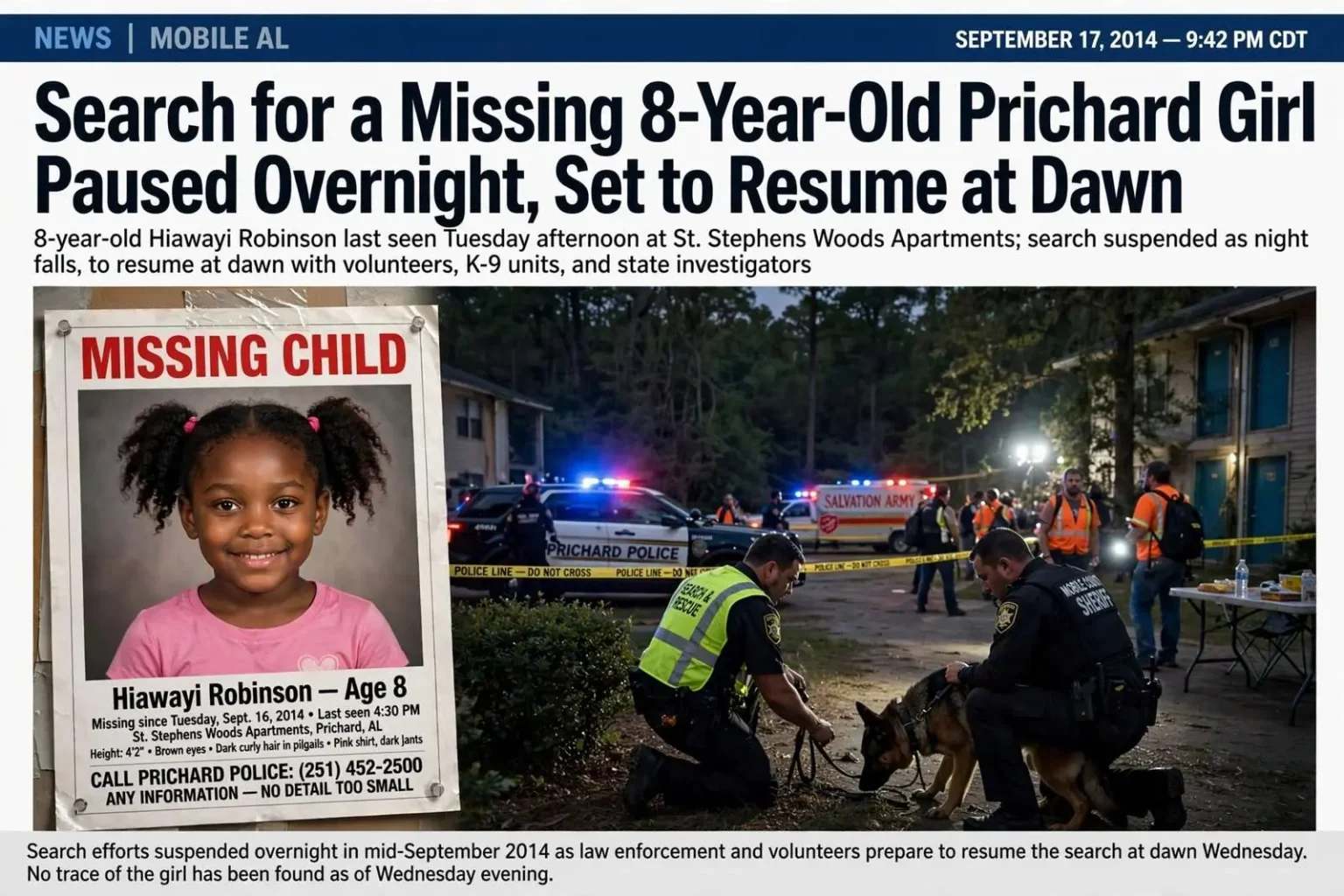
The search for a missing 8-year-old Prichard girl was suspended for the evening in mid-September 2014 and was set to resume the following morning, law enforcement authorities said. Hiawayi Robinson, 8, had gone missing on a Tuesday afternoon from the St. Stephens Woods Apartments in Prichard, where she lived. According to her family, she was last seen around 4:30 p.m. walking toward a cousin’s apartment in the same complex. She never arrived.
The short distance — a walk across a courtyard that should have taken less than a minute — is what has made the case so alarming to investigators and so devastating for the family. There was no journey to retrace along busy streets, no route with dozens of potential witnesses. Hiawayi vanished in the space between two front doors in the complex where she lived.
A wide search effort
The response on Wednesday drew volunteers, search dogs and a helicopter from the Alabama Bureau of Investigation to the area surrounding the complex. As of that evening, no trace of the girl had been reported. Searchers worked on foot through the late-summer heat while the aircraft swept overhead, covering ground that would have taken ground teams days to clear.
According to accounts at the time, search dogs alerted to her scent but led investigators to a bus stop she was known to use regularly. That detail gave investigators a possible waypoint in the girl’s afternoon — evidence that she may have gone somewhere familiar before disappearing — but it did not answer the central question of what happened after she reached the stop.
Prichard police, Mobile County sheriff’s deputies and trained volunteers with the nonprofit KlaasKids Foundation searched the heavily wooded area around the apartments. The KlaasKids Foundation, founded by Marc Klaas after the 1993 abduction and murder of his daughter Polly in California, deploys volunteer search brigades to missing-child cases across the country, and its searchers are trained to work grids systematically rather than wandering wooded terrain at random.
Cars entering the complex were stopped as authorities worked to secure the scene. Controlling access to the apartment complex served two purposes at once: it kept potential evidence from being disturbed, and it allowed officers to note every person coming and going from a property where someone might have information about the girl’s disappearance.
The Salvation Army of Coastal Alabama was also present, providing food and water to first responders, according to a release from the organization. The group said it would return at 7 a.m. Wednesday when search efforts resumed — part of the sustained, round-the-clock effort that had taken shape around the case. Feeding searchers may sound like a small role, but in protracted searches that stretch across summer days, keeping volunteers and officers fed and hydrated is what allows the effort to continue without collapsing from exhaustion.
Questions of foul play
Prichard’s interim Police Chief Michael Rowland said an AMBER Alert — the emergency broadcast used in cases of a suspected child abduction — had not been issued as of Wednesday evening. Rowland said police had not yet determined whether foul play was suspected in the girl’s disappearance.
“We can’t say it’s a crime yet,” he said in a televised interview.
A search alert with details about the case had been issued, and authorities said a press conference was scheduled for 8 a.m. Thursday. The distinction between a missing-child case and a confirmed abduction mattered a great deal in how the response unfolded and what tools authorities could bring to bear. AMBER Alerts in Alabama are reserved for cases meeting strict federal criteria — a confirmed abduction, a child believed to be in imminent danger of serious harm or death, and enough descriptive information about a suspect or vehicle to make a broadcast useful to the public. Absent those elements, agencies issue less dramatic but still far-reaching alerts that push a missing child’s description to media outlets, hospitals and law enforcement statewide.
That distinction can frustrate the public, who often ask why a phone alert did not wake the entire region. But the criteria exist because emergency broadcasts lose their power when they fire too often, and investigators must work the case with the tools that fit the evidence they actually have. In the meantime, the on-the-ground search proceeds the same way either way: doors knocked, woods combed, timelines reconstructed hour by hour.
A city that knows this terrain
Prichard, a small city of roughly 22,000 residents just north of Mobile, has fewer resources than its larger neighbor, and its police department routinely leans on county and state partners for major incidents. The involvement of the Mobile County Sheriff’s Office and the Alabama Bureau of Investigation reflected that reality. The city’s neighborhoods — a mix of aging apartment complexes, modest homes and dense woods left undeveloped between streets — present searchers with some of the toughest terrain in the county.
St. Stephens Woods Apartments sits in that landscape, with thick tree cover pressing close to the buildings. For an 8-year-old, that terrain is both a playground and a hazard, and for searchers it is slow going: underbrush, drainage ditches and pockets of standing water limit visibility and make grid searches physically demanding work.
How missing-child searches are organized
Large searches for missing children follow a structure that has been refined over decades of cases. Investigators establish a command post and divide the area into zones, assigning each to a team that searches it methodically and logs what was covered. Dogs trained in air-scent and tracking work alongside those teams, and the helicopter provides an aerial view that can spot disturbances in tree cover or movement in open ground that searchers on foot would never see. Each element feeds the same central timeline: where the child was last seen, what direction any evidence points, and which areas have been ruled out.
The bus stop detail is the kind of lead that investigators weigh carefully. Children are creatures of routine, and a missing child’s known habits — the route to a cousin’s apartment, the stop where she catches the school bus, the playground she favors — define the search perimeter’s starting point. A scent alert at a place she visited regularly can mean she went there on her own, or it can simply mean her scent lingers where it always does, which is why handlers and detectives interpret such alerts cautiously.
The family’s account placed her final confirmed sighting at about 4:30 p.m., a detail that anchors everything else. In cases like this, investigators rebuild the afternoon in small increments: who saw her, from where, in which direction she was walking, and what vehicles were in the complex at that hour. Each witness interview either tightens the timeline or adds a thread that needs to be pulled.
The first 48 hours
Child recovery specialists consider the first two days the most critical window in any missing-child case, and the mobilization around Hiawayi’s disappearance reflected that urgency. Volunteers from the surrounding community had already begun gathering by the time organized search efforts took shape, and authorities worked to channel that energy — putting untrained volunteers to work in ways that helped rather than hindered the evidence picture.
For the family, the overnight suspension of the search was an agonizing pause, not an ending. Investigators typically continue working leads after dark even when ground searches stop, reviewing what was found, planning the next day’s zones, and following up on interviews conducted at the scene. The Salvation Army’s pledge to return at dawn captured the mood around the case: the effort was going to continue, hour after hour, until there was an answer.
Residents of Prichard and the wider Mobile area were asked to contact Prichard police with any information about the girl’s whereabouts, no matter how small the detail might seem. In missing-child investigations, a single offhand observation — a child in a yard she did not belong in, a car idling near a bus stop — has repeatedly proven to be the thread that unravels an entire case, which is why authorities pressed for any scrap of information the public could offer as the search prepared to resume at 7 a.m.
What families face in the hours after a disappearance
Behind the official effort, the family’s own experience of the first two days follows a pattern familiar to anyone who has worked these cases. Relatives retrace the last known walk themselves, over and over, searching for anything missed. Neighbors gather. Phones ring with secondhand reports that must each be checked out. Police ask hard, uncomfortable questions of the people closest to the child — not because they are suspects in anyone’s mind, but because the closest circle is where timelines are built.
Child advocates note that families in these situations benefit from a single point of contact within the investigating agency, someone who coordinates briefings and relays developments so that relatives are not left scrambling for information. The scheduled 8 a.m. Thursday press conference served part of that function publicly, giving authorities a set time to update a community that was following the case closely.
The case also drew attention across the Mobile area because of what it represented: a child doing something completely ordinary, in a place she knew, in daylight. Parents in the complex and across Prichard spent the following days keeping children close, and community leaders urged anyone with even fragmentary information to come forward. In a city where word travels quickly through churches, schools and family networks, that kind of community attention often produces the tips that formal canvasses miss.
As dawn approached on the day the search was to resume, the pieces of the response were already in place: searchers and dogs set to return at 7 a.m., the Salvation Army restocking food and water, investigators refining their zones based on the previous day’s results, and a press conference scheduled to bring the public up to date. What no one could yet say was where Hiawayi Robinson was — and that unanswered question kept the entire Gulf Coast watching Prichard.