Mobile Judgeship Opens as the City’s 2013 Political Season Heats Up
The retirement of District Judge Charles McKnight set off a scramble for a Mobile County District Court seat as the city's mayoral race and council contests came into focus.
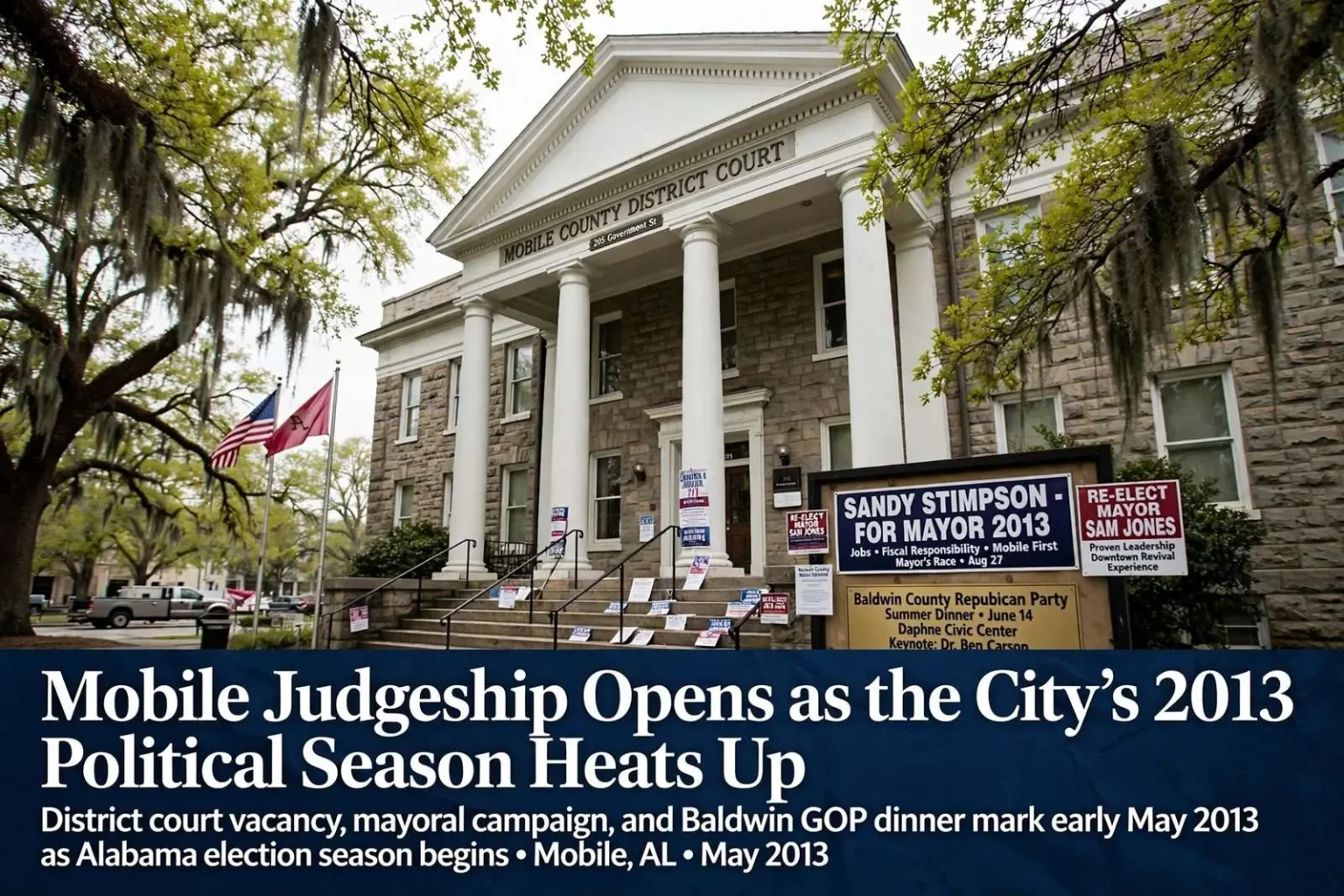
The coming retirement of a veteran jurist and the opening rounds of a hard-fought municipal season combined in early May 2013 to put Mobile’s political calendar into motion. At the center was a vacancy on the Mobile County District Court, one of several developments drawing candidates, committees and campaign donors into the spring sun — a reminder that in an election year, hardly any official departure is ever just a personnel matter.
Within the span of a single week, the county’s judicial selection machinery stirred to life, the Baldwin County Republican Party finalized plans for its biggest fundraiser of the year, and the campaign for Mobile’s top office formally took shape. Each event would have merited attention on its own; together they sketched the outline of a political season that would run from May through the August elections and beyond.
A vacancy on the district bench
Mobile County District Judge Charles McKnight, 68, announced he would retire at the end of the month, saying the timing felt right. He planned to travel and to finish a long-term project restoring an old Chris-Craft boat in the workshop at his Fowl River home. After years on the district bench, where the docket runs through misdemeanors, small claims, traffic cases and preliminary hearings for felony charges, McKnight was leaving with a reputation for steadiness — the kind of judge attorneys describe as predictable in the best sense of the word.
The county’s Judicial Selection Committee, chaired by presiding Circuit Judge Charles Graddick and including attorneys Danner Frazer and Judson Wells along with citizen representatives Harris Morrissette and Chris Pringle, had already begun its work. The panel would interview applicants and forward three nominees to Gov. Robert Bentley, who would make the appointment.
The process is Alabama’s version of merit selection for mid-term judicial vacancies: rather than an open election, the committee screens applicants, evaluates their legal experience and temperament, and sends the governor a short list from which the appointment must come. The appointee then serves until the next election cycle, when the seat must be contested at the ballot box — a structure that makes every appointment both a legal and a political event.
Observers expected as many as two dozen applicants, with early mention going to Walter Honeycutt, municipal judge Matt Green, civil attorney Joe Basenberg and drug-court judge Ed Blount Jr. The breadth of the early list reflected the prize at stake: a district judgeship offers a steady vantage point on the county’s legal system, and drug courts and other specialty dockets have made the bench a place where a judge can build programs as well as decide cases.
A star turn for the Baldwin GOP
Across the bay, the Baldwin County Republican Party prepared for its annual summer dinner on June 14 at the Daphne Civic Center, with pediatric neurosurgeon and author Dr. Benjamin Carson as keynote speaker and Gov. Bentley expected to take part. Chairman Matt Simpson, who noted that fewer than 200 tickets remained, said the party had initially pursued the stars of the television program Duck Dynasty before turning to Carson, then a rising figure among conservatives after his National Prayer Breakfast address.
The dinner is the Baldwin party’s marquee event of the year — a fundraiser, a rally and a gathering of the county’s Republican infrastructure in one hall. Baldwin County is the anchor of the GOP in south Alabama, delivering some of the party’s largest margins in the state, and its summer dinner has a way of drawing statewide figures who want to be seen where the party’s base is thickest. Bentley’s expected appearance was as much homecoming as booking; the governor counted Baldwin among his strongest counties.
Carson’s selection captured the moment in conservative politics. The Johns Hopkins neurosurgeon had vaulted from the medical world into the political conversation after his prayer breakfast speech, delivered with a president seated a few feet away, and his biography — Detroit childhood, Yale and Michigan, pioneering surgical career — had made him a draw long before any campaign attached his name to one. For the Baldwin party, landing him ahead of the 2014 cycle was a coup, and the ticket sales showed it.
The Duck Dynasty anecdote, meanwhile, said something about the party’s instincts in 2013: the reality-television family’s Louisiana duck blinds and beards had become unlikely cultural icons, and the party’s flirtation with them reflected how fully entertainment and politics had merged in the era’s conservative gatherings. Carson, though, offered substance to match the celebrity, and the party’s choice of him signaled where its long-term interests lay.
The mayoral race takes shape
In Mobile, businessman Sandy Stimpson formally opened his campaign for mayor before a lively crowd of 1,000 or more at the fairgrounds in west Mobile. Challenging incumbent Sam Jones in the Aug. 27 city elections, Stimpson entered the race as the candidate the city’s business community had been waiting for — a Mobile native, an engineer and an executive whose family’s manufacturing firm gave him standing in the same rooms that had produced past mayors.
The mayoral contest was the season’s centerpiece. Jones, seeking a second full term, had presided over a city navigating the aftermath of the recession — downtown revitalization projects moving forward even as budgets stayed tight and city finances drew criticism. Stimpson’s kickoff speech emphasized the themes that would define his challenge: jobs, fiscal management and a promise to make city government easier to deal with for the businesses and residents who deal with it every day. A crowd of 1,000 or more at the fairgrounds signaled that the challenge would be taken seriously from the start.
Mayoral races in Mobile turn on coalition geography. The city’s electorate divides among west Mobile’s suburban neighborhoods, the downtown peninsula’s revitalizing districts and the historically African-American communities of the city’s core, and a winning candidate has to assemble a coalition across all three. Jones carried the city in 2009 on exactly such a coalition; Stimpson’s task in 2013 was to pry loose the pieces of it — particularly west Mobile voters and disaffected moderates — while holding his own base firm.
The District Court vacancy and the mayoral race shared a season and a stage, but their timelines differed in a way that matters to political observers. The judgeship would be settled by a committee and a governor’s appointment, in a process conducted largely out of public view. The mayor’s race would be settled by the voters on Aug. 27, with a runoff in September if no candidate won a majority. Between them, the two contests would fill the spring and summer with the ordinary traffic of an Alabama election year — interviews and fundraisers, fish frys and forums, and the steady accumulation of endorsements that decides close races before the ballots are printed.
What the season’s early signals meant
Each of the week’s developments offered its own signal. The long list of prospective judicial applicants confirmed that Mobile’s bar still regards the district bench as worth pursuing, even through the scrutiny of a merit-selection committee. The Baldwin GOP’s box-office success with Carson confirmed the county party’s drawing power — and, with Bentley attending, the governor’s continued strength in the region that anchors his coalitions.
Stimpson’s kickoff said the most. Mayoral challengers in Mobile have historically needed either a scandal or a business-backed coalition to unseat an incumbent, and the size and enthusiasm of the fairgrounds crowd suggested the second ingredient was forming early. Jones, for his part, would run on record and incumbency — the downtown progress and the city’s recovering fortunes — and the incumbent’s advantage in a city that tends to re-elect its mayors should not be underestimated.
What was certain by early May was that the season had started: a judge headed for a Chris-Craft in a Fowl River workshop, a committee assembling a short list, a county party selling out a civic center, and a challenger drawing a thousand people to a fairground. Mobile’s 2013 political season had its cast, its calendar and its stakes — and everything from the district bench to the mayor’s office was about to be decided, in one form or another, before the summer ended.
The district court and the people it serves
The stakes of the appointment are easy to miss from outside the courthouse, but Mobile County’s District Court is where most residents meet the justice system. District judges handle the misdemeanor crimes, traffic cases, small-claims lawsuits and civil matters under a statutory dollar cap that make up the bulk of the county’s caseload — and they conduct the preliminary hearings that determine whether felony charges advance to a grand jury. A judge’s docket practices shape how long a defendant waits in jail, how quickly a small business recovers a debt and how much an ordinary lawsuit costs to resolve.
The county’s drug court and similar specialty dockets have also made the district bench a site of innovation. Judges who run treatment-based dockets manage a different kind of caseload — offenders whose cycles of addiction and re-arrest are addressed with supervision and treatment as much as with sentences — and Ed Blount Jr.’s name among the early contenders reflected the standing such work earns. For the committee, the question is less about ideology than capacity: which applicant can manage a relentless docket with fairness and speed.
McKnight’s own departure illustrated the quiet dignity the office can carry. His plan to restore a Chris-Craft boat at his Fowl River home reads like the closing line of a career spent on measured decisions — a retirement of varnish and patience after years of a docket that allowed for neither.
A season of signals for both parties
The same week’s events also sketched the political map of south Alabama as a whole. Mobile County, long a swing jurisdiction drifting toward the Republicans, and Baldwin County, the party’s south Alabama fortress, were each displaying their character: Mobile through competitive city races where the business community’s endorsement matters and no party label appears on the ballot, and Baldwin through a county party confident enough to sell out a civic center on the strength of a speaker’s conservative celebrity.
Carson’s appearance at the Daphne Civic Center also fed the 2014 and 2016 speculation that followed him all the way to a presidential campaign — proof of how a county party dinner can serve as an early runway for national figures. Local parties, whatever else they do, function as talent scouts and proving grounds, and the Baldwin GOP’s June 14 event was a textbook example.
For Mobile’s city elections, the calendar’s mix of a judicial appointment and a mayoral campaign meant the year’s political energy would be divided but additive — every event feeding attention to the others. By the time the Aug. 27 election arrived, voters would have spent a summer watching judges appointed, a civic center filled and a mayor challenged, and the outcome of any one contest would color the telling of all the rest.