

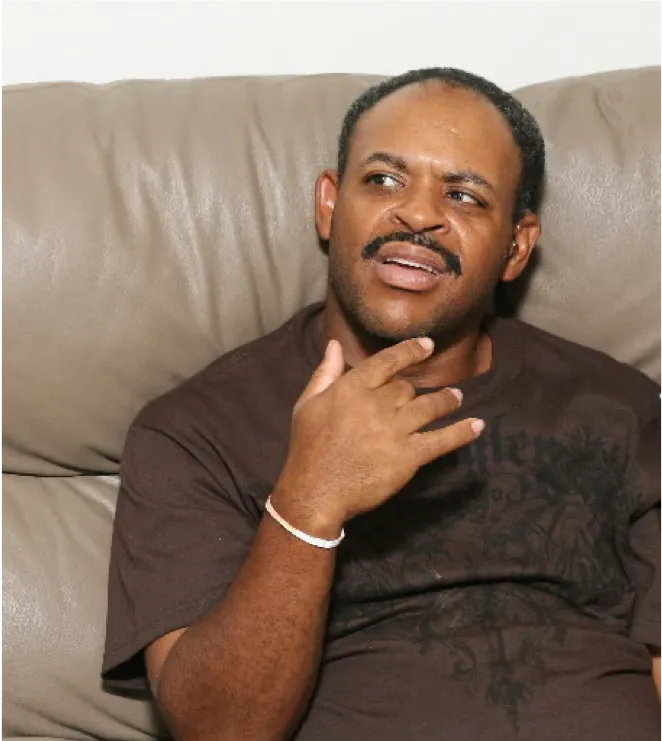
On July 24, 2009, Antonio Love entered a Dollar General store in Mobile, Alabama, bought snacks and a drink, and went into the restroom because he was suffering from stomach cramps. Love was 37 years old, profoundly deaf, used a hearing aid and lived with schizophrenia and other disabilities. What began as a sick man seeking privacy in a store bathroom became a police operation involving pepper spray, a pry bar, several officers and three Taser cycles. The incident remains a stark example of how quickly police can convert disability-related behavior into supposed defiance—and then use the defiance they have misunderstood to justify escalating force.
Store manager Kenneth Gooden called police after the restroom had remained locked for roughly 45 minutes to an hour. Officers Joe Cotner and Harry Milbrath arrived and began pounding on the door and ordering the occupant to come out. Love did not respond. The later federal court record said officers could see a foot braced against the bottom of the door, but the same record established a fact that should dominate any assessment of what happened: Love could not hear the commands being shouted at him. What officers interpreted as resistance was, at least in substantial part, an inability to perceive that police were outside.
Instead of pausing to consider why the person inside was not responding, officers escalated. They tried to manipulate the lock with a screwdriver, warned that pepper spray would be used and then sprayed the chemical under the door. When that failed to produce the response they wanted, additional pepper spray, officers and a supervisor were summoned. Love began coughing and turned on the water, causing water to leak from the restroom. According to his account, the spray looked like smoke or steam and fed a frightening hallucination that the devil was trying to enter the room. The police record describes an expanding tactical response; it describes no meaningful attempt to communicate visually with the person inside before the door was forced.
The door was eventually pried open with a tire iron or similar tool. What happened in the next few seconds was disputed. Officers said Love pushed the door outward and lunged toward them with an open umbrella, its metal end pointed in their direction. Love’s lawsuit presented a very different picture: a terrified man who had used the umbrella as cover while hiding from what he believed was a threatening force outside. The umbrella became the department’s central justification for the force that followed. Police spokesman Christopher Levy characterized it as a potential weapon, allowing an ordinary object in the hands of a confused, deaf man to be recast as an imminent danger.
Officer Cotner fired his Taser. The court record says only five to eight seconds passed between the opening of the door and the first discharge. Cotner then cycled the device a second time and a third time. During the third cycle, Love was already on the floor. The later federal ruling concluded that this use of force was objectively reasonable because Love had not yet been secured, was not following commands and could still be viewed as a threat. That reasoning is legally consequential, but it also exposes the central moral problem: Love’s failure to follow spoken commands—commands he could not hear—was repeatedly used to support the conclusion that more force was necessary.
Only after Love had been shocked and taken under control did officers search him and find identification indicating that he was deaf. They also found his hearing aid. A paramedic at the scene knew some sign language, and officers removed Love’s handcuffs long enough for him to communicate. By then, the most dangerous phase of the encounter had passed, but the discovery should have triggered an immediate reassessment of everything officers thought they had witnessed. His silence was not proof of contempt. His failure to obey was not necessarily resistance. His fear and erratic behavior were not evidence that he intended to attack anyone.
Yet the police response did not end with recognition and care. Supervisor Kevin Rodgers ordered Love arrested on accusations including disorderly conduct, resisting arrest and failure to obey. Police were unable to reach his family, and Love was held for hours before officers sought approval for criminal charges. A municipal magistrate contacted a judge, and the requested warrant was refused. Love was then released and left in the parking lot of his apartment complex, reportedly dazed, with damaged clothing and injuries that his family said included a knot on his head. Contemporary accounts differ on whether he was in custody for about five or six hours, but they agree on the essential point: after the force, after officers learned of his disabilities and after a judge refused to authorize the charges, he was returned home without the kind of support his condition plainly required.
Mobile police officials initially defended the physical force. Chief Phillip Garrett later said the Taser use was justified, but acknowledged that the arrest was wrong and that officers should have taken Love home once they understood his disabilities. The department’s internal investigation found that Rodgers failed to use alternatives to arrest required by policy when dealing with a person whose physical and mental condition called for a different response. Rodgers was placed on administrative duty pending a disciplinary proceeding. The available public sources reviewed for this article do not establish the final outcome of that process.
That internal finding is important because it undercuts the broad claim that the incident was simply an unavoidable response to a perceived threat. Even within the department, there was recognition that discretion existed and was mishandled. Police had choices after learning who Love was. They chose arrest. They had choices before forcing the door as well: seek additional information from store employees, try written communication, look beneath the door for a visual response, use gestures, summon medical help or consider that an unresponsive person might be deaf, unconscious, ill or terrified. Instead, the department treated the absence of obedience as evidence that coercion had to increase.
Federal disability law did not require officers to ignore an immediate threat, and it does not demand an interpreter before every urgent police action. It did, however, require law-enforcement agencies to provide effective communication to people who are deaf or hard of hearing, using auxiliary aids appropriate to the circumstances. Justice Department guidance available before the Love incident explained that communication methods can include written notes, gestures, assistive devices and qualified interpreters, with more formal assistance becoming increasingly important as an encounter grows longer, more complex and more consequential. The law allows officers to stabilize a genuinely dangerous emergency first; it does not excuse them from communication obligations once the emergency is controlled.
That distinction makes the post-Taser decisions especially troubling. Once officers had Love on the floor, found his deaf-identification card and hearing aid, and obtained limited sign-language help from a paramedic, the encounter was no longer an unknowable emergency. Police had direct evidence that their shouted orders had been useless. At that point, continuing toward arrest without securing effective communication risked turning the consequences of disability into criminal accusations. The department’s own later conclusion—that alternatives to arrest should have been used—confirms that the decision was not dictated by necessity.
Love filed a federal civil-rights lawsuit in April 2010 against the City of Mobile, Rodgers, several officers, Dollar General and Gooden. His complaint alleged false arrest, excessive force, assault, battery and negligence. It described a man who detected pounding as vibrations but could not understand what was happening, who became frightened by the pepper spray, and who was struck by the forced door before being shocked three times. The lawsuit also alleged that Gooden knew Love and knew of his disability but did not alert police. Later testimony summarized by the court said Gooden did not know who was inside the bathroom, illustrating one of several factual conflicts that surrounded the incident.
The federal case did not produce a jury verdict deciding which account was more credible. In August 2011, the federal district court granted summary judgment to the police defendants. The court ruled that Cotner and Rodgers were entitled to qualified immunity on Love’s federal claims and rejected the related state-law claims. In evaluating the force, the court emphasized the officers’ account of the umbrella, the confined setting, Love’s failure to obey commands and the fact that he had not yet been handcuffed during the third Taser cycle. The ruling said officers could not be judged with the benefit of facts they learned only afterward, including Love’s deafness.
Qualified immunity is designed to protect government officials unless they violate clearly established law. In Love’s case, it became a barrier between a disturbing encounter and a trial on accountability. The court’s approach separated the officers’ immediate perception from the failures that helped create that perception. It treated the moment the door opened as though it were largely detached from the preceding period, during which officers repeatedly relied on an auditory compliance test that Love was physically incapable of passing. That legal framing may explain the judgment, but it does not answer the public-policy question of why police procedures allowed a deaf man’s silence to be transformed into grounds for chemical spray, forced entry and electrical shocks.
Final judgment was entered for the City of Mobile and the individual police defendants, and Love’s claims against them were dismissed with prejudice. The claims involving Dollar General and Gooden had already been jointly dismissed with prejudice, with each side bearing its own costs. The docket does not show a public trial that tested the competing stories before jurors. Legally, the defendants prevailed. Institutionally, however, the case left behind a serious contradiction: the federal court found the force protected from liability while the police department itself found that the arresting decision violated the need to consider alternatives.
Disability-rights advocates have treated Love’s experience as part of a broader national problem. The Equal Justice Initiative described it as an assault on a deaf and disabled man. Historian and disability-rights writer David Perry later placed Love’s case alongside other encounters in which police interpreted disability-related noncompliance as aggression and escalated instead of slowing down. His criticism focused on the need for independent oversight, de-escalation training and consequences when officers choose force over patience. The comparison is not an assertion that every case is identical. It is a warning that the same institutional reflex appears repeatedly: commands are issued, disability prevents immediate compliance, and police interpret the mismatch as a threat.
The Love case also demonstrates why internal policy alone is inadequate when its breach produces little visible accountability. The public was told that the arrest was wrong and that a supervisor faced a disciplinary board, but the accessible record does not reveal a clear final disciplinary outcome. Meanwhile, the civil case ended without a trial, and the force itself was judicially approved as reasonable. From the public’s perspective, the system acknowledged a failure while making it exceedingly difficult to identify anyone who would bear meaningful responsibility for it.
Race adds another unavoidable dimension. Love was a Black disabled man confronted by officers in a commercial space after a store employee called police. Advocates have argued that disability and race can compound one another during police encounters, making behavior more likely to be viewed as suspicious and people less likely to be granted patience or credibility. The available judicial record does not establish that racial bias consciously motivated the officers. But accountability does not require proof that an officer voiced a racist or ableist intent. Systems can produce discriminatory outcomes through training gaps, threat assumptions and procedures that make no room for people who communicate or behave differently.
The most revealing fact in this case is not merely that officers initially failed to know Love was deaf. Police routinely encounter people whose conditions are not immediately obvious. The revealing fact is what the system permitted officers to do with uncertainty. Instead of treating uncertainty as a reason to slow down, gather information and create distance, the response treated it as permission to escalate. Instead of recognizing that nonresponse can signal disability or medical distress, officers treated it as resistance. Even after Love’s deafness was discovered, a supervisor tried to convert the encounter into a criminal prosecution.
Antonio Love entered a bathroom because he was sick. He left it pepper-sprayed, Tasered three times, arrested and deposited outside his home after a judge refused the charges. A federal court later protected the officers from liability, but legal immunity should not be confused with sound policing. The incident was not simply a communication failure. It was a failure of judgment, training and institutional restraint. Police had time to summon more force. They should have found time to communicate.
A system that measures compliance only by whether a frightened person immediately obeys shouted commands will continue to punish deafness as defiance. True accountability begins with rejecting that standard—and with insisting that disability be treated as a reason for care, not a pretext for force.