

MOBILE, Ala. — The acting head of the Mobile Airport Authority went to a conference in Montgomery a skeptic about electric air taxis. He came back convinced.
“This indeed is the future of low-range aviation and it’s just a matter of when it’s coming,” J. Adam Hays told the MAA board at its regular monthly meeting Wednesday.
“So I was kind of skeptical at the beginning of the conference,” Hays said, “but before the end of the conference they had me completely sold.”
The subject was Advanced Air Mobility — the category of small, largely automated electric aircraft that take off and land vertically and are intended to carry a handful of passengers over short distances. The FAA describes such aircraft as “highly automated,” and the shorthand most people have settled on is air taxi.
What Is Actually Being Proposed
“What we’re talking about is four- to six-passengers, relatively low range, but using electric vertical-takeoff and -landing air vehicles,” Hays said. “Just talking about what infrastructure an airport would require in order for us to accommodate something like this. There are countless companies right now that are going through prototyping and case studies.”
The specification is worth reading literally, because it rules out most of what people imagine when they hear “flying car.”
Four to six passengers is a large sedan, not an airliner. Relatively low range means these are not regional aircraft; they are designed for trips that are awkward by car — too long to be quick, too short to be worth a commercial flight. And electric vertical takeoff and landing means no runway is required, which is the entire point: a landing pad occupies a fraction of the land an airstrip does.
Hays offered an example with obvious local appeal.
“I know the mayor really wants to have ferries go across the bay, but man, these things would be really cool to be able to take us from here to Orange Beach or whatever,” he said.
That is the use case in a sentence. Mobile to Orange Beach is roughly an hour by car in good conditions and considerably worse on a summer Friday. It is a trip that currently has no fast option.
The Infrastructure Problem
The conference, Hays said, was largely about what airports would need to build.
“We were essentially talking about what infrastructure would be needed at airports in order to support the impending surge of these eVTOL vehicles,” he said.
Helipad-style landing areas and charging stations are the obvious requirements. They are also the easy ones.
Charging is where the difficulty starts. An electric aircraft carrying passengers on a commercial schedule needs to recharge between flights, quickly, without degrading the battery. That is a substantial electrical service — closer to what a small industrial facility draws than what a terminal building uses. Installing it means coordinating with the utility, and possibly upgrading the distribution infrastructure serving the airfield.
The harder problems are not physical at all.
“The FAA would have to develop air maps showing where such vehicles would be allowed to operate,” Hays said. “We would need training for air traffic control, things like that. So there’s a lot of things to do and everybody’s really excited about this industry that’s seemingly about to take off.”
Why Air Traffic Control Is the Real Bottleneck
The airspace question is the one that determines the timeline, and it is genuinely difficult.
American airspace is organized around a system built for a relatively small number of aircraft, each in contact with a controller, moving along established routes at established altitudes. Air taxis would introduce a large number of small, highly automated aircraft operating at low altitude over populated areas — a traffic pattern the system was not designed for and does not currently have procedures to manage.
Several things have to be settled before that can work at scale. Corridors have to be defined, which is what Hays meant by air maps. Separation standards for automated aircraft have to be written. Controllers have to be trained on procedures that do not yet exist. And a framework has to be established for how much of the separation work is done by the aircraft themselves rather than by a person on a radar scope.
None of that is impossible. All of it is slow, and none of it can be accelerated by an individual airport authority.
What Makes These Aircraft Different From Helicopters
The obvious objection to all of this is that a vehicle carrying four to six people on a short hop, taking off and landing vertically, already exists. It is called a helicopter, and it has existed for eighty years.
The differences the industry is betting on are noise, cost and complexity.
A conventional helicopter generates lift from one large rotor turning at high speed, which is loud — loud enough that community opposition has limited helicopter operations over populated areas for decades. Distributed electric propulsion spreads the work across several smaller rotors turning more slowly, which changes both the volume and the character of the sound. Whether that difference is large enough to satisfy neighborhoods near a landing site is one of the open questions the sector has not yet answered at scale.
Operating cost is the second argument. Turbine helicopters are expensive to run and expensive to maintain, with a great many moving parts under continuous stress. Electric motors have far fewer, and electricity costs less per mile than turbine fuel. If those savings hold in commercial service, the economics support a price point closer to a premium car service than to a charter helicopter.
The third difference is the automation Hays referenced. Helicopters are demanding to fly and require a trained pilot for every flight. Highly automated aircraft change that equation — eventually removing the largest single recurring cost from the operating model, though not before regulators are satisfied, which will take considerably longer than the engineering.
The Weather Question Nobody Raised
One factor specific to this region did not come up in Wednesday’s discussion, and it will matter here more than it does in most places.
The Gulf Coast has weather. Summer afternoons produce fast-forming thunderstorms with strong downdrafts and lightning. Hurricane season shuts things down for days at a time. Fog settles over the bay in the cooler months. Small aircraft at low altitude are more exposed to all of it than an airliner at cruise.
That does not disqualify the concept — general aviation operates here year-round — but it shapes what a service can promise. An air taxi network across Mobile Bay would face weather cancellations at a rate that a road crossing does not, and any business case built on it has to assume a meaningful number of days when the aircraft do not fly.
It is the kind of detail that tends to surface after the infrastructure conversation and before the first ticket is sold.
Where the Industry Stands
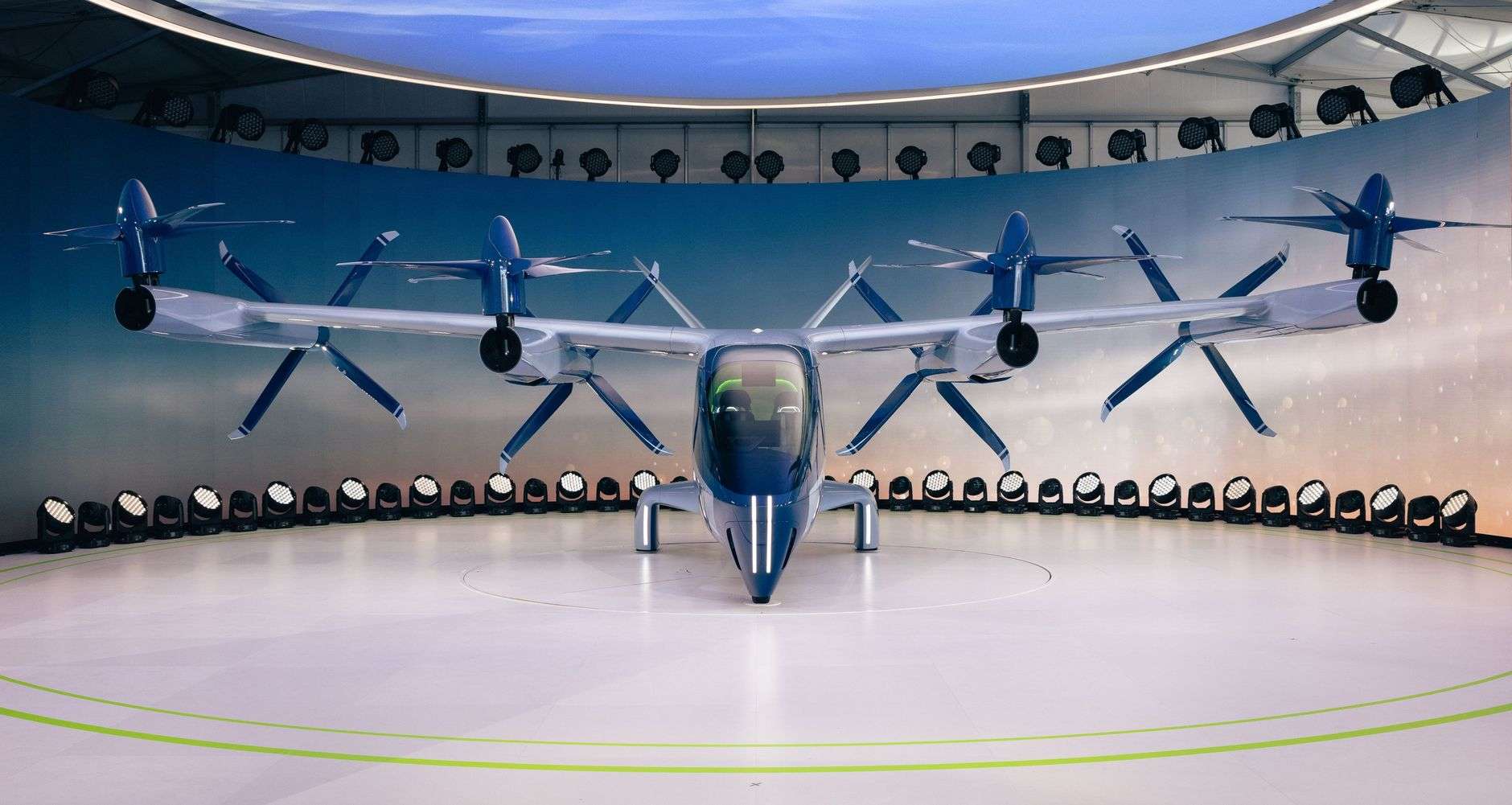
Numerous companies have been developing eVTOL aircraft, and some have moved past the prototype stage into demonstration flights. Joby Aviation’s six-rotor aircraft has recently been on tour. Hays did not name Joby or any other manufacturer in his remarks.
The sector has been a prominent aviation story for roughly a decade, which is long enough for a fair amount of skepticism to accumulate. Certification of a genuinely new category of aircraft is a lengthy process, and several timelines announced early in the sector’s history have come and gone.
Hays’s estimate was measured. Laying the regulatory framework and creating incentives for airports to invest would take a while, he said — but in as little as five years, air taxi service could become a reality.
The Chicken-and-Egg Problem
The most practical observation Hays made was about the shape of the investment decision facing any single airport.
“If we go ahead and say we’re going to invest in this, well, we need to have a partnering site that’s also going to have the same infrastructure on their side,” he said. “So we couldn’t just do it in a vacuum. We would have to have a destination that we would like to go to.”
An air taxi pad with nowhere to fly is an expensive concrete slab. The infrastructure only produces value in pairs, which means the first two airports to build have to build roughly simultaneously and in coordination — and neither gets any return until both are finished.
That structure is precisely why Hays kept returning to legislation and funding.
“So yeah, we were in the room with a lot of like-minded people around Alabama,” he said. “Just you know, waiting on legislation to start taking place so that we can put some funding in for things like this.”
A coordination problem of this kind is the classic case for state-level action. Individual airports acting alone will rationally wait for someone else to go first. A state framework — designating sites, funding a network, setting standards — is what breaks that stalemate.
Why Mobile Is Paying Attention
The region has reason to be in the room early.
The Mobile Aeroplex at Brookley is a substantial aviation-industrial campus, and Mobile has spent the last decade establishing itself as an aircraft manufacturing center. An airport authority in a city that builds aircraft has a different relationship to an emerging aviation sector than one that only moves passengers through a terminal.
There is also the geography. The Mobile Bay region is defined by a body of water that makes short trips long. Mobile to the eastern shore, to Gulf Shores, to Orange Beach — these are distances that look trivial on a map and consume an hour or more on the ground, because everything funnels through a limited number of crossings. Mobile has spent thirty years and $3.2 billion addressing exactly that problem with a bridge.
A vehicle that crosses the bay in a straight line at low altitude is, in that context, not a novelty. It is a category of answer to a question the region has been asking for a long time.
What to Watch
Hays’s remarks were an update to a board, not a proposal, and no MAA action was taken.
The things that would signal real movement are specific: state legislation establishing an Advanced Air Mobility framework and funding, FAA progress on low-altitude corridor design, certification milestones from the manufacturers, and — locally — any indication of a partner site willing to build a matching pad on the other end of a route.
Until those appear, the useful takeaway is the one Hays offered. Not if. When.