
Mobile Airport 9/11 Ceremony Marks 25 Years With a 7:46 a.m. Moment of Silence
The Mobile Airport Authority and TSA held a public remembrance ceremony in the Mobile Regional Airport terminal lobby, marking 25 years since the Sept. 11 attacks with a wreath placement and a moment of silence at 7:46 a.m.
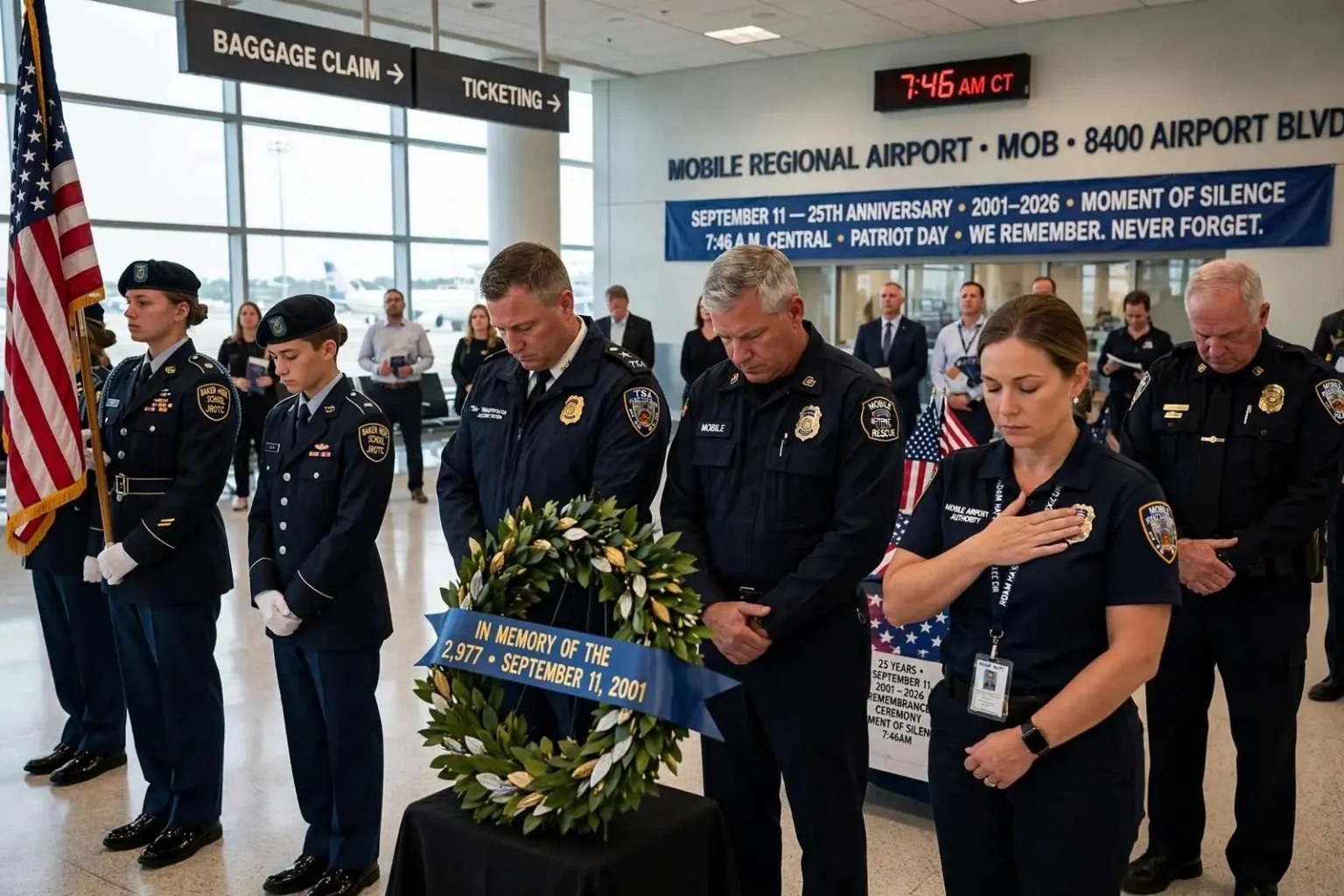
The Mobile airport 9/11 ceremony returned to the main terminal at Mobile Regional Airport on Friday, as the Mobile Airport Authority and the Transportation Security Administration marked 25 years since the Sept. 11, 2001, terrorist attacks with a public remembrance built around a single minute of stillness.
The observance was scheduled for 7:35 to 8 a.m. in the first-floor main terminal lobby at 8400 Airport Blvd. It was open to the public, and the authority invited community members to attend alongside airport employees, TSA personnel and first responders. The program included recognition of first responders and a ceremonial wreath placement.
At 7:46 a.m. Central Time, the gathering paused for a moment of silence. That time corresponds precisely to the moment American Airlines Flight 11 struck the North Tower of the World Trade Center 25 years earlier — 8:46 a.m. on the East Coast, the instant an ordinary Tuesday morning became something else entirely.
A Ceremony Aimed at a Generation That Was Not There
Adam Hays, acting executive director of the Mobile Airport Authority, framed the anniversary in terms of memory rather than mourning alone.
“Twenty-five years later, there is now an entire generation that knows September 11 only through the stories we tell. That makes it even more important that we continue to remember the lives lost, honor the courage and service we witnessed that day, and ensure their stories are never forgotten.”
The arithmetic behind that observation is stark. Anyone born after September 2001 has no firsthand memory of the attacks, which now includes essentially every traveler under 25 moving through the terminal on Friday morning, a substantial share of the airport’s own younger workforce, and the TSA officers who were not yet born when the agency that employs them was created in direct response to the day.
The ceremony was designed to honor the 2,977 people killed in New York, at the Pentagon and in a field outside Shanksville, Pennsylvania. That figure counts office workers, restaurant staff, custodians, security guards, passengers, flight crews, military personnel, civilian defense employees and the emergency responders who went in after them.
Why Airports Observe This Day Differently
Sept. 11 lands on the aviation industry in a way it does not land on most other workplaces. The attacks were carried out using four commercial airliners, and everyone aboard them — passengers, pilots and flight attendants — was killed. The flight crews were, in the most literal sense, the first people confronted by the hijackers, and the industry has never treated that as an incidental detail.
For the people who work inside terminals, the day also marks the beginning of a permanent transformation of their jobs. Airport security in the United States before Sept. 11, 2001, was largely handled by private contractors hired by individual airlines, operating under a patchwork of federal rules. Screening was cursory by modern standards. Small knives were permitted in carry-on baggage. Family members and friends routinely walked to the gate to meet arriving passengers. Cockpit doors were not hardened.
All of that ended within a matter of months. Congress passed the Aviation and Transportation Security Act in November 2001, creating the Transportation Security Administration and federalizing passenger and baggage screening at commercial airports nationwide. The agency stood up a workforce of tens of thousands of screeners in roughly a year, one of the fastest federal hiring efforts in modern American history. In 2003, the TSA moved from the Department of Transportation into the newly created Department of Homeland Security.
Twenty-Five Years of Layered Security
The security architecture that travelers now take for granted was assembled piece by piece in the years that followed, usually in response to a specific incident or intelligence finding. Among the most visible changes:
- Reinforced, locked cockpit doors on commercial aircraft, along with procedures restricting access to the flight deck in flight.
- Universal screening of checked baggage for explosives, which required airports across the country to install large detection systems and, in many cases, rebuild parts of their baggage handling infrastructure.
- A dramatically expanded Federal Air Marshal Service.
- Restrictions on liquids, aerosols and gels in carry-on baggage, adopted in 2006 after a transatlantic plot involving liquid explosives was disrupted.
- Advanced imaging technology at checkpoints, replacing the metal detectors that had been the standard for decades.
- Watch-list matching moved from the airlines to the federal government under the Secure Flight program.
- Trusted-traveler programs such as TSA PreCheck and Global Entry, which sort lower-risk passengers into expedited lanes so screening resources can concentrate elsewhere.
- Identity requirements tied to the REAL ID Act, which set federal standards for the driver’s licenses and state IDs accepted at checkpoints.
Each of those layers has its critics, and the balance between security and convenience has been argued over continuously for a quarter-century. But the underlying premise has not changed since 2001: aviation security is now a federal responsibility, exercised through a uniformed workforce present in every commercial terminal in the country, including the one in west Mobile.
What the Mobile Airport Authority Operates
The Mobile Airport Authority oversees four aviation assets in the Mobile area. They are Mobile Regional Airport, identified by the code MOB; Mobile International Airport, identified as BFM; the Mobile Aeroplex at Brookley; and St. Elmo Airport.
Mobile Regional Airport, where Friday’s ceremony was held, sits on Airport Boulevard in west Mobile and has long served as the region’s commercial passenger gateway. The Brookley complex, south of downtown along Mobile Bay, is a large aviation and industrial campus on the site of the former Brookley Air Force Base, which closed in 1969 and was subsequently redeveloped. St. Elmo Airport is a general aviation field in southern Mobile County.
Together those facilities represent a meaningful piece of the local economy and employ a workforce that spans airline staff, ground handlers, mechanics, air traffic controllers, concessions employees, law enforcement, firefighters assigned to airport rescue duty and federal screeners. The remembrance ceremony was aimed at all of them, and at the traveling public passing through the lobby at the same hour.
The Timeline the Moment of Silence Marks
The 7:46 a.m. Central pause is specific by design. On Sept. 11, 2001, four hijacked airliners were used in an attack that unfolded over roughly 102 minutes of Eastern time.
American Airlines Flight 11 struck the North Tower of the World Trade Center at 8:46 a.m. Eastern. United Airlines Flight 175 struck the South Tower at 9:03 a.m. American Airlines Flight 77 struck the Pentagon at 9:37 a.m. United Airlines Flight 93 crashed into a field near Shanksville, Pennsylvania, at 10:03 a.m., after passengers and crew who had learned of the other attacks by phone attempted to retake the aircraft. The South Tower collapsed at 9:59 a.m. and the North Tower at 10:28 a.m.
In the hours after the first impact, the Federal Aviation Administration ordered every civilian aircraft in United States airspace to land — an unprecedented nationwide ground stop that emptied the skies over the country for the first time in the history of powered flight. Thousands of flights were diverted, including hundreds of international arrivals sent to Canadian airports. Commercial service did not resume for several days, and when it did, it resumed into a system that had already begun changing permanently.
The emergency response in New York produced its own set of numbers that have become part of the standard remembrance: 343 members of the Fire Department of the City of New York died, along with officers of the New York City Police Department and the Port Authority of New York and New Jersey Police Department. It was the deadliest single day in the history of the American fire service.
Patriot Day and the National Observance
The federal designation for Sept. 11 is Patriot Day. Congress established it in the months after the attacks, and it is observed each year with the American flag flown at half-staff on federal buildings and at private residences, and with a nationally recognized moment of silence timed to the first impact. It is a day of remembrance rather than a federal holiday; government offices, banks and schools remain open.
In 2009, Congress broadened the observance by designating Sept. 11 as a National Day of Service and Remembrance, encouraging Americans to mark the anniversary through volunteer work. That has produced a second layer of observances around the country each September — blood drives, cemetery cleanups, food bank shifts and similar projects — running alongside the more traditional ceremonies.
Mobile saw both kinds this year. Ceremonies, tributes to first responders and volunteer service projects filled the calendar across the city and the surrounding counties, from the airport terminal to the University of South Alabama campus to Mobile National Cemetery.
Looking Ahead
The Mobile Airport Authority’s ceremony is an annual observance, and the authority has signaled through Hays’ remarks that it views the storytelling function of the event as increasingly central. As the anniversary moves further from lived memory, the ceremonies themselves become the primary mechanism by which the day is transmitted to people who did not experience it.
Travelers and community members interested in future observances at Mobile Regional Airport can watch for announcements from the Mobile Airport Authority in the weeks ahead of Sept. 11. The airport’s main terminal is located at 8400 Airport Blvd. in Mobile.
Update: How the Ceremony Unfolded
The Mobile Airport Authority has since released a fuller account of the program, which drew airport employees, first responders, students and community members to Mobile Regional Airport on Friday morning.
The ceremony opened with an invocation led by Mobile Airport Authority Board Member Abe Harper. The Baker High School JROTC Color Guard performed the Presentation of Colors, and Mobile’s Singing Children performed the National Anthem a cappella.
The moment of silence followed at 7:46 a.m. Central Time, marking the exact minute American Airlines Flight 11 struck the North Tower of the World Trade Center 25 years earlier.
Representatives from the airport authority and TSA then took part in a ceremonial wreath placement in memory of the 2,977 people killed in the attacks.
‘Not on Our Watch’
TSA Transportation Security Manager Tracy Mize used her remarks to connect the anniversary to the daily work of the people screening passengers a few feet away.
“Today, we remember those who served, those we lost, and the role each of us plays in protecting our country. We reaffirm our promise to the American people: not on our watch,” Mize said. “We have learned from the courage and sacrifice of those who came before us, and we carry that spirit and vision from yesterday, to today, to tomorrow and into the future.”
The ceremony also recognized current and retired firefighters, law enforcement officers, emergency medical personnel and other first responders in attendance.
Adam Hays, acting executive director of the Mobile Airport Authority, framed the changes of the past 25 years around what has not changed.
“The way we travel has changed. The way we protect our airports and aircraft has changed. But the purpose behind that work remains very human: taking care of the people who place their trust in us every day,” Hays said. “Twenty-five years later, we remember those we lost. We honor those who served. And we carry forward the courage, compassion and unity that emerged during one of our nation’s darkest days.”
The Mobile Airport Authority thanked TSA, the Baker High School JROTC, Mobile’s Singing Children, participating first responders and everyone who attended.