Gulf Shores Airport Breaks Ground on $15 Million Terminal Expansion Just a Year After Opening
Gulf Shores International Airport has broken ground on a $15 million terminal expansion, less than a year after its debut, as passenger traffic climbs to record levels.
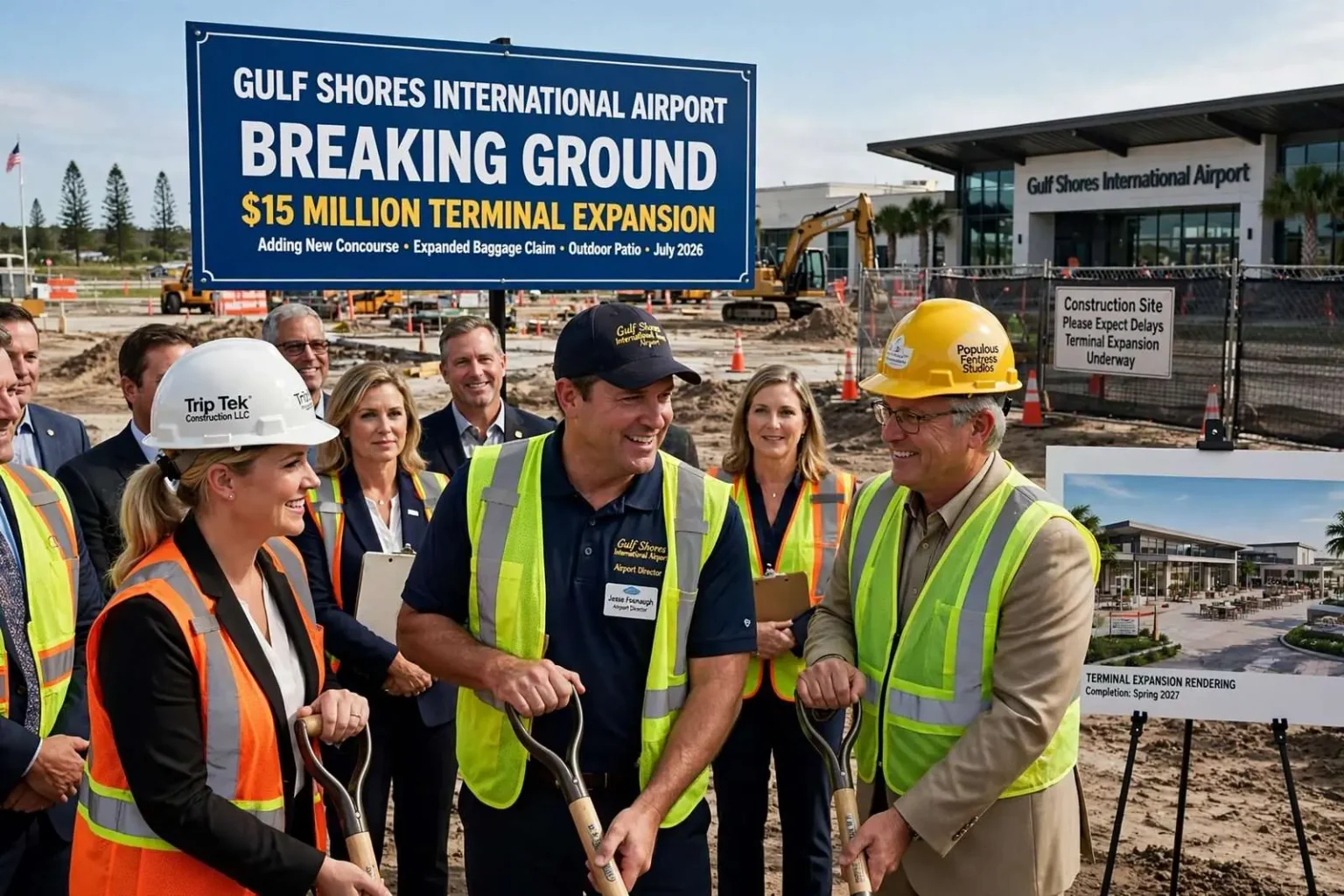
Gulf Shores International Airport, which opened barely a year ago at a cost of roughly $8 million, is already expanding to keep pace with demand. Airport officials broke ground this week on a $15 million terminal addition that is expected to be finished before the summer 2027 flight schedule begins in May.
The project will add a new concourse, a larger baggage claim area, an outdoor patio, a dedicated nursing room for mothers, and more food, beverage and retail space. Roughly 300 additional parking spaces are also planned.
Trip Tek Construction LLC will oversee the build, and renderings released by Populous Fentress Studios show what the finished terminal will look like.
The pace of the expansion tells its own story. The airport — built on the site of the longtime Jack Edwards field at the edge of Gulf Shores — went from a modest municipal airfield to a commercial terminal with scheduled airline service in a single year, and is now growing again before its first anniversary of commercial flights has fully passed.
Federal money and a line of credit
Federal money is again helping foot the bill. Gulf Shores received a $2 million Airport Terminal Program grant from the Federal Aviation Administration, funded through the 2021 Infrastructure Investment and Jobs Act — the same law that contributed $5 million toward the airport’s original terminal two years ago.
Airport Director Jesse Fosnaugh said the rest of the expansion is being covered through a $20 million line of credit while officials pursue additional funding.
“We are working to secure additional contributions from stakeholders as the project advances,” Fosnaugh said. “The ultimate goal will be to secure long-term financing once the project is completed and all contributions and actual construction costs materialize.”
The financing structure — federal grants layered onto a short-term credit line, with long-term financing to follow once costs are known — mirrors how fast-growing small airports typically fund expansion without tying themselves to bonds before the real bill is in hand. It keeps the city flexible, though it also means the airport’s stakeholders will be courted steadily as construction proceeds.
Passenger numbers driving the timeline
The expansion follows a stretch of strong passenger numbers. More than 34,000 passengers passed through the airport in June, the busiest month since Allegiant Air began flying out of Gulf Shores in May 2025. Flights to the airport’s 13 destinations ran at an average load factor of 78% that month, and the airport logged 104,000 enplanements in its first 12 months of commercial service — a result officials described in May as exceeding expectations.
Those numbers explain the urgency. A 78% load factor in a peak beach month means seats are filling to the point where airlines can justify more frequency and new routes — but only if the terminal can physically handle two aircraft on the ground at once, which the original single-gate setup cannot.
“We have been in lockstep with Allegiant throughout this process,” Fosnaugh said. “Measured growth allows for greater route scheduling opportunities, increased space for our passengers, and more supporting infrastructure. Even though we are growing, we will keep the airport experience quick, easy, inexpensive, and cheerful. The ‘small-community’ feel of the airport is paramount to our mission.”
The new terminal will have two gates with the ability to expand to four, according to Fosnaugh.
“Currently we are operating with a gate area that can handle only one flight at a time, so having two gates will allow for two aircraft on the ground at the same time with a third aircraft capable within an hour of one of the two leaving,” he said. “This equates to nearly three times the throughput of the current terminal, depending on flight activity and passenger load factor.”
Throughput is the metric that matters most to a leisure market airport. Summer Saturdays along the Alabama Gulf Coast concentrate demand into a handful of prime arrival slots, and a single-gate terminal forces airlines to spread flights across the week rather than stacking them at the weekend peak. Doubling the gate capacity lets Allegiant — and any carrier that follows — schedule the kind of dense Friday-through-Sunday rotations a beach market generates.
The low-cost model Allegiant operates only works when aircraft turn quickly, seats fill and ground time stays short. Every extra minute of congestion at a single-gate terminal eats into that model, which is why the expansion is aimed at keeping the airport’s famously quick arrivals and departures quick as volume grows.
Fosnaugh said travelers should expect some operational challenges around the terminal and parking areas while construction is underway, but that the end goal is to better serve passengers as the airport continues to grow.
Construction adjacent to an operating terminal is a careful choreography: fencing around the build site, shifted walking routes from the parking lot, and temporary crowding at the existing gate and baggage areas during peak months. Airport officials are asking summer 2027 travelers to plan a few extra minutes — a small price, they argue, for a terminal that will be three times as productive by the following season.
Update: the build runs through summer 2027
Airport Director Jesse Fosnaugh says construction on the new concourse will wrap up next spring, but the project won’t stop there. Once the new terminal is finished, crews will shift to reconfiguring the original terminal building, work that is expected to take most of the summer of 2027 to complete.
Fosnaugh reiterated that the new concourse is being designed to accommodate two flights on the ground at the same time by May 2027, a capability airport officials say they are actively pitching to airlines as they work to add routes.
“I always had the knowledge as a tourist coming here for many years that it was going to be successful; I just didn’t know it would be so quickly,” Fosnaugh said, reflecting on the airport’s rapid growth just over a year after commercial service began.
His remark captures the bet Gulf Shores made. For years, the city’s millions of annual visitors arrived by car on Highway 59 or via larger airports in Pensacola and Mobile, adding hours to trips that ended on the sand. A hometown airport with nonstop leisure routes shortens that last leg — and the demand curves airport officials watched for years as tourists finally proved out the case for scheduled service.
The airport’s 13 destinations map almost exactly onto Allegiant’s leisure-route playbook — the carrier links Gulf Shores with the smaller and mid-sized cities that feed Gulf Coast tourism, flying visitors in for long weekends rather than connecting them through hub airports. Load factors near 78% suggest the formula is working well enough that route additions are now a conversation about terminal capacity, not market demand.
For Baldwin County’s economy, the implications run beyond the ticket counter. Every enplaned passenger is a hotel night, a restaurant meal and a beach chair rental; the airport’s first-year total of 104,000 enplanements represents a new and direct stream of visitors arriving with Gulf Shores as their destination rather than a two-hour drive as their final obstacle.
City officials have framed the airport as part of the same infrastructure wave that has reshaped the coastal strip in recent years — the new Gulf Shores high school campus, ongoing beach renourishment cycles and the traffic work that follows the city’s tourism growth. The terminal expansion slots into that pattern: build ahead of demand rather than behind it.
Travelers watching the project take shape over the next year can expect the visible milestones to come quickly. The concourse shell rises through fall and winter, the spring wrap-up triggers the shift to the original building’s reconfiguration, and the summer 2027 work lands right in the middle of peak season — the hardest window to close anything, and the clearest evidence of how tight the airport’s capacity math has become.
By May 2027, the target the airport has set for itself, two aircraft should be able to sit at Gulf Shores gates at once for the first time. If the route pitches to airlines land, the summer after that could bring more destinations, more frequency and the next round of expansion planning — a pace Fosnaugh says he intends to keep measured even as the numbers argue for speed.
The first year of commercial service has already rewritten what the airport is: from a quiet general aviation field to a terminal moving more than a hundred thousand passengers. The second year, with a $15 million addition under way, is about making sure the building can keep up with the demand the first year created.
Local officials have also stressed that the airport’s growth is being managed rather than chased. The decision to add gates before adding routes, and to fund construction through grants and a credit line before committing to long-term debt, is meant to keep Gulf Shores International from repeating the boom-and-bust pattern of overbuilt regional airports elsewhere — even as the passenger counts keep arguing for more.