Fairhope Sherwin Williams Building Sells for $2.4 Million in a Busy Week of Coastal Deals
A Fairhope investor paid $2.4 million for the Sherwin Williams building on Bushel Drive, a Mobile church bought on Azalea Road for $250,000, and Victoria's Secret and Pandora signed leases at Tanger Outlets in Foley.
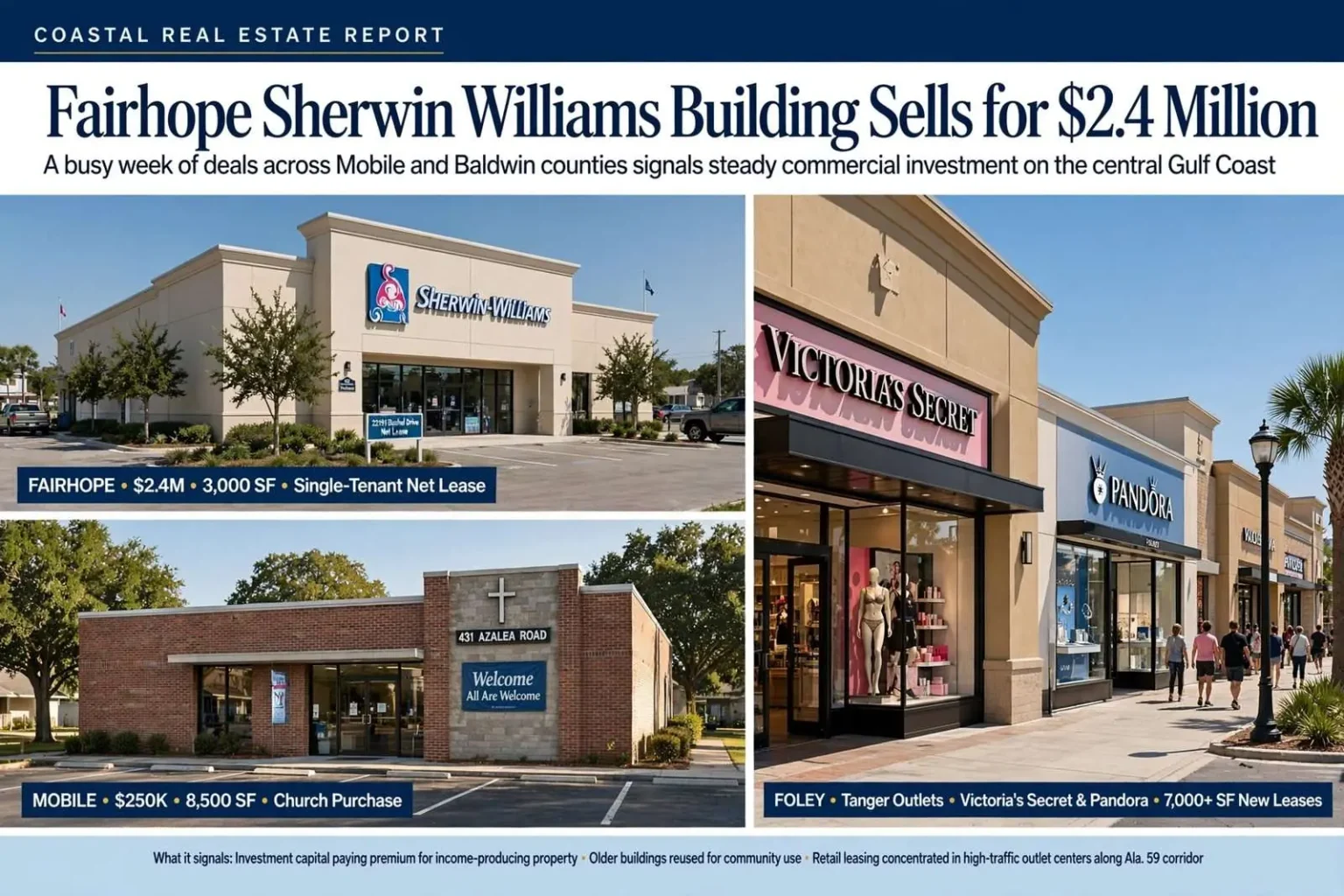
A single-tenant paint store in Fairhope changing hands for $2.4 million, a church buying an 8,500-square-foot building in Mobile for $250,000, and a national lingerie retailer taking more than 7,000 square feet at the Foley outlet mall are not obviously related transactions. Taken together, though, they sketch a fairly clear picture of what commercial real estate on the central Gulf Coast looks like right now: income-producing property trading at a premium, older buildings trading on price per square foot, and retail leasing concentrated where the traffic already is.
Here is a rundown of the deals announced across Mobile and Baldwin counties in recent days, and what each type of transaction signals about the market.
Fairhope: $2.4 Million for a 3,000-Square-Foot Building
A local investor paid $2.4 million for the 3,000-square-foot Sherwin Williams paint store building at 22191 Bushel Drive in Fairhope, according to Herrington Realty, which handled the transaction.
The arithmetic is the first thing that stands out: roughly $800 a square foot for a small, single-story retail building. No one builds a 3,000-square-foot shell for anything close to that. But a sale like this one is not priced on the building — it is priced on the lease.
Single-tenant net lease property is bought as an income stream. The investor is acquiring a contractual series of rent payments from a corporate tenant, and the value is derived by dividing that annual income by a rate of return the market considers appropriate for the risk. The stronger the tenant’s credit and the longer the remaining lease term, the lower the acceptable return — and the higher the price the same rent will support.
Investors in this category are typically buying three things: a recognizable corporate tenant, a lease structure that pushes taxes, insurance and maintenance onto that tenant, and a location that would still lease if the tenant ever left. A paint store is a particularly clean example, because the retailer is not a discretionary destination. It serves painting contractors, builders and remodelers, which ties its performance to construction activity in the surrounding area rather than to shopping trends.
That the buyer is described as a local investor is itself worth noting. Net lease assets in this price range are routinely bought by out-of-state 1031 exchange buyers trading out of higher-cost markets. A local purchaser at this number suggests confidence in Fairhope specifically, in a corner of Baldwin County that has absorbed sustained residential growth.
Mobile: A Church Buys on Azalea Road for $29 a Foot
A local church paid $250,000 for an 8,500-square-foot building at 431 Azalea Road in Mobile, according to Josh Hall and Pete Riehm of CRE Mobile, who represented the seller. The buyer was represented by Nikita Pleasure of IXL Real Estate.
At roughly $29 a square foot, this is the opposite end of the pricing spectrum from Fairhope, and for a straightforward reason: it is a building sale, not an income sale. The buyer is purchasing space to occupy.
Congregations have become steady buyers of second-generation commercial space across the country, and the reasons are practical. New construction of a comparable sanctuary and fellowship space would cost several times the purchase price. An existing building offers parking that is already paved and striped, restrooms, mechanical systems and a roof. Large open floor plates — the kind found in former retail, warehouse or assembly buildings — convert to worship space more readily than a partitioned office layout.
The considerations that usually determine whether such a deal works are zoning and parking. Places of worship are permitted in many commercial districts, sometimes by right and sometimes only with a conditional or special use approval, and the federal Religious Land Use and Institutionalized Persons Act constrains how local governments may treat religious assembly uses relative to comparable secular ones. Parking ratios for assembly uses are calculated on seating capacity rather than floor area, which is why a former retail building with a generous lot is often a better fit than a larger building with a small one.
There is a fiscal footnote as well. Property owned by a religious organization and used for religious purposes is generally exempt from ad valorem taxation, so a sale like this quietly removes a parcel from the local tax rolls even as it puts a vacant building back into active use.
Mobile: A Vacant Office Building Trades at $400,000
A 3,154-square-foot office building at 6313 Piccadilly Square Drive in Mobile was purchased by an investor for $400,000, according to Angela McArthur of Stirling, who represented the seller. The office is not occupied.
That last sentence is the deal. At about $127 a square foot with no tenant in place, the buyer is not purchasing income — there is none — but the opportunity to create it.
Vacant small-office purchases generally follow one of two paths. In the first, the buyer is an owner-user: a professional practice, an agency, a small firm that would otherwise be signing a lease and decides instead to own its own building, converting rent into equity and mortgage interest into a deductible business expense. In the second, the buyer is a genuine investor pursuing a lease-up play, accepting carrying costs and leasing commissions in exchange for the higher value the building will carry once it is occupied and producing rent.
Small office suites of a few thousand square feet have proved considerably more durable than the large corporate office market that dominates national headlines. The tenants are dentists, insurance agencies, accountants, therapists, small law offices and contractors — businesses whose work requires a physical location and whose space needs did not evaporate with remote work.
Foley: Victoria’s Secret and Pandora Add to the Tanger Lineup
Victoria’s Secret has leased a 7,281-square-foot store space in Tanger Outlets on Ala. 59 in Foley, according to Tanger marketing officials. Victoria’s Secret is located near the Ann Taylor store and features best-selling intimates, fine fragrances, body care and loungewear.
Tanger also announced that Pandora jewelry store will open in November in 2,000 square feet of space next to Bath & Body Works. Pandora is known for its hand-finished jewelry featuring signature charm bracelets, rings, necklaces and earrings.
The 532,000-square-foot center is undergoing a major multi-phase renovation to modernize the shopping destination. Watch for new access points, new retailers, and new dining and gathering spaces that will integrate the retail, food and beverage offerings.
Two leases signed at the same center, one of them a national apparel brand taking a large block of space, is a meaningful indicator during a renovation. Outlet centers depend on a mix that gives shoppers a reason to drive past closer alternatives, and anchor-adjacent placement — the Victoria’s Secret space near Ann Taylor, the Pandora space next to Bath & Body Works — reflects the standard leasing practice of clustering complementary tenants so that one visit produces several stops.
The broader industry shift the renovation describes is also familiar. Centers built as pure shopping destinations have spent the past decade adding food, beverage and gathering space, because dwell time correlates with spending and because a place to sit and eat converts a shopping errand into an outing. In Foley, the surrounding market matters: the Ala. 59 corridor carries beach traffic to and from Gulf Shores and Orange Beach, which supplies a steady flow of visitors on top of the year-round Baldwin County population.
Foley: Collins Aerospace Plans a 23,445-Square-Foot Storage Building
Watch for Collins Aerospace to add a 23,445-square-foot storage building to its property at 1300 W. Fern Ave. in Foley, according to planning records. The company, which sits on 19 acres, manufactures and repairs airplane parts.
A storage building is the least glamorous item on this list and arguably the most economically significant. Manufacturing and repair operations add warehouse space when they need to hold more inventory — more raw stock, more parts awaiting repair, more finished units awaiting shipment. That is a throughput signal, and it is a form of capital commitment to a site that a lease is not.
It also fits a regional pattern. South Alabama has spent the past decade assembling an aerospace cluster, anchored by commercial aircraft assembly in Mobile and supported by a supplier and maintenance base spread across both counties. Repair and overhaul work is a durable segment of that industry: aircraft components have finite service lives and mandated inspection intervals regardless of whether airlines are ordering new planes.
Mobile: Two Leases on the Service Side
Mediacom has leased 3,370 square feet of space in Schillinger Place Shopping Center at 2502 S. Schillinger Road in Mobile, according to McArthur of Stirling, who represented the landlord.
Dr. Alicia Evans has leased 1,687 square feet of medical office space at 829 S. University Blvd. in Mobile, according to Jill Meeks of Stirling, who represented the landlord.
These are the smallest transactions in the group and the most representative of what a local leasing market actually consists of. Both illustrate the same principle: service businesses lease where their customers already are.
The Schillinger Road corridor in west Mobile has absorbed much of the city’s residential growth, and a telecommunications provider taking space in an established neighborhood shopping center is following rooftops. Neighborhood centers anchored by everyday necessities have consistently been the most resilient retail format, because grocery, pharmacy and service tenants generate repeat visits that do not migrate online.
The South University Boulevard lease follows a different but equally reliable logic. Medical practices cluster near hospitals, referral networks and the training institutions that supply their staff, and the University Boulevard corridor sits at the center of Mobile’s medical and university district. Medical office has become one of the most sought-after commercial categories nationally for exactly that reason: the tenants invest heavily in build-out, which makes relocation expensive, and renewal rates run high as a result.
What the Week Adds Up To
Read as a set, the transactions describe a coastal market operating on several different clocks at once:
- Investment capital is paying up for credit income. The Fairhope net lease sale at roughly $800 a square foot is a bet on contractual rent, not on bricks.
- Older buildings are trading on utility. The Azalea Road church purchase at roughly $29 a foot and the vacant Piccadilly Square office at roughly $127 a foot are priced on what a buyer can do with the space.
- Retail leasing is consolidating in proven locations. New tenants are going into an established outlet center that is being reinvested in, not into new speculative construction.
- Industrial expansion is incremental and quiet. A storage building added to an existing 19-acre site is how manufacturing growth usually shows up in the record.
- Service tenants follow rooftops. The west Mobile and University Boulevard leases track population and institutions rather than trends.
None of these deals is individually large by national standards. Collectively, they are the ordinary machinery of a growing coastal economy: capital chasing income in Baldwin County, reuse and repositioning in Mobile, and expansion at the edges where the people and the traffic are.