Mobile Council to Weigh Four More Community Safety Team Positions in County Schools
A resolution before the Mobile City Council would add four Community Safety Team prevention positions in city schools at a cost of about $672,000 to Mobile County Public Schools over three years, with four new school resource officers to follow.
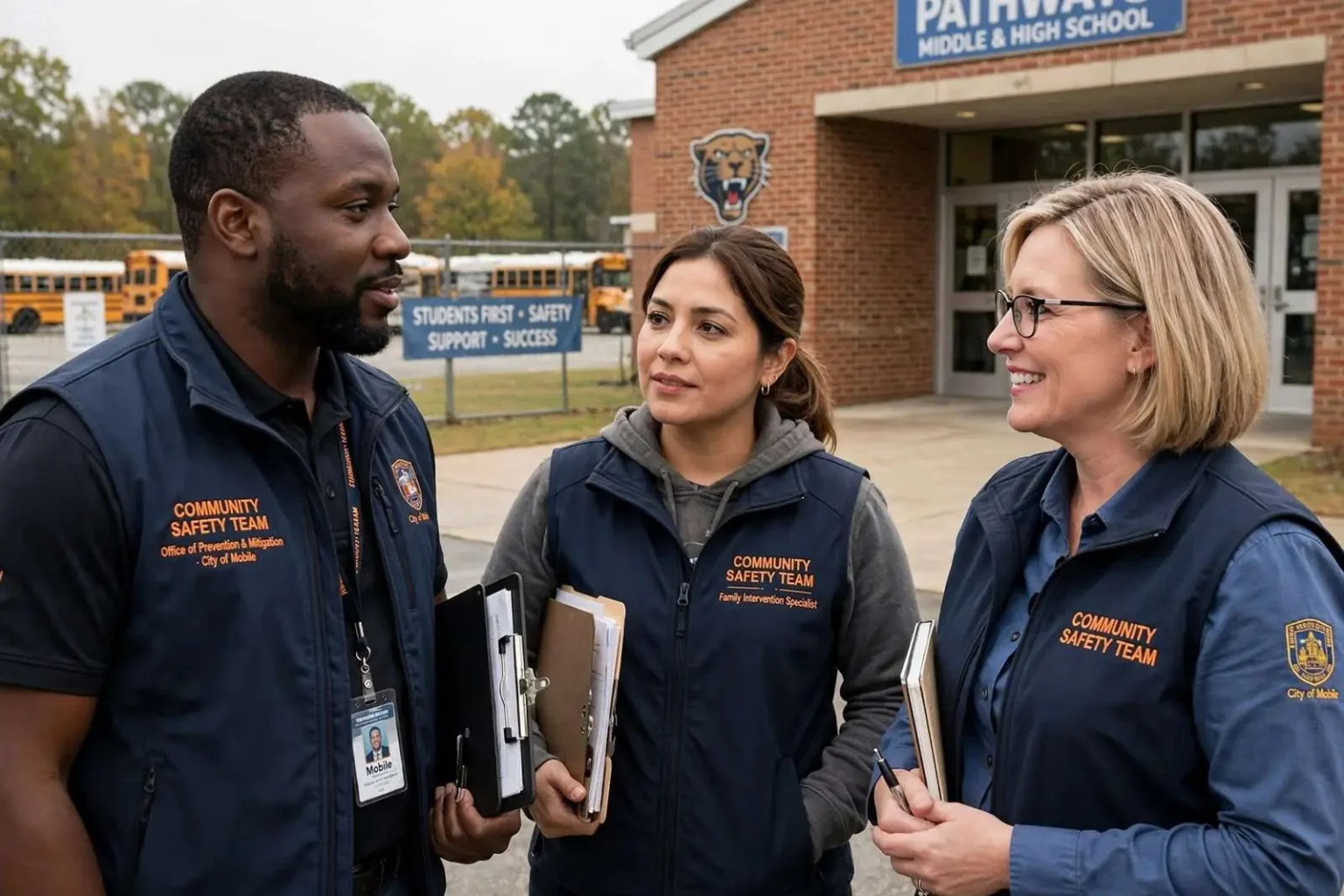
The item waiting on the Mobile City Council’s agenda Tuesday does not pave a street, buy a truck or break ground on anything. It pays for four people.
A resolution submitted by the City Attorney would fund four additional Community Safety Team prevention positions assigned to public schools in Mobile. The money, according to the resolution, would come from the Board of School Commissioners of Mobile County — the elected body that governs Mobile County Public Schools — rather than from the city’s own coffers. The council’s role is to authorize the arrangement and add the jobs.
The four are contract employees specializing in school intervention services, and they will cost the Mobile County Public School System about $672,000 over three years. The agreement itself is between the school board and the city’s Office of Prevention and Mitigation, which operates within the Department of Public Safety.
The four positions break down this way:
- A Community Intervention Specialist assigned to Pathways Middle and High School
- A Family Intervention Specialist assigned to Pathways Middle and High School
- A Family Intervention Specialist assigned to Williamson Middle and High School, Hall Elementary and Craighead Elementary
- A Family Intervention Specialist assigned to LeFlore High School and Booker T. Washington Middle School
City officials describe the agreement as the first step in a broader push rather than a self-contained item. The Mobile County Board of School Commissioners will soon consider funding four additional school resource officers through the Mobile Police Department for schools inside the city, an expansion that would put sworn officers alongside the specialists the council is being asked to authorize.
“We are excited in what we are trying to accomplish and that’s improving the relationships with the schools and our students,” said Curtis Graves, the city’s executive director of public safety. “It’s about fostering positive relationships.”
Read quickly, it is a routine personnel item on a long agenda. Read closely, it is a map: a short list of campuses where the city and the school system have decided that the most useful thing they can add is an adult whose entire job is knowing students and their households before something goes wrong.
What the Resolution Says the Teams Do
The resolution describes Community Safety Teams as serving school-age youth and their families by providing daily mentorship, whole-family engagement, conflict identification and de-escalation, and sustained connection to social, economic, health and educational resources.
Each phrase there is doing work, and describes a model of public safety that looks almost nothing like the version most people picture.
Daily mentorship is the part that distinguishes this kind of position from a counselor with a caseload of several hundred students or an outside program that visits once a month. Daily means presence — in the hallway before first bell, at lunch, at dismissal, at the bus loop. The value of that presence is not any single conversation. It is the accumulated familiarity that lets an adult notice that a student who is usually loud has gone quiet, or that two students who were friendly in August are now avoiding each other in September.
Whole-family engagement is the reason two of the four positions carry the title Family Intervention Specialist rather than a student-facing one. The premise is that the pressures that surface in a classroom — an eviction notice, a utility cutoff, a parent working a night shift, a sibling in crisis, a household without transportation — do not originate in the classroom and cannot be resolved there. A specialist who can sit at a kitchen table is working on a different set of variables than one who can only work in a school office.
Conflict identification and de-escalation is the piece closest to what people normally mean by safety, and it is deliberately sequenced: identification comes first. Most serious incidents involving young people are not spontaneous. They have a history — a dispute that started days or weeks earlier, often online, often known to a wide circle of students long before it is known to any adult in the building. The intervention that matters is usually the one that happens while the conflict is still an argument.
Sustained connection to resources is the least dramatic phrase and, in practice, often the most demanding. A referral is easy to make and easy to lose. The difference between handing a family a phone number and actually getting them enrolled in a program is measured in follow-up calls, paperwork, appointments and rides — the unglamorous labor that determines whether an identified need ever becomes a met one.
Community Specialist Versus Family Specialist
The resolution funds two distinct titles, and the distinction is not cosmetic.
A Community Intervention Specialist, as the title is generally used in this kind of program, works the space between the school building and the neighborhood around it. That means knowing which blocks students walk home through, which corners disputes tend to migrate to after dismissal, which rec centers and churches and coaches already have relationships with the young people in question, and which outside adults can help defuse something the school alone cannot reach.
A Family Intervention Specialist works the household. That means home visits, contact with guardians who may be difficult to reach during business hours, help navigating benefit applications, coordination with health providers, and the ordinary translation work of explaining what a school is asking for and why.
The agreement puts its own language to the same split. A community intervention specialist, according to the document, serves as a peer mentor for parents and youth while acting as a bridge between schools, neighborhoods and families. Family intervention specialists provide intensive, non-clinical psychosocial support, mentorship, individualized support planning, conflict mediation and family engagement services for students and their families.
The phrase “non-clinical” is the boundary line in that description. These are not therapists, and the support they provide is not treatment. The work is mentorship, planning, mediation and engagement — the connective tissue around clinical services rather than the services themselves.
Programs that use both titles are describing a division of labor rather than a hierarchy. One position follows a conflict outward into the community; the other follows a student inward into the home. Notably, Pathways Middle and High School is slated to receive both — the only campus in the resolution assigned two positions.
Why the Assignments Are Clustered
The schools named in the resolution — Pathways, Williamson, Hall Elementary, Craighead Elementary, LeFlore and Booker T. Washington — are not a random sample. They are a cluster, and the way the assignments are drawn says something about how the positions are meant to function.
Two of the three Family Intervention Specialist slots are assigned to multiple campuses, and in both cases those campuses are feeder-connected: an elementary school and the middle and high school its students move into, or a middle school and the high school it feeds. That structure lets a single specialist follow families across the transition points where students are most likely to fall out of contact with the adults who know them.
Those transitions are well documented as risk points in education research generally. The move from elementary to middle school, and again from middle to high school, tends to coincide with declines in attendance and grades and increases in disciplinary referrals — not because the students changed over a summer, but because every relationship they had with an adult in a building was severed at once and had to be rebuilt from zero. A staff member whose assignment spans both sides of that line is, in effect, continuity made into a job description.
Prevention Work Versus Response Work
It is worth being clear about what these positions are and are not. They are prevention positions. They are not sworn law enforcement, and they are not the school resource officer model, in which a police officer is stationed on a campus with arrest powers and a uniform.
The two approaches answer different questions. A response-oriented posture asks what happens after an incident occurs: who intervenes, who is removed, what charge applies. A prevention posture asks what could have made the incident less likely three weeks earlier: whether the dispute was known, whether anyone had standing with both students, whether the household was stable enough that the student was in class at all.
Cities across the country have added prevention staffing of this kind over the past decade, often under the general heading of community violence intervention. The common thread is the recognition that a large share of serious youth incidents involves a comparatively small number of young people who are already known to schools, courts and social service agencies — and who are frequently known to all three separately, with no one connecting the records.
Whether any given program works is a question of implementation, not philosophy. The variables that tend to matter are caseload size, staff turnover, and whether the position survives past its initial funding cycle long enough for relationships to compound.
None of that means the city has set the school resource officer model aside. Graves has described the specialists and the sworn officers as complementary parts of a single strategy.
Who Pays, and Why That Detail Matters
The resolution states that the four positions would be funded by the Board of School Commissioners of Mobile County. That single line is the most consequential piece of municipal plumbing in the whole item.
Under this structure, the city is the employer and the school system is the funding source. That arrangement is common in intergovernmental staffing agreements, and it exists because each side brings something the other cannot easily supply. The school system has the campuses, the student records, the daily contact and, in this case, the money. The city has an existing team, a hiring and supervisory structure, and a footprint that extends past the school property line into the neighborhoods where much of the work actually happens.
It also means the positions carry a dependency. Personnel funded by an outside body live and die by the continuation of that funding. When an agreement lapses, a city either absorbs the cost into its general fund or eliminates the jobs — and in prevention work, eliminating a position does not just remove a salary. It removes every relationship that person had built, which is the entire asset the position was created to produce.
Four School Resource Officers, Once the Money Is Found
The second piece of the plan carries the same funding dependency, and a longer question mark.
Graves said the intervention specialists complement a broader strategy that includes adding four new school resource officers to schools within Mobile city limits. Those officers, however, will be added only after the school system identifies funding for the positions, and there is currently no timeline for hiring them.
“The strategy is to hire four and the school system will seek to fund those positions,” Graves said.
He laid out the reasoning for council members Tuesday.
“The goal is to create those relationships with our youth and have school resource officers in those schools as well. They will be trained to be SROs. The goal is to make sure we are building relationships with those wrap around services and enhancing those we provide with our family intervention team.”
Graves said the new officers would be Mobile police officers trained through the National Association of School Resource Officers and assigned to schools within city limits. NASRO is the national body that sets the training standard for school-based policing, and its basic course covers the distinct demands of working in a school building rather than on a patrol beat.
Graves also said the four additional officers are not intended to replace the sheriff’s deputies currently serving schools. He said he hopes the new officers can be placed in schools before the end of the year, and that during the summer months they would work in the communities surrounding their assigned schools — an arrangement that keeps the officers in contact with the same young people when classes are out, which is precisely when school-based relationships are most likely to lapse.
Rena Philips, spokeswoman for Mobile County Public Schools, said that once the school board approves the agreement, district officials will work closely with the Mobile Police Department in much the same way they currently partner with the Mobile County Sheriff’s Office.
“The safety of our students and employees is a top priority at Mobile County Public Schools, and we are always looking for opportunities to strengthen and expand the security measures we have in place,” Philips said.
The Security Footprint the New Officers Would Join
The four proposed officers would be added to a system that already fields a substantial security operation, and the shape of that operation explains why the new positions are described as an addition rather than a replacement.
The school system currently employs 13 full-time school resource officers, a cybersecurity officer, an operations manager and a director of safety and security. The district also funds 12 sheriff’s deputies who are assigned to schools throughout the county.
Those deputies are distributed among the district’s high school feeder patterns, including Mary G. Montgomery, B.C. Rain, Baker, Blount, Williamson, Murphy, Davidson, LeFlore, Vigor, Theodore and Alma Bryant. Beyond that, the district contracts with approximately 20 law enforcement officers from various municipalities to work part-time in schools, and maintains a contract with a private security firm to assist with school security and sporting events.
Read together, those numbers describe a patchwork rather than a single force: district employees, county deputies funded by the district, part-time municipal officers under contract, and private security. Mobile County Public Schools is the largest school system in Alabama, spread across a county that includes a major city, several smaller municipalities and a great deal of unincorporated territory, and no single law enforcement agency has jurisdiction over all of it. The four proposed Mobile police officers would fill one specific gap in that map — campuses inside the city limits, where the municipal department, not the sheriff’s office, is the primary agency.
Not the First Joint Venture
The intervention specialist positions will be added once the agreement receives final approval. It would be the latest public safety collaboration between the two governments, following the Safe School program at Williamson and LeFlore high schools.
That program places police officers, firefighters and volunteers along city streets during weekday afternoons as students travel home — a response to the reality that the hours immediately after dismissal are among the least supervised of a student’s day, and that the walk home passes through territory no school staff member has any authority over.
The continuity between the two efforts is not incidental. Williamson and LeFlore appear in both, and the campuses named in Tuesday’s resolution overlap substantially with the schools the city has already chosen for street-level presence. Two governments returning to the same set of neighborhoods with a second and third instrument is a reasonable indication of where both believe the need is concentrated.
How a Resolution Like This Moves
For residents who do not follow council procedure closely, the mechanics are straightforward. Alabama municipalities act through two main instruments: ordinances, which are laws of general and continuing application, and resolutions, which express the governing body’s decision on a specific matter — authorizing a contract, accepting funds, approving a position, setting a policy for a single case. Funding staff positions through an agreement with another public body falls squarely in the second category.
The fact that the item was submitted by the City Attorney rather than a council member is ordinary rather than notable. Administrative and legal items — contracts, agreements, personnel authorizations, grant applications — are typically drafted and introduced by the city’s legal office, which is responsible for putting the arrangement into a form the council can lawfully adopt.
From there the path is short: the resolution appears on the published agenda, is introduced at the meeting, may be discussed, and is voted on by the council members present. Items of this kind frequently pass without extended debate, particularly when the underlying money comes from outside the city budget. That is not the same as the item being trivial; it means the disagreement, if there was any, happened before the meeting rather than during it.
What to Watch After Tuesday
If the resolution passes, the visible steps that follow are hiring and assignment. The less visible questions are the ones that determine whether four positions change anything:
- How many students and families each specialist is expected to carry, and whether that number is small enough to permit the “daily” contact the resolution describes
- How quickly the roles are filled, and with people who already have standing in the neighborhoods involved
- Whether the specialists have working access to attendance, discipline and referral data, or are expected to build a picture of each student informally
- How the work is measured — attendance and chronic absenteeism, disciplinary referrals, conflicts defused before escalation, families connected to services and still connected months later
- Whether the funding agreement is renewed, and on what timetable
- Whether the school system identifies funding for the four school resource officers, and how quickly after that the officers are hired and placed
Those questions rarely make it into a resolution. They are where the outcome lives.
Why It Matters
Four positions will not, by themselves, transform six schools. The honest case for an item like this is narrower and more durable: prevention staffing is one of the few public safety investments that produces its results before anything happens, which is precisely what makes it hard to measure and easy to cut.
The clearest way to read the resolution is as a statement of where two governments believe the pressure is. The city is being asked to add four adults whose job is to know a specific set of students and households well enough to see trouble forming — and the school system is being asked to pay for it. That both bodies arrived at the same set of campuses is the part of the item worth noticing.