Jerry Carl Presses Oil Industry on Prices as Alabama Diesel Hits $5.85 a Gallon
Former U.S. Rep. Jerry Carl, the GOP nominee in Alabama's 1st District, says he supports oil industry profits but wants lower prices and transparency, with Alabama gasoline averaging $3.80 and diesel at $5.85 a gallon.
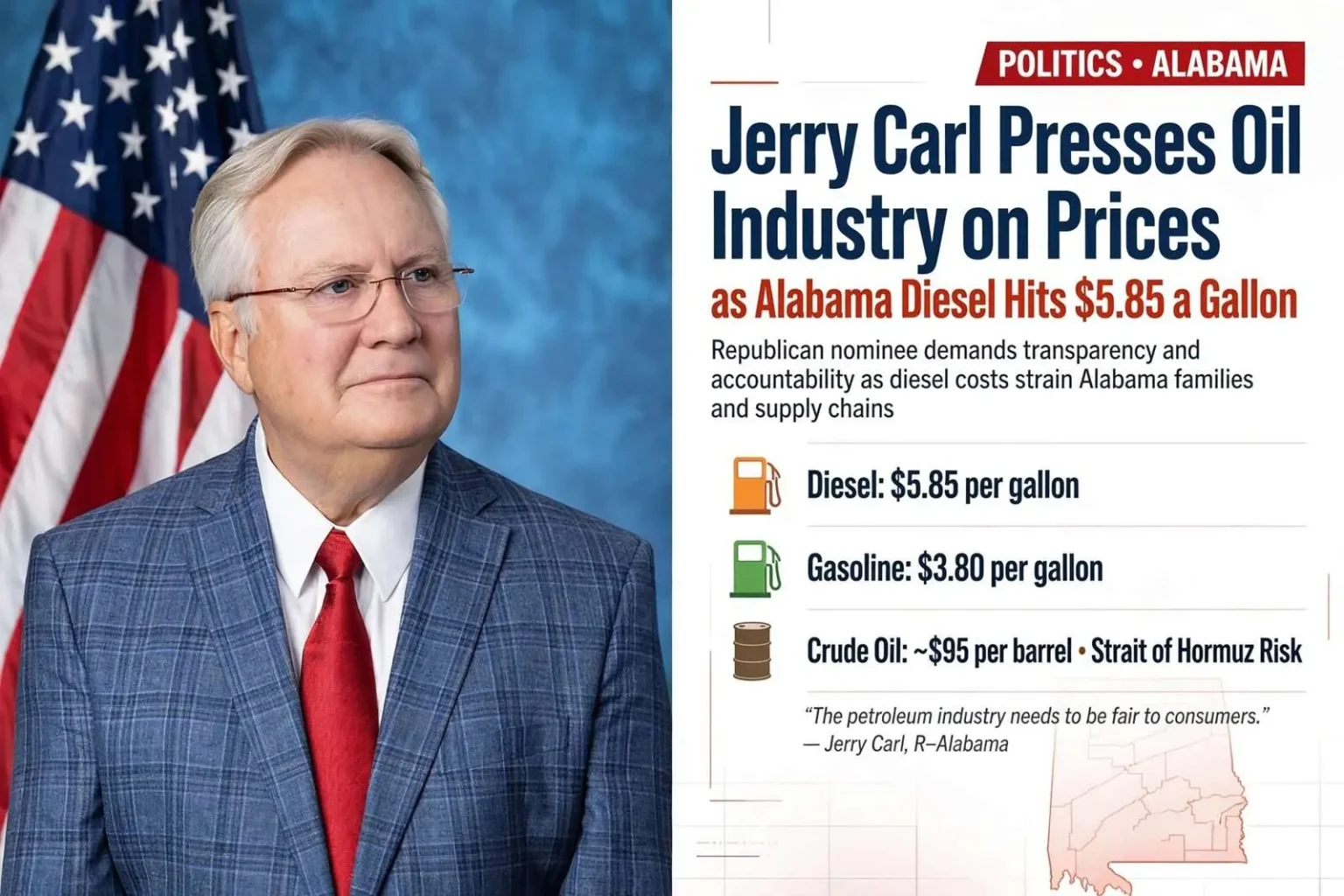
Fuel prices have a way of turning into politics faster than almost any other number in the economy, and in an election year they arrive with a bill attached. Former U.S. Rep. Jerry Carl, the Republican nominee in Alabama’s 1st Congressional District, says he wants the petroleum industry to explain itself.
Carl, a Mobile Republican, said he supports the industry making money but wants answers as prices continue to cause tension across the country. He called for accountability, lower prices and more transparency.
“The petroleum industry needs to be fair to consumers,” Carl said. “I am all for companies making profits. I like companies to be healthy. We need all of our American companies healthy. But whether we want to admit or not, we’re at war. And at war times, we have to come together and we all have to give and take a little bit.”
The Numbers Behind the Argument
According to AAA, Alabama’s average price for a gallon of regular gasoline is $3.80. Diesel is up to $5.85 a gallon, a figure that works its way into the price of other goods and services.
Nationally, prices fell in June and early August before rebounding to an average of more than $4 a gallon. Oil is trading around $95 a barrel, reportedly pushed higher by the war involving the United States and Iran and by low volumes moving through the Strait of Hormuz.
The gap between those two Alabama numbers — $3.80 for gasoline, $5.85 for diesel — is the most revealing detail in the whole set, and it is the part that gets the least attention.
Where a Gallon of Gasoline’s Price Actually Comes From
The federal Energy Information Administration breaks retail gasoline into four components, and every argument about pump prices is really an argument about one of them.
- Crude oil. Historically the largest single share of the retail price, and the one that swings the most. When crude moves, the pump follows within days to weeks.
- Refining. The cost and margin involved in turning a barrel of crude into finished fuel. This is where outages, maintenance turnarounds and seasonal blend changes show up.
- Distribution and marketing. Pipelines, terminals, tanker trucks, and the retailer’s own costs and margin. Retail fuel margins per gallon are typically thin; convenience stores make much of their money inside the building.
- Taxes. The federal excise tax is 18.4 cents a gallon on gasoline and 24.4 cents on diesel. Alabama’s state motor fuel excise tax rose to 28 cents a gallon under the 2019 Rebuild Alabama Act, with periodic adjustments tied to a highway construction cost index, plus additional per-gallon inspection fees. Alabama’s combined tax burden remains below the national average, which is one reason the state usually posts prices under the national number.
The important consequence of that structure is that no single company sets the price of a gallon. Crude is a globally traded commodity, and the United States being a large producer — the largest in the world in recent years — does not insulate American drivers from world prices. A barrel produced in Texas is worth what a barrel is worth anywhere, which is why domestic production records and high pump prices can coexist.
Why the Strait of Hormuz Moves a Price in Mobile
The Strait of Hormuz is a chokepoint between the Persian Gulf and the Gulf of Oman, at its narrowest only a few dozen miles across, with shipping lanes narrower still. By the Energy Information Administration’s reckoning it is the world’s most important oil transit chokepoint: roughly a fifth of global petroleum liquids consumption passes through it, along with a large share of seaborne liquefied natural gas.
There is very little spare pipeline capacity that can route around it. When traffic through the strait slows, the market does not simply reallocate the barrels; it prices in the possibility that more will be lost. That expectation is what traders call a risk premium, and it is added to the price of every barrel in the world, including barrels pumped in west Texas and refined on the Gulf Coast.
This is the mechanism that makes energy politics so frustrating for elected officials of both parties. A conflict thousands of miles away can add real money to a fill-up in Mobile within a week, and no policy available to a member of Congress can subtract it on the same timeline.
Diesel Is a Different Market, and It Explains the Grocery Bill
Diesel at $5.85 while gasoline sits at $3.80 is not a rounding error. It is a structural feature of the fuel market that most drivers never have reason to learn.
Diesel belongs to a family of fuels refiners call middle distillates, the same cut of the barrel that produces jet fuel and heating oil. A refinery has only limited flexibility to shift its output between gasoline and distillate; the crude slate and the plant’s configuration set the range. When distillate demand runs hot, the industry cannot simply make more of it without making less of something else.
Several forces push distillate prices harder than gasoline:
- Demand is far less discretionary. Gasoline demand softens when prices rise because people combine errands and postpone trips. Diesel moves freight, rail, marine traffic, agriculture and construction. A trucking company cannot decide to haul less because fuel got expensive.
- It competes with heating oil and jet fuel. Northern Hemisphere winter heating demand and recovering air travel both draw on the same barrel.
- Global trade flows have been reshuffled. The rerouting of diesel and other distillates away from traditional supply routes since 2022 has left the market with longer, less efficient shipping patterns and thinner buffers.
- Inventories run tight. Distillate stocks have repeatedly sat below their seasonal averages in recent years, and a thin inventory cushion magnifies the price effect of any disruption.
That is why Carl’s point about diesel affecting the prices of other goods and services is economically sound rather than rhetorical. Nearly everything sold in a store arrived on a diesel truck, often after a diesel-powered train or ship. Diesel functions as a tax on physical goods, and it reaches consumers with a lag, embedded in prices that never say “fuel surcharge” on the receipt.
Rockets and Feathers
One reason pump prices generate suspicion is a genuine and well-documented asymmetry that economists have nicknamed “rockets and feathers.” Retail prices tend to rise quickly when wholesale costs rise and drift down more slowly when wholesale costs fall.
The academic explanations are mundane: station operators buy inventory in advance and price against replacement cost, consumers shop harder when prices are climbing than when they are falling, and local competition adjusts unevenly. None of that requires a conspiracy, but it does mean the public perception that prices go up faster than they come down is not imaginary. It is measurable.
Seasonal rules add another layer. Summer gasoline blends are formulated to evaporate less in heat and cost more to produce; the switch back to cheaper winter blends in September typically pulls prices down. On the Gulf Coast, hurricane season carries its own risk, because a storm that shuts refineries or the pipelines feeding the Southeast can move prices in Alabama within days.
Fuel Prices and Midterm Elections
As the midterms approach, the source of concern Carl is responding to is the possibility that voters blame Republicans for high prices. Carl argued the responsibility runs the other way.
“We, by nature, we all want to blame somebody. We wanna blame the Republican Party. We want to blame Trump,” Carl said. “We the people have got a responsibility, too. We the people have got to ask our elected officials to say more and do more. We the people have got to stand up and be heard and you do that on Election Day.”
The pattern he is pushing back against is a durable one in American politics, and it is bipartisan in its operation. Gasoline is one of the few prices posted in foot-high numbers on street corners, encountered weekly, and paid in a lump. Political scientists have long found that fuel costs track with presidential approval more closely than most other economic indicators, and the party in power absorbs the blame regardless of which party it is.
The history runs in both directions. High prices during the 1970s energy crises damaged Democratic incumbents. The $4 gasoline of 2008 fueled Republican drilling campaigns against a Republican administration’s economy. Price spikes in 2022 became a central Republican argument against Democratic control of Washington. In each case the price was set largely by global supply, demand and geopolitics, and in each case voters assigned it to whoever held office.
The tools available to Washington are real but limited and slow. Congress can adjust fuel taxes, blending requirements and leasing rules; a president can release oil from the Strategic Petroleum Reserve, waive fuel specifications in an emergency, or use diplomacy and sanctions policy. Permitting and production decisions play out over years. None of them reliably changes the number on the sign this month.
What Carl Is and Is Not Proposing
It is worth being precise about the ask. Carl did not call for price controls, a windfall profits tax, or new federal authority over the industry. He called for the industry to be fair to consumers, to be transparent, and to accept thinner margins during wartime — a request framed as shared sacrifice rather than a legislative proposal.
That is a familiar posture for a candidate in a producing and refining region. Alabama’s 1st District sits on the Gulf Coast, where the energy sector is an employer and a customer as well as a cost. The refining, petrochemical, shipbuilding, port and logistics economy of the central Gulf Coast means fuel prices in south Alabama are simultaneously a household expense and a source of local jobs.
Why It Matters
For households in Mobile and Baldwin counties, the practical effect is straightforward. A driver covering 12,000 miles a year in a vehicle getting 25 miles per gallon burns roughly 480 gallons; every dime on the price of a gallon is about $48 a year. For a small business running diesel trucks, the arithmetic is an order of magnitude larger and lands in a single line on a monthly statement.
That is the practical case behind the political one. Whether voters ultimately hold Congress, the White House, the industry, or the Strait of Hormuz responsible, the price at the pump is one of the few economic numbers people encounter in person and remember on Election Day — which is exactly why candidates of every party will keep talking about it between now and November.