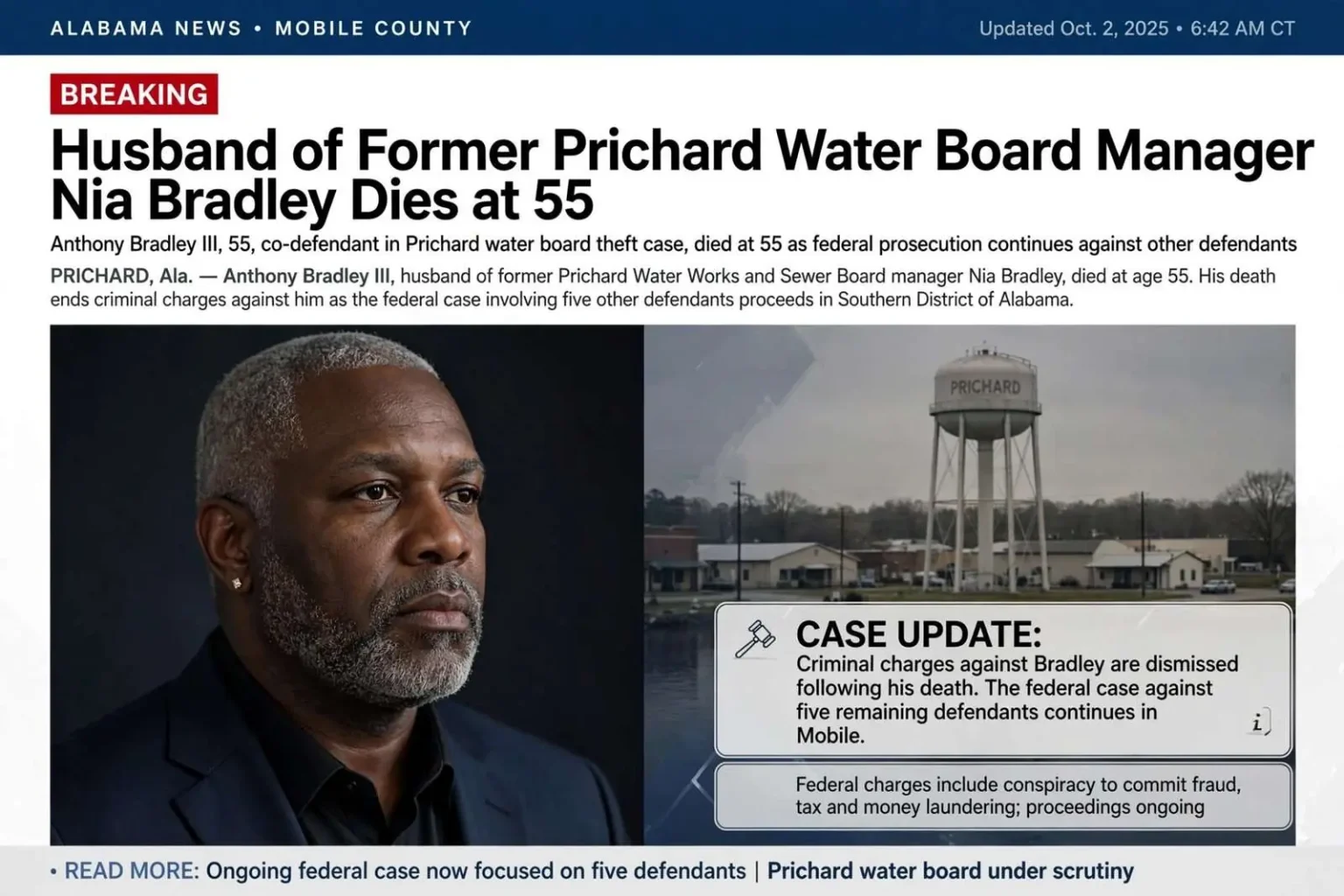
PRICHARD, Ala. — Anthony Bradley III, the husband of former Prichard Water Works and Sewer Board manager Nia Bradley and a co-defendant in the theft case against her, has died at age 55, according to sources. His death comes as the sprawling case tied to the water board continues to move through state and federal courts, leaving questions about how his passing will affect proceedings that already named him in multiple sets of charges.
Anthony Bradley was arrested in February 2022 in connection with what authorities described as a “criminal ring” tied to the water board, and was charged with first-degree receiving stolen property. The charge, a felony under Alabama law, alleged that he knowingly received property that had been stolen from the board, the agency that supplies water and sewer service to residents of Prichard and parts of surrounding Mobile County. First-degree receiving stolen property applies when the value of the property exceeds the threshold set by state statute.
He was arrested again in November of that year and charged with two counts of fraudulent use of a credit card. Alabama’s fraudulent use statute covers the unauthorized use of a credit card or card number to obtain goods, services or anything of value, and multiple counts typically indicate separate transactions alleged by investigators. The second arrest, coming months after the first, showed that prosecutors continued to build the case through the balance of 2022.
Nia Bradley was also arrested in February 2022, charged with aggravated theft by deception and first-degree theft. As the board’s manager, she occupied a position of trust over the agency’s finances, and the aggravated designation in Alabama theft law reflects thefts involving that kind of entrusted authority. The charges against her alleged a pattern of misusing the board’s resources for personal benefit rather than a single isolated transaction.
Investigators said her name was on a PWWSB card used to make purchases from retailers including Gucci and Louis Vuitton. The detail became one of the most widely cited elements of the case, illustrating the gap between the board’s utility function and the luxury spending alleged in court documents. Card records are often central to financial prosecutions, creating a paper trail of dates, merchants and amounts that prosecutors use to reconstruct the alleged scheme transaction by transaction.
The Federal Case
She has since pleaded guilty to federal charges including conspiracy to commit mail, bank and wire fraud; conspiracy to defraud the United States; making and subscribing a false 1040 tax return; and conspiracy to commit money laundering. The federal indictment treated the alleged conduct not as a series of isolated thefts but as a coordinated scheme, with the tax and money laundering charges reflecting the government’s effort to trace proceeds through the financial system.
In a Department of Justice indictment unsealed in April 2025, seven people were federally indicted in connection with the case, five of whom faced a combined 32 counts. The scale of the federal case — spanning multiple defendants and dozens of counts — showed how far the investigation had grown beyond the original state arrests of February 2022. Federal prosecutors in the Southern District of Alabama, whose jurisdiction includes Mobile County and Prichard, handled the case.
Conspiracy charges of the kind filed in the federal case carry their own weight separate from the underlying offenses. To prove conspiracy, prosecutors must show an agreement between two or more people to commit the charged fraud, along with a participant’s knowing involvement. Mail, bank and wire fraud conspiracies are among the most commonly charged federal financial crimes because so many ordinary transactions — anything crossing state lines by mail, phone or internet — can fall within their reach.
The tax-related charge, making and subscribing a false 1040 return, reflects how financial prosecutions frequently extend to income reporting. When proceeds of fraud are not reported as income, the tax charge gives federal prosecutors an additional avenue that carries its own penalties and can be proven directly from the return and the underlying financial records. Combined with money laundering conspiracy, the suite of charges allowed the government to address both the acquisition and the concealment of the alleged proceeds.
The Prichard Water Board’s Troubled History
The Prichard Water Works and Sewer Board operates in a city that has long struggled with financial distress. Prichard, once a thriving industrial city in northern Mobile County, has faced severe fiscal problems for decades, including a nationally noted pension crisis that pushed the city into bankruptcy in the late 1990s. The water board itself has periodically drawn scrutiny over rates, service quality and governance, making allegations of internal theft particularly damaging to public confidence in the utility.
Water boards and similar public utilities operate with their own revenue streams from customer billing, and their boards hold significant discretion over spending. That structure is designed to insulate utilities from municipal budget pressures, but it also creates an environment where oversight depends heavily on board governance, internal controls and external audits. Cases involving utility officials and luxury spending on company cards typically prompt calls for strengthened controls, and prosecutors’ filings in this case described purchases far removed from the board’s mission.
The February 2022 arrests, described by authorities as the work of a criminal ring, suggested that investigators believed the activity involved multiple people acting together rather than a single official. Subsequent developments — the additional state charges, the guilty pleas, and the April 2025 federal indictment of seven people — traced the expanding scope of that investigation over more than three years.
What His Death Means for the Case
The death of a defendant mid-case raises procedural questions that courts resolve according to longstanding principles. In general, criminal charges against a deceased defendant are dismissed, because the constitutional guarantee of a fair trial cannot be honored for someone who cannot appear in his own defense. Any restitution or civil remedies, by contrast, can follow different paths, and prosecutors sometimes pursue civil claims against estates when public money is involved.
For co-defendants and witnesses, a death can change the shape of the case rather than ending it. Statements, financial records and testimony remain part of the record, and the government’s case against the remaining defendants proceeds on its own evidence. In a conspiracy case built on documents — card statements, bank records, tax filings — the loss of one defendant does not erase the paper trail that formed the core of the prosecution.
The case has been watched closely in Prichard and across Mobile County, where residents of a city with some of the highest poverty rates in the region have followed the allegations with particular attention. Utility customers ultimately bear the costs of mismanagement through rates and reduced service investment, which is why theft cases involving public utilities resonate so strongly locally. Community meetings about the water board in recent years have drawn crowds concerned about billing practices and the utility’s direction.
Money laundering conspiracies rest on showing that proceeds of unlawful activity were moved, spent or concealed with intent to disguise their origin. In practice, prosecutors present the flow of funds through accounts, purchases and transfers, then argue about which movements were designed to hide the money’s source. The charge reaches everyone who knowingly played a part in that movement, which is why such cases often sweep in people who never touched the original theft.
The 32 counts spread across five defendants in the April 2025 indictment represent only the federal side of the matter. State charges filed in 2022 against the Bradleys and others developed in parallel, and the eventual disposition of the state cases remains a separate track. Defendants facing parallel state and federal prosecution typically see the federal case proceed first, with state prosecutors coordinating to avoid duplicative punishment.
Public records and court filings in the case have generated sustained coverage across Mobile-area media since the first arrests, and each new development has brought renewed attention to the water board’s operations. Utility governance in small Alabama cities often depends on part-time boards and limited administrative staff, and the case has become a reference point in local discussions about what oversight should look like for agencies that hold ratepayer money and public trust at the same time.
Receiving stolen property and fraudulent use charges, for their part, are among the most frequently filed offenses in Alabama financial cases because they fit the evidence of possession and use rather than requiring proof of an original taking. That flexibility is one reason investigators often charge them early, while broader conspiracy cases take longer to assemble.
As the case continues, the remaining federal defendants will move through arraignment, pretrial motions and, unless pleas resolve their cases first, trial. Each count in a federal indictment must be proven individually, and the combined 32 counts give prosecutors a roadmap of the transactions they say made up the scheme. Whatever the outcome, the case has already left its mark on a small city’s most essential public utility — and on the expectations Prichard residents bring to the agencies that serve them.