Mobile Ends Private Banner Program After Dueling Pride and ‘Protect Our Children’ Displays Downtown
Eleven privately funded banners reading "Protect Our Children From Gender Ideology" went up along Government Street this week. The City of Mobile responded by closing its banner program to private applicants entirely.
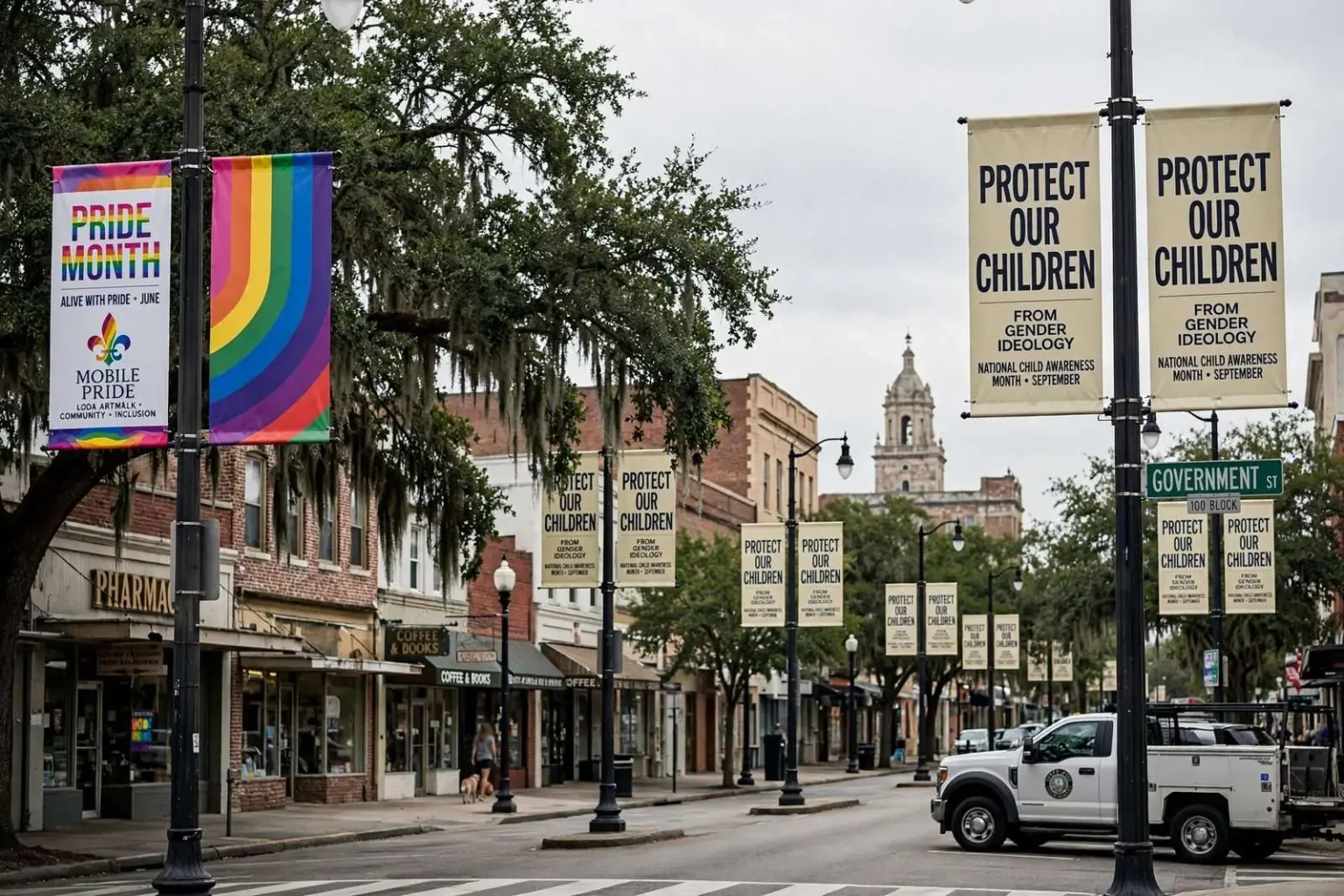
Eleven banners hanging from public street poles in downtown Mobile — promoting National Child Awareness Month and urging residents to “protect our children from gender ideology” — have become the final chapter of the city’s privately funded banner program. The City of Mobile announced Wednesday that once the September displays come down, private individuals and organizations will no longer be able to place banners on city-owned poles at all.
The decision closes a public forum that produced two sharply opposed displays in the space of three months: Pride Month banners along Water Street in June, and the “Protect Our Children From Gender Ideology” banners now hanging over Government Street.
What the City Decided
In a statement Wednesday, the city said allowing private entities to display banners on public poles can distract staff and divert attention from municipal priorities.
“Moving forward, all banners will be limited to official City programs, events, and initiatives,” said Dale Liesch, media relations manager for the City of Mobile.
Liesch said the program was created for a narrower purpose than the one it ended up serving. “The City of Mobile began this program to add character and a sense of place for downtown,” he said. “Once the public process was established, we were legally required to administer it consistently and fairly. We have since determined that permitting banners for private use can distract staff and take the focus away from our core mission.”
The September banners will remain in place through the end of the month. After that, the poles will be reserved for official City of Mobile programs, events and initiatives.
How the Program Worked
The banner program was administered through the Mobile Parks and Recreation Department, and it carried a multi-step approval process rather than an open-access sign-up.
Applicants were required to contact the department at least three months before their requested display date. After payment, an applicant submitted a proposed banner design to the city for review and approval. Once approved, the design went to a printer, and the finished banners had to be reviewed and approved by the city a second time before installation.
The city’s published guidelines described the program as a way to promote events and holidays and to welcome visitors to downtown. Liesch stressed that the city’s approval of a privately funded banner should not be read as an endorsement of its message.
“As it relates to the content of these privately funded banners, the City does not take a position on a particular cause, organization or viewpoint, but must apply the same rules evenly in order to honor the constitutional rights of our citizens,” Liesch said. “The First Amendment protects lawful expression and we are simply adhering to the law. Our commitment is to fairness, consistency and respect for all Mobilians.”
The June Banners
The chain of events began in June, when Mobile resident Bryan Fuenmayor personally paid for Pride banners displayed downtown during Pride Month. Those banners coincided with Mobile’s Alive With Pride celebrations and the Pride-themed LODA ArtWalk.
Pride ArtWalk, held June 12, drew collaboration among more than 40 downtown businesses, Mardi Gras societies, advocacy groups, community leaders and faith communities, and included a parade and a stage presentation. It is consistently one of the most heavily attended ArtWalks of the year and one of downtown Mobile’s largest one-night festivals outside the Mardi Gras season.
The September Banners
The new banners were requested by the Rev. Travis Johnson, pastor of Pathway Church in Mobile, who had objected publicly to the Pride displays and then sought access to the same program.
Johnson has been open about the connection. “I figured that if Mobile, Alabama was going to allow Pride Month banners to fly in June, these could fly in September,” he wrote in a Facebook post. In an earlier interview, he put it similarly: “I figured that if Pride Month banners were flying on light poles in June, then I’d run some ‘Protect Our Children’ banners in September.”
Johnson framed the display as a matter of protecting children from what he described as radical gender indoctrination. “I think we ought to protect our children from radical extremist and gender indoctrination ideologies,” he said. “I think it’s a terrible thing that’s happened to our children. They should be safe in their schools, safe in their libraries, and Mobile is such an incredible family-friendly, faith-oriented community.”
He also grounded the message in his church’s theology. “Genesis 1:26 says, ‘Let us make man in our image.’ God made man in His image, and in His image, according to verse 27, He made them male and female,” Johnson said. “So, we trust what the Creator says.” He added: “Jesus didn’t mince words about protecting children. Neither should we.”
Johnson has participated in orphan care and humanitarian work, including efforts to feed refugees on the Cambodia-Thailand border, and has worked with children’s homes. Pathway Church operates a children’s ministry in Mobile. “How could we not stand up for kids in our own community? So, that’s what got me motivated,” he said.
During a sermon at his church in June, Johnson had predicted — and welcomed — the outcome that arrived this week. He called the possible end of the banner program “perfect,” arguing the September display would lead to the end of the privately funded Pride banners, which he described as “gender indoctrination banners.” He characterized the result as a “victory for every family in this city,” adding, “I will take that outcome every single day of the week.”
Johnson did not respond to a request for comment Wednesday afternoon.
Criticism From LGBTQ Advocates
Prism United, a Mobile-based nonprofit that provides programs and services for LGBTQ youth and their families in southwest Alabama, issued a lengthy statement criticizing the banners.
“The banners on Government Street do the opposite of celebrating our expansive community,” the organization said. “Their function is to isolate, to sow division, to make us smaller.”
The group objected to the use of National Child Awareness Month in the message, arguing the observance was established for a different purpose, and said the framing continues a long-running line of rhetoric. “For decades, LGBTQ people have been portrayed as a threat to children,” the organization said. “Today, that same harmful rhetoric presents LGBTQ visibility as something children need to be protected from.” It added: “It was untrue then, and it is untrue now.”
Prism United said its central concern is the effect on young people who already feel rejected. “Unfortunately, moments like these have an impact on LGBTQ lives, especially the lives of young people,” the group’s statement reads. “The message of these banners reinforces the experience of those who have been kicked out of their homes and rejected by peers, who have felt the sting of: ‘You are not welcome here.’ For youth already struggling to feel accepted, this message can deepen isolation, reinforce shame, and take a devastating toll on their mental health and well-being.”
The organization also pushed back on the premise of the slogan itself, pointing to its own support programs, mental health services, family programs and community spaces as its version of protecting children. “We believe that all children should be able to grow up safe, supported and free to be themselves,” the statement reads. “We believe that Mobile shines brighter when we are together. And we believe that when any part of our community is made to feel unwelcome, it diminishes all of us.”
The Man Who Paid for the June Banners
Fuenmayor, who funded the Pride banners, said he was not surprised to see Johnson’s banners appear. “Back in June, the pastor said that he was going to put it up, so I expected that to happen this month,” he said.
He drew a distinction between the two halves of the September message. “I think he is expressing his religious beliefs and he has a right to do so,” Fuenmayor said. “If it was just him putting up National Child Protection Month, then it’s fine. That is a message that we could all be behind.” His objection, he said, is to the additional language: “When he attaches the ‘protect kids from gender ideology,’ you know, that is a message that attacks a minority community, one that is very misunderstood.”
Fuenmayor argued the two displays are not equivalent because his coincided with city-supported events. “The banners that we had up in June, they coincided with local events that the city put on,” he said. “For example, LODA ArtWalk, it was to celebrate National Pride Month. And so the banner that I had was celebrating National Pride Month. The two coincided.”
He said he believes any banner carrying a political message should not have been approved, and that the September display does not fit the program’s stated mission. “From a legal standpoint, I do think that the banners go against the mission of the program,” he said. “I think we really need to hone in on that and make sure that these banners that are going up go with the mission and the purpose of the program.”
Asked about Johnson’s motivation, Fuenmayor said he did not want to presume. “I can’t assume,” he said. “I would love to sit down and talk with him and find out what his intention is.”
On the city’s decision to end private access altogether, Fuenmayor said he is “about 50/50.” He said he understands the city’s position that it was obligated to protect lawful expression and treat applicants consistently, while continuing to question whether the September message fit the program’s original purpose.
Political Reaction
Jerry Carl, the Republican nominee for Alabama’s 1st Congressional District seat, expressed support for the September message in a Facebook post, writing that “gender ideology to children has to go.”
“As a father and grandfather, protecting our children is one of the most important things we can do,” said Carl, who faces Democratic challenger Clyde Jones Jr. in the Nov. 3 general election. “The breakdown of the nuclear family is one of the biggest issues facing the country. We all as Americans must stand up to protect our next generations.”
The display arrives against a national backdrop in which polling has generally shown majority support for restrictions on gender-transition medical treatments for minors. A 2025 Pew Research Center poll found that U.S. adults generally support bans on health care providers performing care related to gender transitions for minors, and support requiring transgender athletes to compete on teams matching the sex assigned at birth.
An Echo of the Midtown Cannon
The banner dispute closely mirrors an earlier fight over public use of city property. In 2023, Mobile stopped issuing permits allowing people and organizations to paint the Civil War cannon at The Loop — the Midtown Cannon near Memorial Park at Houston and Government streets.
The practice had long been associated with students from McGill-Toolen Catholic High School and Murphy High School painting the cannon after the schools’ rivalry football game, before expanding to other groups, nonprofits and awareness campaigns. The cannon became a flashpoint in 2022 after it was painted in the colors of the Pride flag and later defaced with black paint. At the time, the city said its decision to stop issuing permits was “not made in response to any particular organization or request.”
Students have continued painting the cannon after football games unabated.
Where Things Stand
The pattern in both cases is the same: a city-created space open to public expression, a display that generates controversy, and a decision to close the space rather than choose between the messages within it. City officials say that is precisely the point — that they are not picking a side, and that private groups will simply no longer have access to the forum.
For now, the “Protect Our Children From Gender Ideology” banners will remain along Government Street through September. When they come down, Mobile’s downtown poles will carry only the city’s own messages.