Man Shot on Carver Avenue After a 500-Person Gathering, Atmore Police Say
An officer on patrol heard gunfire on Carver Avenue at about 1 a.m. Sunday, where police say more than 500 people had gathered. One man was shot and is in stable condition, and a second person was struck by a vehicle.
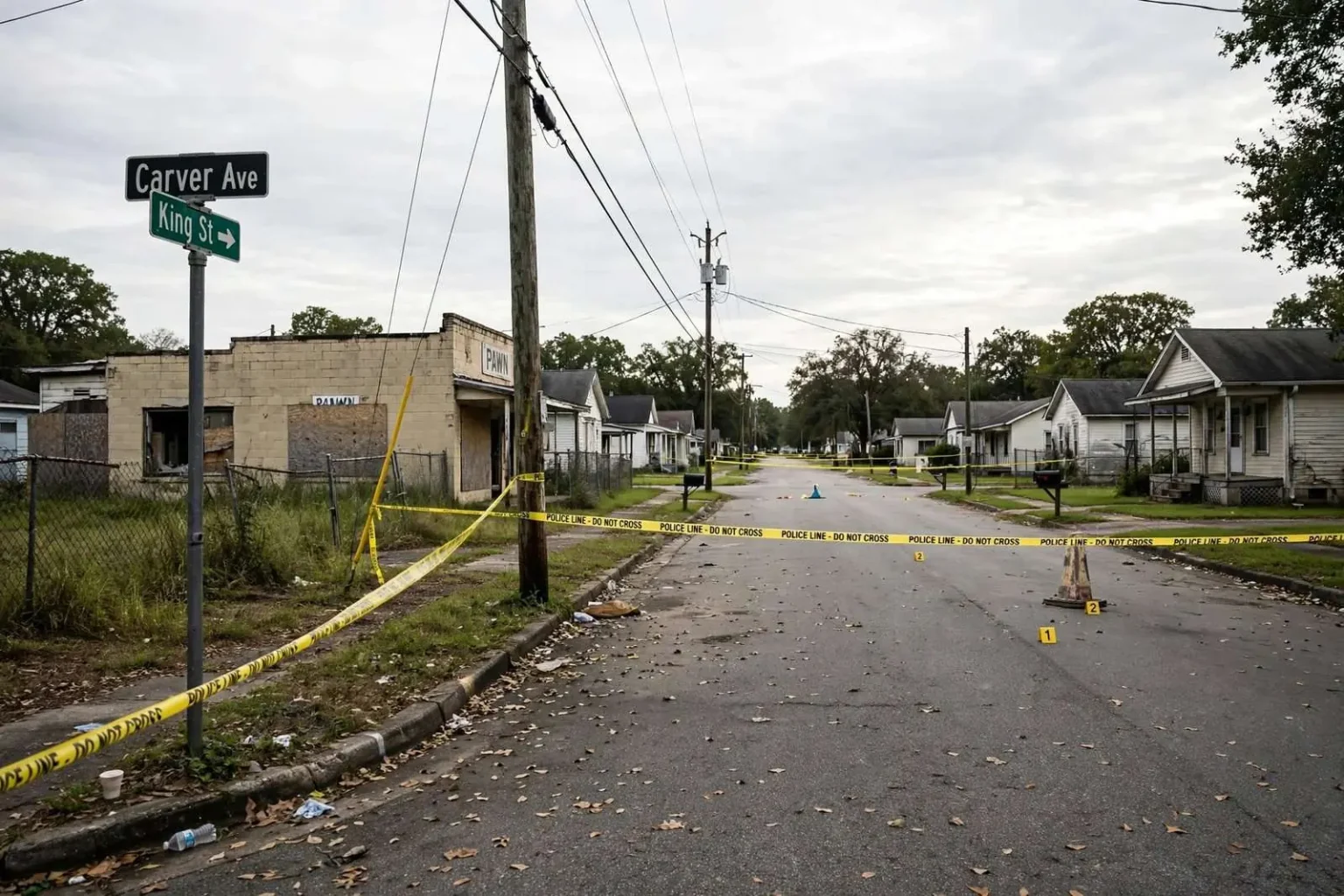
By Sunday afternoon, a wisp of police tape was the only thing left on the block. The several hundred people who had filled the roadside on Carver Avenue in the middle of the night were gone. So were the patrol cars, the crime scene technicians and the investigators. What remained was a stretch of a small Escambia County city trying to work out how an overnight gathering ended with a man being carried into a hospital with a gunshot wound.
The Atmore Police Department says an officer was patrolling Carver Avenue when he heard gunshots at about 1 a.m. Sunday. The department also received a call reporting numerous shots fired and a person struck by a vehicle. One adult man was shot. He was taken to Atmore Community Hospital for treatment and was reported to be in stable condition. Police have not released his identity.
“In my opinion, I don’t believe there’s anything that one person and another can argue enough to where they have to discharge a firearm at each other or harm someone with a firearm outside of the self-protection realm,” said Atmore Police Major Charles Thompson.
A Crowd of More Than 500 People
The detail that separates this from an ordinary street shooting is the size of what officers found when they arrived.
“There had been a large gathering/party, with an estimated crowd of more than 500 people at the location,” officials said. “It was reported by officers to be a large number of people in the area and gathered roadside.”
Five hundred people is a substantial number anywhere. In a city the size of Atmore — one of the two largest municipalities in Escambia County, with a population well under 10,000 — it represents a meaningful share of the town standing on one residential street in the middle of the night. It is the kind of crowd that would normally require a permit, a venue, traffic control and a plan. This one appears to have had none of those things.
Police said Sunday morning that they were not aware of any organized party advertised online. Neighbors interviewed in the area said they were not sure why so many people had gathered outside either.
That combination — a very large crowd, no advertised event, no organizer — is not unusual, and it is one of the harder problems in modern policing of small cities. Gatherings of this type tend to assemble through private group chats, direct messages and word of mouth rather than public posts, which means the first indication a department gets is often the traffic. By the time officers can see how big something has become, it is already too big to safely disperse without a coordinated response. That is precisely why a patrolling officer, rather than a dispatcher, was the first to register that shots had been fired.
The Block Between King and Sims
Investigators concentrated on one block of Carver Avenue, between King Street and Sims Street. It is an area dotted with a handful of empty lots and vacant buildings, sitting near both homes and businesses.
That physical description matters more than it might appear. Vacant lots and empty structures are, in practical terms, unclaimed space. They have no lighting maintained by an occupant, no security cameras, no doorbell video, no one whose job it is to notice who is standing there at midnight. They also provide open ground — room for hundreds of people to spill out of a street and into a lot without immediately drawing a complaint from an adjacent property owner.
For investigators, the same features that make such a block attractive to a spontaneous crowd make it difficult to reconstruct afterward. A shooting outside a bar generates a customer list, a bartender, an interior camera and a parking lot camera. A shooting in the middle of an unorganized crowd on a block of empty lots generates none of that automatically. Everything has to be built from physical evidence and from what the people who were present are willing to say.
‘We Don’t Believe There’s a Threat to the Public’
One of the first judgments a police department has to make after a shooting is whether the danger is over. Atmore police said they believe it is.
“We don’t believe there’s a threat to the public, but we believe that this was a contained incident for what happened, and we don’t believe that anyone in the community should be nervous,” Thompson said.
The phrase “contained incident” carries a specific meaning in this context. It signals that investigators believe the violence arose from a dispute among people who were present, rather than from someone targeting the neighborhood, a business or the public at large. It is the difference between an event that has already run its course and an active threat that could recur at a different location. It is not, however, a statement that the case is solved, and Atmore police have released no information about any suspects.
Thompson also indicated that investigators are working through competing accounts of what set the shooting off.
“There’s a lot of a lot of people in here so that we’re getting in a lot of information that’s coming in to us that potentially that it could be about. But right now, there’s nothing that we can release saying and definite that’s what we believe it was in reference to,” Thompson said.
That is a familiar problem in a mass-witness case. Hundreds of people present does not translate into hundreds of reliable accounts. It usually produces a large volume of partial, secondhand and contradictory information, much of which circulates through the same social networks that assembled the crowd in the first place. Detectives have to treat each thread as unverified until it can be matched against something independent — shell casing locations, wound paths, video from a phone, a vehicle description, a hospital record, a timeline.
What a Four-Unit Response Signals
The department’s own description of who responded is a useful measure of how it is treating the case.
“Numerous Atmore Police Department personnel including officers from Patrol, Criminal Investigations, Narcotics/Vice and Crime Scene responded to the incident,” officials said. “This remains an active investigation. Additional information will be released when it becomes available.”
Each of those units does something different at a scene like this one:
- Patrol secures the perimeter, renders aid, identifies and separates witnesses, and keeps a fluid crowd from walking through evidence.
- Criminal Investigations takes over the case file — interviews, canvassing, warrants for phone and video records, and the work of building a chronology.
- Crime Scene photographs and maps the scene, marks and collects shell casings and projectiles, documents damage to vehicles and structures, and preserves anything that can later be tested.
- Narcotics and Vice officers are often used at large-scene callouts for their familiarity with the people and networks in the area, and because they can add manpower quickly when a scene involves hundreds of people.
Deploying all four at once, in a department that serves a city of this size, means most of the on-duty and callable strength of the agency was committed to a single block for several hours. It is not the response to a routine call.
The Person Struck by a Vehicle
Alongside the gunfire, police said one person was hit by a vehicle. The department has not released that person’s identity or condition.
That element is easy to lose in a story about a shooting, but it is a predictable consequence of the circumstances. When hundreds of people are gathered in and along a roadway and gunfire begins, the crowd moves all at once, in the dark, in a space shared with moving cars. Pedestrian strikes in that setting can be the result of panic rather than intent, and untangling which it was is part of what investigators have to determine. Until they do, the vehicle strike remains an open part of the same case rather than a separate one.
A Neighborhood That Would Rather Not Talk
Neighbors in the area declined to be interviewed, though some said they heard the commotion early Sunday morning. One man who said he had moved to the neighborhood two days earlier said he now wants to move out.
Reluctance to speak on the record after a shooting is common, and it is rarely about indifference. People who live on a block where something like this happened still have to live there afterward. They know who is likely to hear what they said and how quickly. In a small city where social networks overlap heavily, the perceived cost of being publicly identified as a witness can be higher than it would be in a larger place.
That dynamic is one reason police departments lean on anonymous reporting channels and on physical evidence. It is also why the volume of information Thompson described flowing in to investigators is not the same as the volume of information that can be used. Detectives frequently know more, informally, than they can prove — which is exactly the gap between what Thompson said the department is hearing and what he said it is prepared to release.
Who Responded
The scale of the scene drew most of the department at once. Personnel from the Atmore Police Department’s Patrol, Criminal Investigations, Narcotics/Vice and Crime Scene divisions all responded to Carver Avenue.
Committing four divisions to a single call is a substantial deployment for a department of this size, and it reflects two realities of the scene: a crowd of several hundred people required enough uniformed officers to establish control, and a shooting with a surviving victim required investigators and crime scene technicians working simultaneously with patrol rather than after it.
Where the Case Stands
As of the department’s most recent statement, the picture is straightforward and incomplete:
- An adult man was shot on Carver Avenue near King Street and Sims Street at about 1 a.m. Sunday.
- He was taken for medical treatment and is reported to be in stable condition. His name has not been released.
- A second person was struck by a vehicle at the scene.
- An estimated crowd of more than 500 people had gathered at the location; police were not aware of any organized party advertised online.
- No suspect information has been released, and no arrests have been announced.
- The investigation is active, and the department says additional information will be released when it becomes available.
No one has been charged in connection with the shooting. Anyone who is eventually charged would be presumed innocent unless and until proven guilty in court.
Why It Matters
Atmore sits in the southwestern corner of Escambia County, close to the Florida line and just off Interstate 65 between Mobile and Montgomery. It is a place where a single violent night is not absorbed the way it would be in a metropolitan area. There is one hospital in town. There is one police department. A crowd of 500 on a residential street is, in relative terms, an event.
That scale cuts both ways. It makes an incident like this one deeply felt — the kind of thing a man who moved in two days ago hears about immediately and reacts to by looking for somewhere else to live. It also means the pool of people who know what happened is not anonymous. In a city of this size, the information investigators need almost certainly exists within the community that was standing on Carver Avenue when the shots were fired.
Thompson’s reassurance that residents should not be nervous rests on the department’s belief that the violence was contained to a dispute between people who were there. Confirming that belief — and identifying who fired — is what the rest of the investigation is for. Atmore police say they will release more when they have it.