Mobile Arts Council Director Bob Burnett Steps Down After 13 Years
Mobile Arts Council Executive Director Bob Burnett has resigned after thirteen years leading the nonprofit arts organization.
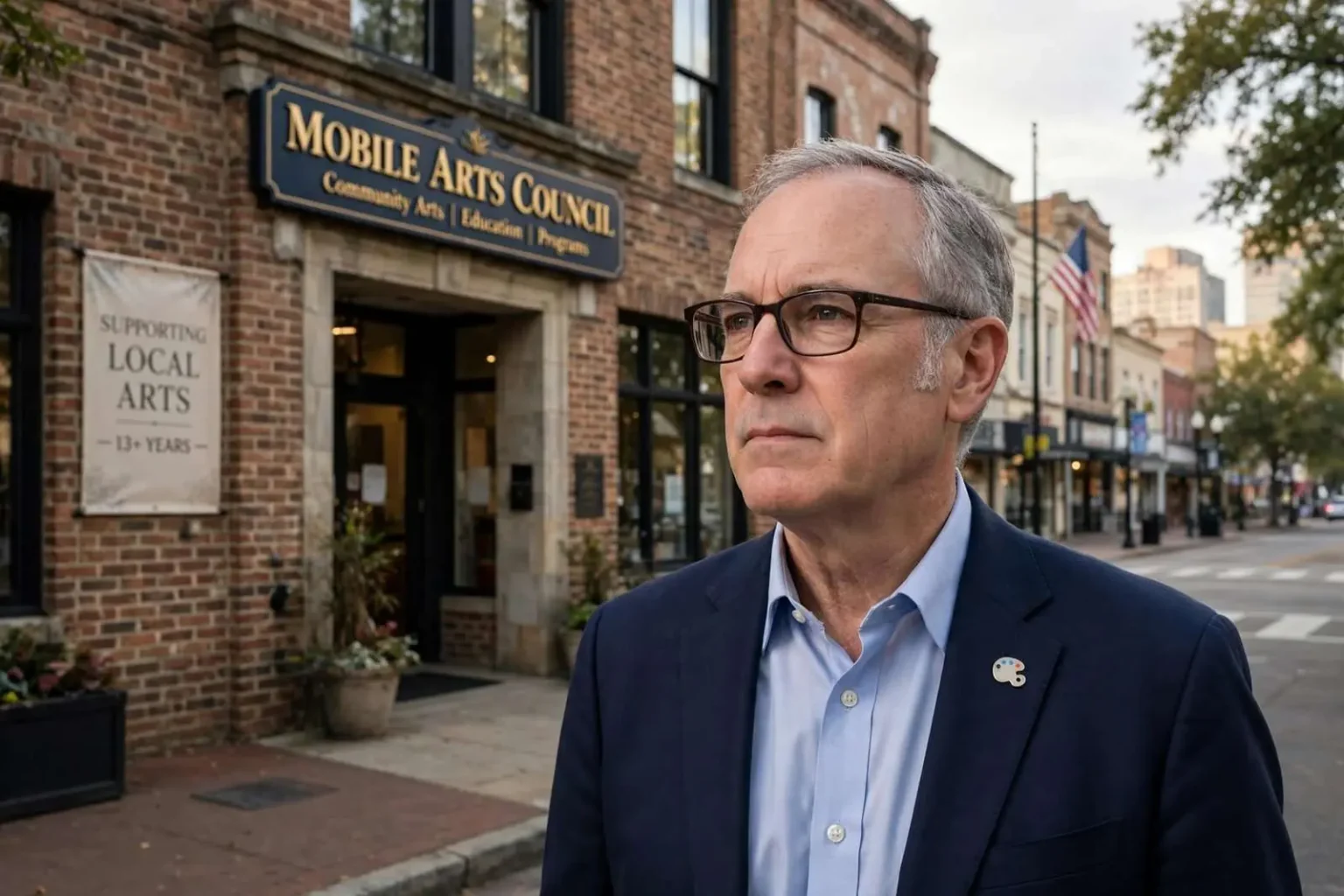
The Mobile Arts Council has announced the departure of Bob Burnett, who is stepping down as the organization’s executive director after thirteen years leading the nonprofit. According to a statement from the Arts Council, Burnett resigned to pursue other career opportunities, closing out a tenure that spanned more than a decade of change in Mobile’s creative community.
Bunky Ralph, president of the Mobile Arts Council’s board of directors, thanked Burnett for his long tenure in the role. “We wish Bob all the best in this next chapter of his career,” Ralph said in the release. “Our organization is grateful for his contribution to Mobile’s creative community and we thank him for his service.”
Thirteen Years at the Center of Mobile’s Arts Scene
Burnett’s thirteen years at the helm of the Mobile Arts Council placed him at the center of the city’s efforts to support local artists, arts education and creative programming across downtown Mobile and the surrounding area. The executive director’s job at a community arts council is a peculiar one — part fundraiser, part advocate, part impresario — and over more than a decade Burnett became one of the faces of the city’s cultural sector, working with artists, schools, businesses and city government alike.
Under his leadership, the council operated as a hub connecting artists, patrons and sponsors, a role that has grown more important as downtown Mobile has worked to rebuild its identity around arts, dining and entertainment. Community arts councils occupy a specific niche in the cultural landscape: they are not museums with collections to maintain, nor presenters with a single venue to fill, but network organizations whose product is the health of the artistic community itself.
That work happens in ways the public rarely sees — grant writing, sponsor recruitment, membership drives, jury processes for shows, and the endless coordination that turns individual artists into a coherent calendar of events. Burnett’s departure marks the end of a lengthy chapter in that work, and the board’s search for a successor will be, in effect, a search for someone who can hold that network together.
A Transition With No Expected Interruption
Ralph said the Arts Council’s current staff will oversee day-to-day operations in the interim, with support from the board’s executive committee, and that no interruption in the organization’s regular activities is expected during the transition. The approach is a standard one for nonprofits of the council’s size, which rarely have the resources for lengthy outside consulting engagements but typically have a staff deep enough to keep programs running while the board works.
“We will keep our members, patrons, sponsors and stakeholders updated as plans are made to address the leadership of the organization,” Ralph said. The commitment to communication is more than a courtesy — the council’s funding base depends on sponsors and members who expect continuity, and a visible, orderly transition is part of maintaining the confidence that keeps checks arriving.
The Mobile Arts Council has not announced a timeline for naming a permanent successor. In the meantime, officials say programming, member services and community partnerships will continue without disruption as the board works through its leadership transition plan. For working artists in Mobile, the practical effect of the change is expected to be minimal in the short term: the shows, the calls for entries, and the member services that artists rely on will continue under the interim arrangement.
Why the Timing Matters on the Gulf Coast
Burnett’s exit comes at a time when arts organizations across the Gulf Coast have been navigating changing funding landscapes and evolving community engagement strategies, making the choice of new leadership an important decision for the council’s board in the months ahead. Regional nonprofits have watched traditional funding sources shift — corporate sponsors consolidating, grant programs reshaped, and audiences whose habits changed after years of economic and demographic churn across the coast.
Arts organizations in cities like Mobile have responded by leaning harder on earned revenue, private memberships and partnerships with the businesses that benefit from arts-driven foot traffic. A council that connects artists with patrons sits at the center of that adaptation, and its director must be equal parts fundraiser and public advocate — someone who can speak to a city council about the economic value of the arts in one meeting and walk a gallery with a prospective sponsor in the next.
Downtown Mobile’s revitalization has made that advocacy easier to make in concrete terms. ArtWalk nights fill the Lower Dauphin district, festivals bring thousands into public squares, and studios and galleries have opened in buildings that stood empty a generation ago. The council’s role in that story is largely behind the scenes, but its director is among the first people the city calls when an arts question reaches government.
What a Successor Will Inherit
Whoever takes the job will inherit an organization with thirteen years of momentum behind it, a membership base of working artists, and a set of partnerships built through years of relationship maintenance. Succession at community arts councils tends to follow one of two paths: promotion from within the existing staff and board network, or an outside hire who brings fundraising experience and fresh connections to the city’s philanthropic community.
The board’s executive committee, guiding operations in the interim, will have time to assess which direction fits the organization’s needs. Boards typically use an interim period to review the organization’s finances, programming portfolio and strategic plan before writing a job description — a process that can stretch for months without harming operations if the staff is stable.
For Mobile’s artists, the transition will be measured in smaller things: whether calls for entries go out on schedule, whether member communications continue, and whether the council’s events keep their place on the city’s calendar. On each of those points, the board has pledged continuity, and the staff that runs those programs day to day remains in place.
The Broader Role of a Community Arts Council
The Mobile Arts Council’s mission — supporting artists, arts education and creative programming — reflects a model that cities across the country have adopted to keep working artists rooted locally. Councils provide the connective tissue that individual artists cannot build alone: group insurance and show opportunities, collective advocacy for public arts funding, and a recognized voice when decisions about downtown development, school programs or tourism marketing are made.
In Mobile, that voice has mattered during periods when the city’s cultural assets competed for attention and dollars with larger attractions. A strong council gives artists leverage they would never have individually, and thirteen years of consistent leadership built the trust that makes that leverage possible. Rebuilding that trust under new leadership will be the quiet task ahead — less visible than any single show or festival, but central to the council’s reason for existing.
The organization says it will announce its leadership plans as they develop. Until then, the council’s work continues on the schedule its community has come to expect, with a new chapter for the organization beginning even as its former director starts his own.
Arts Education and the Next Generation
Among the council’s longest-running commitments is its work connecting the arts to local schools. Arts education programming gives students across Mobile County access to experiences — exhibitions, visiting artists, classroom workshops — that school budgets alone rarely cover, and the council acts as the bridge between artists willing to teach and classrooms that want them. Educators across the region have credited such partnerships with keeping arts instruction alive in schools where dedicated arts staff have been trimmed over the years.
The value of that work compounds over time. Students who encounter working artists early are more likely to see creative careers as attainable, and communities with strong school-arts pipelines tend to develop the audiences and patrons that sustain adult programming later. A council director oversees those relationships personally, visiting schools, attending student shows and keeping the council visible to superintendents and principals — unglamorous work that shapes the organization’s reputation across the county.
The transition plan announced by the board keeps those school partnerships under the existing staff, which matters to educators who plan their calendars around council programming months in advance. A change at the top, handled poorly, could ripple into classrooms; handled as the board has described, students and teachers should notice nothing at all.
How the Search Will Likely Proceed
Nonprofit boards in the council’s position generally follow a familiar playbook: the executive committee stabilizes operations, the full board appoints a search committee, and that committee surveys stakeholders before drafting a profile for the next director. Members, sponsors and partner organizations are often asked what they want from the next leader, and the answers typically emphasize a blend of fundraising skill, artistic credibility and visibility in the community.
Compensation realities shape the candidate pool. Community arts councils cannot match museum or university salaries, so successful candidates tend to be people with a genuine stake in the city’s cultural life — often homegrown administrators, gallery operators or arts educators ready to step into a leadership role. Boards sometimes discover during a transition that the best candidate has been on staff all along, quietly running programs while the director handled the public role.
Whatever the board decides, the announcement will end a period of uncertainty that Mobile’s arts community has watched closely. Thirteen years is long enough that Burnett’s leadership became part of the organization’s identity, and part of any transition of that length is allowing the institution to show it is bigger than any one person — a test the council’s staff, board and members are now, together, in the middle of passing.